Flyback with PWM Inquiry

Thread Starter

Eagle111

Joined Jan 9, 2024
17
Hi all!

I would like to make this circuit's transistor more durable and resilient from voltage and current spikes as it gets burning hot in this circuit after 15-30 seconds of use with 50/50 duty cycle. The flyback transformer is of common variety in the old style Televisions.
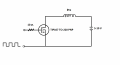

Flyback PWM Circuit.pngMy Ideal scenario is to be able to run this circuit 24/7 without failure. (not that I plan to, but for durability sake.) Aside from a heat sink and fan, I've heard of a couple options like placing a capacitor across primary, and/or adding a pull down resistor to ground. However, I would like some specific value and placement of any component additions from more experienced electrical engineers. Thanks.
 

Ian0

Joined Aug 7, 2020
13,117
Your circuit shows no output.
As it stands the current will increase until it is equal to Vdc*d/R, where d is the duty cycle and R is the resistance of the transformer winding.
 

DickCappels

Joined Aug 21, 2008
10,661
In a CRT television set there is usually some capacitance across the inductor that feeds the flyback transformer. Try adding a little capacitance. Also, you might find using a metal oxide varistor (MOV) to be a useful way to hold down the output voltage.

This articles and the attachment might give you some other ideas:
https://en.wikipedia.org/wiki/Snubber

Can you produce a waveform plot of the drain current? The problem might be somewhere other than breakdown voltage.
 
Last edited:

MisterBill2

Joined Jan 23, 2018
27,362
What is the duty cycle of the driver waveform?? It needs to be rather short, like in a television. , it was driven by the horizontal retrace. Maybe a 2% duty cycle can still deliver the voltage but reduce the heat.
 

MrAl

Joined Jun 17, 2014
13,686
Hi all!

I would like to make this circuit's transistor more durable and resilient from voltage and current spikes as it gets burning hot in this circuit after 15-30 seconds of use with 50/50 duty cycle. The flyback transformer is of common variety in the old style Televisions.


View attachment 327807My Ideal scenario is to be able to run this circuit 24/7 without failure. (not that I plan to, but for durability sake.) Aside from a heat sink and fan, I've heard of a couple options like placing a capacitor across primary, and/or adding a pull down resistor to ground. However, I would like some specific value and placement of any component additions from more experienced electrical engineers. Thanks.
Hello,

There really isn't enough information here to determine what is going on and what to do about it.
For example, a strong possibility is that the coil is saturating and that causes a huge current in the transistor which causes it to get very hot if not blow out at some point. That's the first thing to check for.
If that is the case, then you either have to increase the frequency, decrease the pulse width, or increase the coil inductance, or a combination of those.
It is much less likely that a voltage spike is causing the transistor to overheat.

To check for coil saturation you can look at the current through the coil when the transistor turns on. If you see a ramp in current followed by a very sharp increase in current that indicates saturation. If you can't look at the current, then look at the voltage of the power supply near the coil and see if there is a sharp dip in voltage as that usually accompanies a sharp rise in current through the coil.

You might still need a snubber but that's a separate issue.
 

MisterBill2

Joined Jan 23, 2018
27,362
Flyback schemes do not use a 50% duty cycle. Given that reality, at least part of the problem is clear. AND, contrary to the Jim Moore syndrome, wanting something to be true does not make it true. ( Mister Moore was a sales weasel at one place I worked. In a number of instances he sold shortcuts that failed to work as he had hoped they would. This usually added cost to do things so that they would work.)
 

Ian0

Joined Aug 7, 2020
13,117
. ( Mister Moore was a sales weasel at one place I worked. In a number of instances he sold shortcuts that failed to work as he had hoped they would. This usually added cost to do things so that they would work.)
short cuts that fail to work and end up costing more: That’s usually done “in house”.
 

Paul_Sock

Joined Apr 24, 2024
9
Hi all!

I would like to make this circuit's transistor more durable and resilient from voltage and current spikes as it gets burning hot in this circuit after 15-30 seconds of use with 50/50 duty cycle. The flyback transformer is of common variety in the old style Televisions.


View attachment 327807My Ideal scenario is to be able to run this circuit 24/7 without failure. (not that I plan to, but for durability sake.) Aside from a heat sink and fan, I've heard of a couple options like placing a capacitor across primary, and/or adding a pull down resistor to ground. However, I would like some specific value and placement of any component additions from more experienced electrical engineers. Thanks. And let's not forget to download anwhatsapp 10.
Could you provide more details on the specific components and their ratings used in your flyback converter design? It would help to understand the potential issues and optimize the PWM control.
 
Last edited:

Papabravo

Joined Feb 24, 2006
22,066
Could you provide more details on the specific components and their ratings used in your flyback converter design? It would help to understand the potential issues and optimize the PWM control.
It is not a flyback converter design. It is a trivial experiment with a flyback transformer from an old TV set.
 

MisterBill2

Joined Jan 23, 2018
27,362
Think about the horizontal deflection system in an old CRT display. That transformer only gets a very narrow pulse. The excessive heating is not due to those " voltage and current spikes ", it is because the transistor is biased on for much longer than it should be. In addition, if you calculate the power dissipated in the transistor you will find that it should have a heat sink, and I am guessing it does not have one.
 

MrAl

Joined Jun 17, 2014
13,686
Think about the horizontal deflection system in an old CRT display. That transformer only gets a very narrow pulse. The excessive heating is not due to those " voltage and current spikes ", it is because the transistor is biased on for much longer than it should be. In addition, if you calculate the power dissipated in the transistor you will find that it should have a heat sink, and I am guessing it does not have one.
The excessive current would occur if the core was to saturate, which is not usually the case.
 

MisterBill2

Joined Jan 23, 2018
27,362
Evidently my explanations have not been adequate: The 50% duty cycle is way too much. It needs to be short enough that the core does not have time to saturate. So start with a 1% duty cycle, Especially for " a trivial experiment with a flyback transformer from an old TV set. "
 

MrAl

Joined Jun 17, 2014
13,686
Evidently my explanations have not been adequate: The 50% duty cycle is way too much. It needs to be short enough that the core does not have time to saturate. So start with a 1% duty cycle, Especially for " a trivial experiment with a flyback transformer from an old TV set. "
Well, strictly speaking, the root reason for saturation is not about duty cycle it's about time and amplitude. A core can saturate on the first half cycle even before we even have a complete cycle, and there is no such thing as duty cycle if we do not have at least one full cycle, and even then we really need a lot of them. Also, if the volt seconds can be decreased fast enough there is no real limit on a duty cycle.
I have to agree though that 1 percent is pretty low, as long as the amplitude is in reason also and there is time to dissipate the energy stored. That, and flyback transformers are not usually driven into saturation I don't think.
I guess it could be I do not understand your reasoning enough yet.
 

Ian0

Joined Aug 7, 2020
13,117
On this circuit (as drawn) there is no output, so nothing to demagnetise the core except the avalanching of the power transistor, so any duty cycle will saturate it.
 

MrAl

Joined Jun 17, 2014
13,686
On this circuit (as drawn) there is no output, so nothing to demagnetise the core except the avalanching of the power transistor, so any duty cycle will saturate it.
Oh right good point. I guess we all assumed there was some load just not shown yet.
 

MisterBill2

Joined Jan 23, 2018
27,362
The core of a typical flyback does not have much residual magnetism, and so the field tends to collapse as the current decreases.
And I would suggest that the concept of duty cycle applies to repetitive wave-forms, at least as I use the term.
 

MrAl

Joined Jun 17, 2014
13,686
The core of a typical flyback does not have much residual magnetism, and so the field tends to collapse as the current decreases.
And I would suggest that the concept of duty cycle applies to repetitive wave-forms, at least as I use the term.
Oh yes absolutely, I was just trying to indicate the most basic way something could saturate. I agree with you.
 

MisterBill2

Joined Jan 23, 2018
27,362
I recall another website that presented a high voltage circuit using a flyback transformer in an oscillator scheme. I don't recall any explanations about the circuit, though. Failed flybacks seem to have suffered mostly from overheating damage. But I never got an explanation as to if that was the damper tube or the horizontal output tube that failed.
 

MrAl

Joined Jun 17, 2014
13,686
I recall another website that presented a high voltage circuit using a flyback transformer in an oscillator scheme. I don't recall any explanations about the circuit, though. Failed flybacks seem to have suffered mostly from overheating damage. But I never got an explanation as to if that was the damper tube or the horizontal output tube that failed.
I had a flyback transistor blow out one time in a TV set. Replaced it with several transistors to test, then replaced the transistor with the original part and it worked fine again.
The problem is probably that they were designed right on the edge of the specifications.
 
Top