Flyback for dc motor

Thread Starter

EricSutton

Joined Oct 7, 2018
37
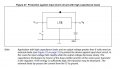
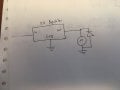
Hi, I have a question about the position of this flyback diode. I believe this is correct the way I have it but want to be sure.

The flyback diode should not go back to the actual power supply correct? My understanding is that the current goes in a loop and slowly gets dissipated in the motor (via resistance and inductance) once the motor turns off.RegulatorFlybackDiode.jpg
 

daba1955

Joined Apr 27, 2019
218
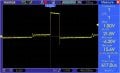
Remember that the diode will need a Vf of above 0.6V before it switches on, and in the case of typical 1N400x series diodes is about 1.0V. There is also an issue with standard diodes with switching speed. Before it turns on, you will get a hefty negative spike that can destroy the switching circuit.

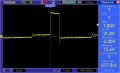
This trace is from a PWM motor circuit driven by a MOSFET, and there is a standard 1N4004 diode across the motor terminals. 0V is centre screen. You can clearly see the negative spike, and the figures on the right tell the story, -6.2V until the diode starts to conduct. You will therefore need a fast diode for best protection, such as a Schottky diode like, for example, an SB260.

I will post a further trace for comparison when I have replaced my 1N4004 with an SB260, should be here today or tomorrow.

2019-05-22_082114.jpg
 
Last edited:

daba1955

Joined Apr 27, 2019
218
Actually, I have a question about that trace above.

The PWM frequency is 490 Hz, and I believe that to be too slow for that motor. The flywheel diode is coming out of conductance at about 1.1mS after the PWM MOSFET turns off, and you can see a period of oscillation before the next PWM pulse.

Could this be the source of interference with the RF remote controller attached to the project. Something is crippling the range of the RF signal to the point where it is unusable.

If I upped the PWM frequency so that the diode stays turned on until the next pulse, does anyone think this will clean this up and give me a fighting chance ?
 

AlbertHall

Joined Jun 4, 2014
12,625
I understood that the difference between 'fast' and 'slow' diodes is the turn off time but it doesn't make difference to the turn on time. Is that wrong?
 

daba1955

Joined Apr 27, 2019
218
I understood that the difference between 'fast' and 'slow' diodes is the turn off time but it doesn't make difference to the turn on time. Is that wrong?
According to Wikipedia, Schottky diodes are "fast switching". Presumably that means both turn on and turn off times.

They do go on to say that the turn-off time is particularly fast, due to there being no "recovery" time of the charge carrier depletion region.

Given that they can be used for frequencies up to 2MHz, I read in to this that they are "fast on" and "super-fast off".
 

Thread Starter

EricSutton

Joined Oct 7, 2018
37
Remember that the diode will need a Vf of above 0.6V before it switches on, and in the case of typical 1N400x series diodes is about 1.0V. There is also an issue with standard diodes with switching speed. Before it turns on, you will get a hefty negative spike that can destroy the switching circuit.

This trace is from a PWM motor circuit driven by a MOSFET, and there is a standard 1N4004 diode across the motor terminals. 0V is centre screen. You can clearly see the negative spike, and the figures on the right tell the story, -6.2V until the diode starts to conduct. You will therefore need a fast diode for best protection, such as a Schottky diode like, for example, an SB260.

I will post a further trace for comparison when I have replaced my 1N4004 with an SB260, should be here today or tomorrow.

View attachment 177942
Right, I was thinking of using a schottky diode because of the fast switching speed and lower forward voltage required to turn it on.
 

crutschow

Joined Mar 14, 2008
38,503
I understood that the difference between 'fast' and 'slow' diodes is the turn off time but it doesn't make difference to the turn on time. Is that wrong?
Mostly not. ;)
The turn-on time of all diodes is relatively fast (typically less than 30ns for junction diodes).
Schottky diodes are somewhat faster for turn-on, typically under 10ns.
When they mention "fast" diodes, they are mainly referring to the turn-off (recovery) time, which is slow for standard junction diodes, but recovery time is not a factor in their use for inductive suppression.

It's not clear that this small difference in turn-on would be significant for this application, as the voltage fall-time at the motor terminals is likely significantly slower than 30ns (the scope photo states 617μs).

That negative spike in the post #3 scope photo may be due as much to circuit wire/trace and ground inductance as it is to any slow turn-on of the diode.
I would like to see the same test/same circuit/same setup, but with a Schottky diode, to see the difference.
 
Last edited:

daba1955

Joined Apr 27, 2019
218
That negative spike in the post #3 scope photo may be due as much to circuit wire/trace and ground inductance as it is to any slow turn-on of the diode.
I would like to see the same test/same circuit/same setup, but with a Schottky diode, to see the difference.
To be fair that trace has been taken with an old PCB design that has the flywheel diode on the PCB, not on the motor terminals, so what you say be wholly correct. My Schottky's should arrive today, so I will do a like-for-like comparison by putting the 1N4004 diode on the motor terminals then changing it for the Schottky.

EDIT : In preparation for the Schottky's arriving, I have taken the 1N4004 off the PCB and put it directly on the motor terminals, and it has not made any significant difference to the maximum negative spike, I'm still seeing varying spikes of the same magnitude

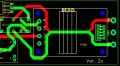
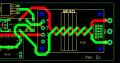
Incidentally, having been recommended to twist my motor leads, I have realised that I can "twist" my motor PCB tracks by going diagonally over/under with vias. Do you think this is even a good idea, and worth doing?

2019-05-23_075525.jpg 2019-05-23_081310.jpg
 
Last edited:

Sensacell

Joined Jun 19, 2012
3,784
Just run the traces to minimize the loop area.

Next to each other, or on opposite sides.

The twisting idea is cool, but I have never seen this done in practice.
 

daba1955

Joined Apr 27, 2019
218
Just run the traces to minimize the loop area.

Next to each other, or on opposite sides.

The twisting idea is cool, but I have never seen this done in practice.
Lol, "cool", but do you think it has any merit at all, or possibly a waste of time as we have effectively doubled the length of the tracks.
And I would want to make the vias more substantial, by making a footprint of a component with 12 pins, so that I could fill the holes with solder.

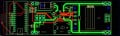
The original design had the motor PCB tracks on opposite edges of the board, separated by about 38mm. This minimised the track lengths. I was advised to run them as per picture 1 above on another forum, possibly to increase capacitance ?

Original design....
MainPCB.jpg
 

mvas

Joined Jun 19, 2017
539
Hi, I have a question about the position of this flyback diode. I believe this is correct the way I have it but want to be sure.

The flyback diode should not go back to the actual power supply correct? My understanding is that the current goes in a loop and slowly gets dissipated in the motor (via resistance and inductance) once the motor turns off.View attachment 177927
Do you have a 0.1 uf Capacitor between the 7805 Output Pin & Ground Pin ?
That will slow down the spike, until the diode turns on.

And a reverse bias diode from the Output Pin to the Input Pin - to discharge the capacitor.
 
Last edited:

shortbus

Joined Sep 30, 2009
10,050
Just thinking out loud here. Are the spikes shown actual spikes or just normal "noise" of the brushes and commutator segments? Also the PWM frequency of only 430Hz might be too slow, since normally PWM is around 18KHz.
 

crutschow

Joined Mar 14, 2008
38,503
I have taken the 1N4004 off the PCB and put it directly on the motor terminals, and it has not made any significant difference to the maximum negative spike, I'm still seeing varying spikes of the same magnitude
Are you measuring directly across the diode?
 

Daniel Sala

Joined May 28, 2015
65
Hi,

I understand about flyback diodes around motors and the ubiquitous 100nF across terminals (and the ones from terminals to chassis for Christmas Tree decoration fans), just wondered why this wouldn't be of use, too? Everything stays in the diode-motor loop so it's unnecessary? btw, I know it says "input short-circuit with high capacitance loads".
 

Attachments

daba1955

Joined Apr 27, 2019
218
Just thinking out loud here. Are the spikes shown actual spikes or just normal "noise" of the brushes and commutator segments? Also the PWM frequency of only 430Hz might be too slow, since normally PWM is around 18KHz.
The negative spikes I observe must be reverse EMF generated by the driving MOSFET being turned off, commutation noise would be asynchronous to the PWM pulses.

As for the PWM frequency, I have a choice of the following...

31372.55 Hz
3921.16 Hz
980.39 Hz
490.20 Hz
245.10 Hz
122.55 Hz
30.64 Hz

... but if I try to go higher than the 490 Hz, for some reason my 433MHz receiver module stops working, and I have yet to find out why. In my particular case, I'm more concerned with suppressing noise that is degrading the receiver performance.
 

Thread Starter

EricSutton

Joined Oct 7, 2018
37
Do you have a 0.1 uf Capacitor between the 7805 Output Pin & Ground Pin ?
That will slow down the spike, until the diode turns on.

And a reverse bias diode from the Output Pin to the Input Pin - to discharge the capacitor.
Hi mvas, I will have the capacitors on both sides of the voltage regulator, but I had not heard about the reverse bias diode. Is that a standard thing to do with voltage regulators?
 

Thread Starter

EricSutton

Joined Oct 7, 2018
37
Lol, "cool", but do you think it has any merit at all, or possibly a waste of time as we have effectively doubled the length of the tracks.
And I would want to make the vias more substantial, by making a footprint of a component with 12 pins, so that I could fill the holes with solder.

The original design had the motor PCB tracks on opposite edges of the board, separated by about 38mm. This minimised the track lengths. I was advised to run them as per picture 1 above on another forum, possibly to increase capacitance ?

Original design....
View attachment 178035
I think you should just run the traces next to each other. I've done some layout and have never heard of the jumping up and down with vias. Usually differentials are run side by side and length matched. I would say side by side to reduce emi
 

daba1955

Joined Apr 27, 2019
218
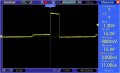
I promised to show the oscilloscope trace after I replaced the 1N4004 diode with an SB260 Schottky diode.

For completeness, here are both traces. I think you will agree the Schottky diode produces a much cleaner trace, and gone is that huge negative spike. Nothing else has changed, just the diode ...

2019-05-22_082114.jpg 2019-05-27_072139.jpg
 
Top