Fluid level Measurement

Ya’akov

Joined Jan 27, 2019
10,226
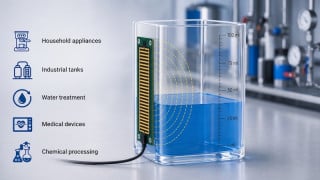
So the way the sensor works is by forming a capacitor between the electrodes. The capacitor’s dielectric is formed from the material used to construct the sensor and any liquid that it is in contact with.

By placing the electrode perpendicular to the surface of the liquid, the amount of the sensor covered—and therefore the dielectric that can store the charge—increases linearly with the amount in the container.

This means that the dielectric constant (κ or εᵣ) of the liquid is the key to the influence on the sensor. κ—also called relative permittivity (hence εᵣ where ε is permittivity)is the ratio between the a material’s ability to conduct AC to the ability of vacuum to do it.

κ tells us the relative ability of a material to be polarized by an electric field. as κ increases so does capacitance.

This means vacuum (ε₀) has εᵣ = 1, by definition. So, κ (dielectric constant) = εᵣ (relative permittivity) = ε (permittivity) / ε₀ (permittivity of a vaccum, that is 1 or something so close to 1 that is makes no practical difference).

A fluid‘s εᵣ is influenced by several factors including temperature and frequency. Since practically speaking frequency is a fixed value of our choice, the cogent variable is temperature which must be taken into account for the best accuracy.

Liquids vary in the effect of temperature on ε, some with little or no effect while others considerably. For example water has κ = 80.1 at 20°C and κ = 10 at 320°C, while deionized water exhibits no temperature sensitivity with κ = 29.3.

As another example, diesel fuel is unaffected by temperature and has κ = 2.1. It doesn’t really matter what κ happens to be, except that the greater it is compared to the preexisting dielectric, the more effect liquid levels will have. The variations in κ are dealt with during the calibration process for the sensor.

Accounting for temperature would require factoring in the current temperature and a stored curves for the particular variation of κ in the liquid being measured.
 

KeithWalker

Joined Jul 10, 2017
3,603
Liquids vary in the effect of temperature on ε, some with little or no effect while others considerably. For example water has κ = 80.1 at 20°C and κ = 10 at 320°C, while deionized water exhibits no temperature sensitivity with κ = 29.3.
Just a thought: It must be fairly difficult to measure k for water at 320°C. :)
 

Irving

Joined Jan 30, 2016
4,996
water has κ = 80.1 at 20°C and κ = 10 at 320°C
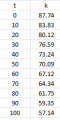
Can you get water to 320°C? Or is that superheated steam and therefore a gas which will have a lower κ than a liquid. According to some papers I read the chart is:

1708705319747.png

It only goes to 100!

For continuous sensors a commercially available product for depth monitoring has two guard sensors above and below the actual measuring strip. So it doesn't need calibrating for temperature as it has all the info it needs from the guards plus an inbuilt temperature sensor.
 

Hymie

Joined Mar 30, 2018
1,347
There might be a lengthy time lag in response to a change in fluid level, especially a drop in level where the fluid has to drain away from the ribbon cable (or evaporate), and how would the system respond where a highly viscous medium is used.
 

MisterBill2

Joined Jan 23, 2018
27,166
Other things will have an effect on the reading, and the first question is how will you measure the capacitance?? And how stable will the circuit be as the temperature changes and the density of the liquid changes and the temperature of your circuit components change?? Certainly it will provide an indication of the level, but accuracy and stability issues will cause some drift in the reading.
 
Top