Floating MOSFET Gate Drive- how does it work?

Thread Starter

shortbus

Joined Sep 30, 2009
10,050
Ok, I'll take all of this as you say, but it seems like I'm not the only one that's been misled about high side switches over the years. Even all of the half bridge drive manufactures disagree.

So if these are so good why aren't there more people using them, or more companies making them? I understand that they are "slow" but for PWM control of a DC motor you could just switch the low side and use one of these to keep the high side on constant, no switching of the high side to recharge a boot strap.
 

Thread Starter

shortbus

Joined Sep 30, 2009
10,050
Nonetheless, having visited his museum in Belgrade and seen first hand his earliest experiments on rotating magnetic field -- there's one where a brass egg is made to spin continuously under the influence of 4 end-to-end electromagnets connected to a battery
You do know that ,rotating egg, was to illustrate the rotating field don't you. To prove it to other people.
 

DickCappels

Joined Aug 21, 2008
10,661
(some text removed for clarity)

So if these are so good why aren't there more people using them, or more companies making them?
These are really slow. For most MOSFET circuits you need hundreds of milliamps or amps of gate drive. These things are good from a few microamps. Switching in switching power supplies for example, would be very slow and painfully inefficient. These isolators are really neat but can only be used in very limited uses.
 

nsaspook

Joined Aug 27, 2009
16,330
Hey James .........
Nikola Tesla invented 3-Phase Power, and 3-Phase Motors and Generators, for a lot of very good reasons .......
.
.
.
As usual Tesla didn't invent polyphase power because he wasn't a scientist. As a gifted engineer of the 1880's he designed a marketable application of a electric motor using existing science when the day's technology evolved to the point it could be done at several points on the globe. Tesla's first patents were to two-phase motors and supply systems, not 3-phase Motors and Generators. Most credit Mikhail Dolivo-Dobrowolsky with 3-phase power engineering.

https://en.wikipedia.org/wiki/Mikhail_Dolivo-Dobrovolsky#Invention_of_the_three-phase_system
 
Last edited:

LowQCab

Joined Nov 6, 2012
5,101
Ok, I'll take all of this as you say, but it seems like I'm not the only one that's been misled about high side switches over the years. Even all of the half bridge drive manufactures disagree.

So if these are so good why aren't there more people using them, or more companies making them? I understand that they are "slow" but for PWM control of a DC motor you could just switch the low side and use one of these to keep the high side on constant, no switching of the high side to recharge a boot strap.
It depends substantially on how much Power, ( in Volts or Amps or Both ), must be controlled,
and at what Frequency .

There is a very significant amount of Capacitance in a FET Gate,
and the higher the Voltage Rating, and/or,
the higher the Current Rating is for the particular FET,
the more Gate Capacitance it will have.

It takes a certain amount of Current to pump the Voltage of a Capacitor up and down.
The more Current you have available, the faster you can pump the Gate Voltage .

The Photovoltaic Devices being discussed here
are extremely limited in the amount of Current that they can produce .
This means that they will be, ( relatively speaking ),
very "slow" at changing the Gate Voltage on a large FET.
This means Low Switching Frequencies,
Low Switching Frequencies means that the FET will
spend more time acting like a varying resistor, instead of acting like an "On-Off" Switch,
this means more heat will be generated, and all heat is 100% wasted Power,
and must be removed by a large and expensive Heat-Sink .

Using these devices for FET Gate Drive could be compared to driving the Gate with a 10K resistor,
it will still work,
but the Gate Voltage is going to change in a very sluggish manner .

One way around this, is to parallel multiple Chips to multiply the available Gate Drive Current,
but this gets expensive very quickly at around ~$3.oo each .

The funny part about all this is that the only reason for "Charge-Pumps" is so that you can use a
cheaper N-Channel FET as a High-Side Switch,
but the higher cost of P-Channel devices is very slowly coming down, while their performance is going up,
but designers have been so focused on N-Channel devices, for so many years,
that the adoption of the newer, higher performance, P-Channel devices may never happen,
and the manufacturers are not going to spend time and money on
developing a superior device, that very few engineers will even consider looking at,
because ........ well ...... "we've always done it that way".
 

Thread Starter

shortbus

Joined Sep 30, 2009
10,050
Ok, doing my normal trying to learn about new things, I spent some time online searching. Seems that International Rectifier came up with the original idea, according to an App Note from them it was ~2005, or that is the app note date. Other people then took over the parts Infineon and IXYS there may be others out there. IXYS also make at least one more that is much more powerful, the FDA217, more volts and current outputs. The Infineon is, PVI15033R series.

Infineon has the most information on how to use them and how they came about. Their APP note is an old IRF app note that shows all the things they can be used for, I'll attach it.

Thank you LowQCab for showing an old dumb dog a new trick!
 

Attachments

LowQCab

Joined Nov 6, 2012
5,101
Thanks for that new part number.
When I found the FDA215, it was by complete accident while I was looking for some other Opto-Iso.
The FDA217 is definitely a stronger unit, and with these types of things, more is never enough !!!

After your post prompted me to take another look,
I bumped into another very interesting Chip,
the Fairchild, ( On Semi ), H11F1M, which has a "Symmetrical, Bilateral, Silicon, Photo-Detector",
basically it's a small 30V, 100ma, FET for an output,
with the standard LED Input,
in an 8-Pin DIP Package .
This part also has some very interesting possibilities !!!
Virtually zero capacitance Load or interaction from the LED,
and it gives complete drive isolation .
 

Thread Starter

shortbus

Joined Sep 30, 2009
10,050
H11F1M, which has a "Symmetrical, Bilateral, Silicon, Photo-Detector",
basically it's a small 30V, 100ma, FET for an output,
with the standard LED Input,
in an 8-Pin DIP Package .
The part I found with that number is actually a 6 pin part. I didn't save the part number, but when looking at this deeper there is another way some one is doing it, without a led for isolation. It uses a built in microtransformer and oscillator instead.

The one idea that I thought was kind of amazing in the app note I gave is making a very small mains to DC power supply, with galvanic isolation and no transformer needed! And these or at least the FDA parts have much higher isolation than the common half bridge drivers do.
 

Thread Starter

shortbus

Joined Sep 30, 2009
10,050
Think of it as a LED and a tiny solar cell. You do get voltage and current from a solar cell or cells. Our research grade solar cells that I tested and helped make were 0.08 sqcm. We put 12 of them on a 1"x1" piece of glass.
I had problems with this in the beginning because I thought of them as like a photo transistor or photo diode or opto isolator. But by reading more about it I then saw that they work like you described, and add a new concept to my meager electronic knowledge.
 
@shortbus I think they are pretty cool

Probably they would make it like an upside down solar cell. The top layer would probably be a conductive layer of Indium Tin Oxide or Zinc Oxide and then a layer of say quartz or saphire. I can't find any good pictures.

Our silicon devices started out on Molydinum coated glass substrate and the layers were deposited via PVD (Physical Vapor Deposition) RF is used to break down gasses like Silane. Top contacts were either grids or conductive oxides with metalic pads.

For our research devices, a mask was used. Photolithography was available.
 

kubeek

Joined Sep 20, 2005
5,796
... Our research grade solar cells that I tested and helped make were 0.08 sqcm. We put 12 of them on a 1"x1" piece of glass.
Why are your solar cells almost metric, but your glass is still imperial? :D
And by almost metric I mean, no sane metric person would write 0.08 sqcm instead of 8 mm2. Also sqcm? What about cm2?
 

LowQCab

Joined Nov 6, 2012
5,101
When I first stumbled on to them I thought they must be a gift from God himself.
Then I realized the extremely limited Current available, and it popped my bubble.

On the other hand, a FET Gate only requires an RMS Current of around ~10%, or maybe even less,
of its PEAK Current Requirements during the actual switching transition time.
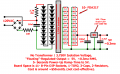
So, Capacitors are your friend ......... Maybe even an Inductor-Input Power-Supply topology.
Do the actual switching with a Darlington-Output-Opto,
and use the PV-Cells for a DC "Power-Supply".

Check out this Idea .......
.
.
.FET Driver 1 Flat  .png
Note: Resized to be more friendly toward small screens.
 
Last edited by a moderator:
Why are your solar cells almost metric, but your glass is still imperial? :D
And by almost metric I mean, no sane metric person would write 0.08 sqcm instead of 8 mm2. Also sqcm? What about cm2?
Good question. I never thought about it except when you have to store these things. So, the microscope slide, I think, became part of the standard.

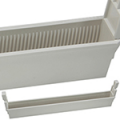
We stored them in these:

1613439627134.png

so https://www.emsdiasum.com/microscopy/products/histology/slide_storage.aspx

is a storage system. You don;t want to go to the edge.

The sputtering system had 8" diameter targets. e.g. https://www.lesker.com/newweb/deposition_materials/depositionmaterials_sputtertargets_1.cfm?pgid=cr1

Although our substrate holders were either square or rectangular because that's easier to machine. trymaking an 8" diameter radiant heater. It was square.

the grid of our cells were 3 x 4, because 2 edges had to hold the substrates, so that constrained one side to 3.

The units that we cared about was current density (J) in mA/sqcm.

Sheet resistance is measured in ohms/square. See https://en.wikipedia.org/wiki/Sheet_resistance

ideally, you would like a cell to be 1 cm^2, but doing 12 cells gives you a handle on uniformity which is extremely important.

Getting a light source 100 mW/sqcm uniform over say a 4"x 4" area is tough.

I hated dealing in units of cm, um and Angstroms.

For one measurement, you had to input cross sectional area/length. It could be rectangular or circular, so I wrote an RPN interpreter any you could type for A/L = 2.1cm 5000A * 100um /; PI was available and so was + - * / ^ and the constant PI.

So, the dimensions were entered in their native units and the conversion to cm was done automatically.
 
Top