Fireplace Gas Valve Controller Circuit

sghioto

Joined Dec 31, 2017
8,634
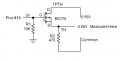
I connected this circuit using R2 to simulate the TH load with a 3 volt input from the Pico and measured 0.56 volts on the source of the BS170.
So it seems that the circuit should work as shown in post #1 removing the 10K resistor in series with the gate.
1699724482518.png
 
Last edited:

Thread Starter

JimStokes

Joined Oct 25, 2015
38
I connected this circuit using R2 to simulate the TH load with a 3 volt input from the Pico and measured 0.56 volts on the source of the BS170.
So it seems that the circuit should work as shown in post #1 removing the 10K resistor in series with the gate.
View attachment 307280
Tried, but there seems to be losses that don't effect the gas valve. I even tried without the resistors R1 and R2. It may be the losses in wires that take it down. Also, I've tried higher gate voltages, as per crutschow, and it consistently comes on around a gate voltage of 4V and higher. My guess is that this 'overflows' into the source a bit, reaching the threshold where the gas valve will come on.

Thanks for you help.
Jim.
 

Thread Starter

JimStokes

Joined Oct 25, 2015
38
Can you apply 10V to the MOSFET gate and see if that works to close the gas valve?
If so, then reduce the gate voltage until you find the minimum voltage needed.
Yup, so applied 10V at gate and it effected the gas valve. I consistently got it to start when coming up from lower voltages to around 4V. So, the 3.3V from PICO is insufficient. I also suspect losses in wires that I'm using between TPTH and TH, so it takes a higher voltage to effect the gas valve.

Thanks for you help. Back to the drawing board.....

Jim.
 

sghioto

Joined Dec 31, 2017
8,634
Thanks for you help. Back to the drawing board.....
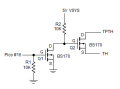
If you program the GPIO output to normally HIGH this circuit will activate Q2 with 5 volts on the gate when pin 16 goes LOW.
1699728654606.png
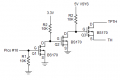
Or add the inverter circuit comprised of Q1 and Q2 if the maintaining the logic output on pin 16.
1699729189052.png
 
Last edited:

Thread Starter

JimStokes

Joined Oct 25, 2015
38
If you program the GPIO output to normally HIGH this circuit will activate Q2 with 5 volts on the gate when pin 16 goes LOW.
View attachment 307295
Or add the inverter circuit comprised of Q1 and Q2 if the maintaining the logic output on pin 16.
View attachment 307296
Thanks. This is to be a battery powered circuit. A constant drain on the 5V vsys doesn't look efficient. But thanks again.

Jim
 

Ajith-N

Joined Sep 14, 2020
31
Seeing that the solution seems to veer towards several FETS and resistors, I think posts #9 and #11 from sghioto
hold the best promise.

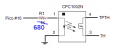
I would say, go with CPC1002N, but with a minor change to the series resistor R1, from 1K down to say 680 Ohms.

Assume the worst case GPIO output of 2.8V (ref. Pico datasheet), and LED drop in the SSR at 1.2V (ref. SSR datasheet), that leaves 1.6V across R1, to drive 2mA that the SSR needs (ref. datasheet) it is best not to exceed 1.6V/2mA = 800 Ohms for R1.
 
Last edited:

MisterBill2

Joined Jan 23, 2018
27,639
The thread starts with a question about powering a fireplace heater gas valve and then starts talking about a power-pile circuit in a stove.
I do not suggest even considering the use of any power pile hardware, valve or thermo-couples.
Is the intention to use a system taken from a stove?
 

crutschow

Joined Mar 14, 2008
38,539
Another option, if 5V is not available, is to have the micro output a 3.3V square-wave, and use a diode voltage-doubler, which would give over 5V to drive the high-impedance gate, and would require very little added power.
 
Last edited:

Alec_t

Joined Sep 17, 2013
15,123
I don't know what sort of fire you have, but for all the gas appliances I'm familiar with the thermopile voltage (<1V) can drive an Amp or so through the low-resistance gas valve solenoid to hold the valve open. Shorting out that voltage causes the valve to close and shut off the gas supply. The arrangement you have, or are trying to create, seems the complete opposite of this norm?
 

Thread Starter

JimStokes

Joined Oct 25, 2015
38
I don't know what sort of fire you have, but for all the gas appliances I'm familiar with the thermopile voltage (<1V) can drive an Amp or so through the low-resistance gas valve solenoid to hold the valve open. Shorting out that voltage causes the valve to close and shut off the gas supply. The arrangement you have, or are trying to create, seems the complete opposite of this norm?
Maybe I'm wrong to call it 'shorting'. If I connect TPTH to TH with a wire, the gas valve opens and the fire lights. So, I suppose, it's more like 'closing' the circuit, which uses power from the thermopile to open the gas valve.

Thanks, Jim.
 

Thread Starter

JimStokes

Joined Oct 25, 2015
38
The thread starts with a question about powering a fireplace heater gas valve and then starts talking about a power-pile circuit in a stove.
I do not suggest even considering the use of any power pile hardware, valve or thermo-couples.
Is the intention to use a system taken from a stove?
The fireplace works and all the hardware works. The remote controller died - two components, the handheld remote control and the receiver which was wired between the TPTH and TH on the fireplace. It is a simple operation, but I am trying to avoid spending hundreds on a new remote controller (which I already did on another fireplace I have) while trying to learn and innovate by creating my own device.

Thanks,
Jim.
 

MisterBill2

Joined Jan 23, 2018
27,639
The fireplace works and all the hardware works. The remote controller died - two components, the handheld remote control and the receiver which was wired between the TPTH and TH on the fireplace. It is a simple operation, but I am trying to avoid spending hundreds on a new remote controller (which I already did on another fireplace I have) while trying to learn and innovate by creating my own device.

Thanks,
Jim.
OK, an arrangement that is simpler but not as modern as trying to bias a transistor will be to use a small mechanical relay to do the switching. I know that they are available with five volt coils, I am not sure about 3.3 volt coils. They have very good isolation between control and the contacts, And the voltage drop in the on mode is very low.
 

crutschow

Joined Mar 14, 2008
38,539
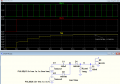
Below is the LTspice sim of an example voltage doubler circuit:
It uses two outputs from the micro for the minimum number of parts (two diodes, two capacitors, and one resistor).
One output is a 3.3V, 1kHz to 10kHz (1ms to 0.1ms period) square-wave (green trace), and the other is a steady 3.3V (red trace).
When both outputs are active, the MOSFET gate voltage (yellow trace) goes to about 5.7V.
It basically adds the peak-peak voltage of the square-wave to the 3.3Vdc.


1699800322106.png
 
Last edited:
Top