It sure sounds like alternator whine. First, check the intercom system ground connection. Maybe even scrape clean to bare shiny metal and reattach. If that doesn't fix it, put a filter in the power supply line to the intercom as close to the intercom's power feed at the intercom as possible. If still no joy, then try all the other suggestions.
Possibly you can discover the fault, the front and rear floating ground plates have no noise and the insulating washers on jacks and cable bulkheads
and power supply are fully isolated the communications pass band filter and squelch improves to a first response level. When speaking over diesel pumps and equipment takes a lot of practice regardless of the equipment. http://mustang.stratologic.net/Reference/intercom wiring.txt
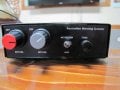
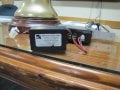
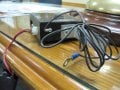
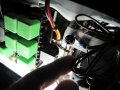
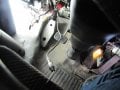
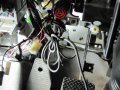
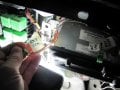
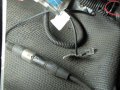
Thanks everyone for your suggestions so far. I've just been to the station, I pulled out the intercom, tried to follow the wiring and took some photos. Here's what I've got:
The tanker is a diesel.
There is no buzz in the cab speaker at any time. There is only a constant buzz in the outside rops speaker.
When the truck revs, the buzz changes pitch - alternator (as someone mentioned there are no spark plugs)???
When the outside mike button is pressed, the outside speaker goes silent as it should and the inside speaker is clear (voice).
We have 2 tankers with the same intercom - one has no buzzing, but the other is noisy. Hmmm, curious.
Both have an "intercom noise filter" on the power cable (figure 8 cable)
The filter says "Plug into rear of intercom. Plug harness into filter. 24v supply should be direct from battery via ignition switch relay".
So I assume the tanker must be 24V? As for the power to the filter plug it was so hard to chase back to it's origin. But this is what I could see in all the mess of wires under the dash:
There is an ground from the intercom metal case to the intercom holding bracket
The power as I mentioned goes to the filter and the filter picks up it's power at the cigarette lighter, not the ignition switch relay - unless this is where the cigarette lighter gets its power. I couldn't trace where the positive from the cigarette lighter went - it went via enclosed looms that dissapeared up the dash (and I'm not game to pull a CFA dash apart!). The negative of the cigarette lighter I "think" went to the chassis.
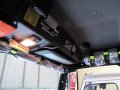
The goose neck mike in the cab has a "low noise microphone" cable. It's about 1m long connects in the overhead cabinets. It is connected via an XLR type connector to an extension cable that is probably a little over a meter too long (see below)
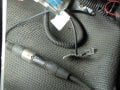
The cable then connects again via an XLR connector to some thinner cable that has a CAT5 (or CAT3?) type connector on the end. This plugs into the intercom unit
So as a first test, should I maybe ignore the current power cable and run a new cable directly from the battery to see if it resolves the issue?
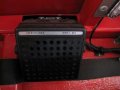
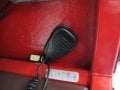
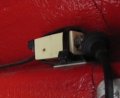
Can I just add to my previous comment (please see #25 above), here are some photos of the mikes, speakers, wires, etc.
Goose neck mike in cab:
Speaker in the rops:
Mike in rops (MC507B) and plug connection. PS. pressing a button in the middle of turning out is a pain while your trying to do up all your gear. In the past, the setup allowed us to just "speak":
Speaker wires (internal and external speaker):
Mike wire (near intercom) - only about a foot long - the rest is proper "low noise microphone cable":
I hope that all helps.
Maybe having a look at the unit that does not have any noise may reveal something useful. A one way noise would seem to suggest the problem is not alternator noise - but I can't say for sure. I've never worked on the electrics of a diesel, let alone a Certified Firefighting Apparatus. Nor would I want to be the one to give advice on how to work on such an important piece of equipment. So my best guess is that it's something to do with the head unit. Does the unit in the rops have a separate power supply? If so that may clue you into where the issue may be. And as others have said - check and clean the grounding points. Ground issues can be boogers to trace down. Once had a car that you had to step on the clutch to get the headlights to light up. Bad ground.
Diesels don't have spark plugs, but modern diesels with common rail fuel injection run crazy high fuel pressures and the injectors surely operate on more than 12v, so that's potential for electrical noise from a diesel.
Common rail injection has been around a long time (as opposed to mechanical plungers inside the injectors), but newer systems operate at up to 36,000psi in some cases (reference). Many are also capable of multiple injections per firing for more precise control of the fuel burn. This is great for performance, not so good for the wallet, especially when they wear out or fail, parts get expensive fast. Another side note; a common failure mode for modern injectors is a change of spray pattern that results in fuel spraying directly on the piston, which pretty quickly melts a hole in the piston and the repair bill gets real big real fast. So long story short; modern diesel engines can have some reasonably high voltages to some parts, which can always be a potential noise source.
Oh, I wasn't challenging you on it. Just commenting on the fact that I've never heard of them before. But then again I've never owned a diesel anything.
Oh, I wasn't challenging you on it. Just commenting on the fact that I've never heard of them before. But then again I've never owned a diesel anything.
I wonder if diesel fire trucks burn petroleum oil or burn the used cooking oil from McDonalds?
I think the oil gets very thick when cold then the injectors need a lot of power. Maybe the glow plug heats the air and fuel before the engine starts?
I'm a member of a volunteer fire brigade. For the past 3 or 4 years we have had endless issues trying to get an intercom functioning clearly between the front cab of the truck and the "rops" (the bench seat behind the cab - outside the truck). Clear communication between all member on turning out to a job is vital.
From the cab, the driver or OIC (officer in charge) can speak freely into a goose neck mike that hangs off the ceiling, connected to an amp of some sort and wired back to the rops. In the rops there is a hand held mike with a button we press if we want to talk, and a speaker to hear the cabin when we let go of the button. As the engine revs up and down, so does the "whine" and static. To hear the crew in the cab, the volume has to be turned up so high that it doesn't allow us to hear each other in the back when they're not communicating with us. Our district maintenance officers have been unable to fix it to date.
There are countless trucks across the brigades with the same issue. Head office has said new trucks will use a digital intercom, but that doesn't help us now and our district maintenance officers don't have a fix.
I'm wondering if anyone can give me any advice on how I can test what the problem is with this setup, or if I could make a change to fix it. If not, I'd be happy to design/build an intercom from scratch run on cell batteries if that helps against the interference. All suggestions welcome.
One option to consider would be a simple voice-powered headset system. No electrical power needed at all. We used those when I was in the service when using our hydraulic test stand, which was extremely loud. Another option is to look at the intercom systems commonly used in light aircraft which are also an extremely high noise environment. David Clark is a well-known and respected brand for both types of systems.
I would suspect the mic in the cab. Since there is no noise in the cab when using the rops mic tells me the intercom is OK. Have you tried unplugging the cab mic to see if the noise disappears?
In answer to Short bus, the 110V DC comes from an inverter in the sytem. There also was a very easy to read warning sign on the wiring loom for the injectors. I will try & find the Ford training course i did about 10 years ago. I would have thaught this was common in America as those F trucks were imported in to Australia.
I believe CFA is investigating headsets for use on and off the truck - more off the truck. Given most new trucks are dual cab now, intercom isn't really and issue - hence the reason their a bit slow at fixing ours. David Clark - great but way too expensive for volunteers, but thanks for the suggestion.
I would suspect the mic in the cab. Since there is no noise in the cab when using the rops mic tells me the intercom is OK. Have you tried unplugging the cab mic to see if the noise disappears?
Looking at that last photo of the mic and cable wire has me concerned. Very unusual connector for a mic input. I'm wondering if the shield or outer coax is getting grounded to the chassis of the intercom through that ethernet connector.

 Facebook
 Google
 GitHub
 Linkedin