Fire Hazard

Thread Starter

BPet

Joined Oct 30, 2017
25
I purchased a B&K CT600 Home Stereo Multi room Amplifier on Ebay and the seller indicated it was working fine and that they just upgraded their home system and that is why they were getting rid of the unit. (based on the other items they were selling and some snooping I did, it seemed like a plausible scenario - but now I have my doubts?)

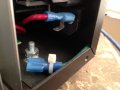
The power cord that came with the unit only had two holes, while the CT600 has 3 prongs and so I'll have to get a new power cord - no big deal. Then I opened up the CT600 to change a dip switch and I noticed that the green grounding wire from the chassis is 'not' connected to the power outlet? Humm...that does not seem normal. Does anyone have experience with this and is this indeed normal and ok? Or do I need to slide that green wire onto the outlet prong. Here is a pic.

Thanks for helping me keep from burning my house down
 

Attachments

Domophone

Joined Sep 10, 2013
65
It should be re-connected to the input power socket.

Maybe they had issues with leakage current tripping a GFI outlet so they disconnected it?
 

Reloadron

Joined Jan 15, 2015
7,890
This image of AC Power and Line Fuse shows a standard 3 wire grounded power cord connection. I have no clue why the internal ground would have been disconnected unless the unit was previously connected to an incorrectly wired home outlet. I can't find a system schematic for comparison but would connect chassis ground and use the correct power cord and see what happens.

Ron
 

MrChips

Joined Oct 2, 2009
34,812
The green connection (ground) is not so much about fire prevention (that is the function of the fuse) but more about shock hazard.

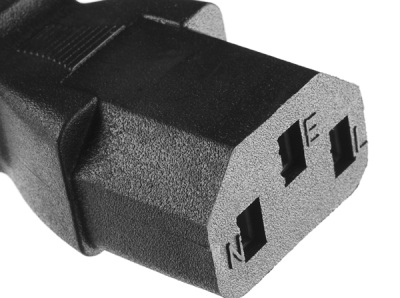
Make sure your unit has one of these AC power receptacles:


that mates with the proper AC power cord that you find on desktop computers:


Conform with the markings on the cord and connector:

N - NEUTRAL - White
E - EARTH - Green
L - LINE - Black
 

Thread Starter

BPet

Joined Oct 30, 2017
25
Thanks to Domophone, Reloadron & MrChips - the consensus seems to be that I should re-connect it, so I will do that. Thank you all very much for giving your advice!
 

MrChips

Joined Oct 2, 2009
34,812
Domophone has a hint as to why the green wire was disconnected.

After you restore the wire to its proper place, test the unit on an outlet that has a GFI circuit. There should be one in your bathroom.

If the GFI trips then you have as serious problem on the amplifier.
 

GopherT

Joined Nov 23, 2012
8,009
It may have been disconnected in an attempt to get rid of s background hum, known as a ground loop. I suggest you test it out as soon as possible so you can return it (or file an eBay claim) as soon as possible.
 

Tonyr1084

Joined Sep 24, 2015
9,744
Once, living in a very old house, I plugged a power supply into the outlet. Immediately the internal fuse blew (in the power supply). The home was wired with the old "Knob & Tube" type wiring, and there was no given attention to polarity. Simply reversing the hot and neutral on that outlet meant my power supply would not blow its fuse again. However, with K&T wiring, there is often no ground at all. Exactly why the fuse would blow when connected backwards I have never figured out. However, the outlet was one of the modern 15 amp three prong outlets. I don't remember if someone added a ground wire to it. That may have been the case.

I mention this because it's possible the wiring going to your outlet is reversed. You can pick up a cheap outlet tester for a few bucks at almost all home improvement stores. They come with three lights. One red, and two green. When plugged into a properly wired outlet only the two green lights should come on. If the red light comes on it means your ground is wired hot. If only one green light comes on it means your hot and neutral may be reversed. Not a bad idea to test your outlets. In my current home I had a bad experience, which is why I bought one of these testers. The former owner replaced all the two wire outlets with three wire. They then connected the neutral and ground terminals together so that it would appear that the outlet was properly grounded. The problem I ran into was that in the basement the wire was broken and so the home owner repaired the wires by tying the black wire (hot) to the white wire (neutral) and the white wire to the black, thus, switching the hot and neutral on some outlets. With the illegally grounded outlets and with the white wire being the hot wire, the case of my computer was not ground, it was "LIVE" (with 120 VAC on it). Plugging the printer into another outlet (Hot properly wired) when I went to plug the printer into the computer I got a heck of a shock on my hand. I was laying on the floor reaching behind the computer and feeling for the USB outlet. With two fingers on the metal jacket of the printer cable and with a third finger finding the USB, as soon as my finger touched the case hot computer I got a full on 120 VAC shock to my hand. Very unpleasant experience. It was then that I started opening up outlets and finding out what was done. I went through and added a ground wire tied back to my cold water inlet and to the circuit breaker panel. The panel (old as it was) did not have a bus bar for ground, so I added one. I also added a ground rod where the meter was so that I could be still more confident I had properly grounded outlets.

It's never a bad idea to check your outlets. If you're confused or concerned about something you're finding and not fully understanding it's always worth it to have a professional give you an estimate of the problem and the cost to fix it. If you're competent you can fix it yourself. If you have any doubts, the money is well worth spending to make sure you and your family is safe from electrical shock.
 
Top