Finding the equivalent impedance with an OP amp

Thread Starter

Phycho_cat

Joined Aug 23, 2024
26
Hello everyone!
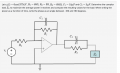
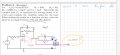
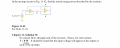
I'm working on solving this question, but there are a few points I’m unsure about. So, we have a negative feedback amplifier here, and I used icl to find the Vout of the amplifier. The issue is, I think I might’ve misunderstood or forgotten some basic amplifier rules.

Specifically, in the section I highlighted in yellow. will the current there also be zero? If yes, what happens to the current flowing through R2 ,R1 and c1?

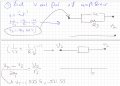
My overall approach to solving this was to find Vth and In then divide them to calculate the load impedance. After determining the Vout of the amplifier, I simplified the circuit more to work through it. I’ve also uploaded my calculations for reference.
Screenshot 2025-01-25 at 2.45.42 PM.pngIMG_0721.jpgIMG_0722.jpg
 

WBahn

Joined Mar 31, 2012
32,707
If the current in the yellow trace is zero, what does that say about the current in either R3 or ZL? What does that say, in turn, about the voltages across them?
 

Thread Starter

Phycho_cat

Joined Aug 23, 2024
26
If the current in the yellow trace is zero, what does that say about the current in either R3 or ZL? What does that say, in turn, about the voltages across them?
If that current is zero we will basically end up with zero current through R3 and C2 and so Vth=Vout of the amplifier. since voltage drops across R3 and C2 will be zero as well
 

0ri0n

Joined Jan 7, 2025
161
Specifically, in the section I highlighted in yellow. will the current there also be zero?
No, it isn't zero. Why would it be? The amplifier behaves like an ideal voltage source therefore replace it with one. As amplitude/frequency of the input voltage is given, calculate amplifier gain and output voltage considering that the amplifier has lowpass characteristic with the corner frequency determined by R1/C1.
As for ZL, transform R2/C3 into a series network for the given input frequency. Use the conjugate complex value as ZL.
 
Last edited:

Thread Starter

Phycho_cat

Joined Aug 23, 2024
26
No, it isn't zero. Why would it be? The amplifier behaves like an ideal voltage source therefore replace it with one. As amplitude/frequency of the input voltage is given, calculate amplifier gain and output voltage considering that the amplifier has lowpass characteristic with the corner frequency determined by R1/C1.
As for ZL, transform R2/C3 into a series network for the given input frequency. Use the conjugate complex value as ZL.
I think I'm confusing myself. Could you explain how the current through all the resistors here is zero? Maybe I'm misunderstanding your explanation, but if I were to consider the op-amp here as an ideal voltage source, it wouldn’t make sense to me that the current through the resistors would be zero.1737861844402.png
 

WBahn

Joined Mar 31, 2012
32,707
If that current is zero we will basically end up with zero current through R3 and C2 and so Vth=Vout of the amplifier. since voltage drops across R3 and C2 will be zero as well
You completely ignored the rest of what I asked.

If the current in R3 and C2 are both zero. The what is the current in ZL?

What does that then say that the voltage across ZL must be?

What does that then say about what Vth must be?

Does that make ANY sense?

If not, then the claim that there is no current in the yellow segment of wire is incorrect.
 

0ri0n

Joined Jan 7, 2025
161
Could you explain how the current through all the resistors here is zero?
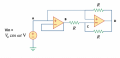
The 1st op amp is a unity gain buffer, with Vout=Vin. Technically the buffer is redundant because the voltage source is already ideal.

The voltage at the (+) input of the 2nd op amp is Vin. The voltage difference between the (+) and (-) input of an ideal op amp is 0, which means the 2nd op amp will steer it's output as far as needed to make the voltage at (-) input equal to Vin. This resuslts in no current flowing through the leftmost resistor. No current through this input resistor also means no current through the rightmost, bottom resistor. For that to happen, Vout of the 2nd op amp would need to be equal to Vin. With Vout=Vin=V(+)=V(-) for the second op amp, there is also no current flowing through the rightmost, top resistor.
 

WBahn

Joined Mar 31, 2012
32,707
I think I'm confusing myself. Could you explain how the current through all the resistors here is zero? Maybe I'm misunderstanding your explanation, but if I were to consider the op-amp here as an ideal voltage source, it wouldn’t make sense to me that the current through the resistors would be zero.
You need to learn how to tease information out of a system.

1737868129965.png

If V_A = Vin is the voltage at the non-inverting input of the first opamp, what is the voltage at the non-inverting input of the second opamp?

If the opamps are both operating in their linear region, what is the voltage at their inverting inputs?

What is the voltage across the left-most resistor?

How much current is flowing in the left-most resistor?

What is the relationship between the current in the left-most resistor and the current in the bottom resistor on the right?

Given that current in the bottom resistor on the right, what is the voltage drop across that resistor?

Given that voltage drop, what is the voltage at the output of the second opamp?

What is the voltage drop across the top resistor on the right?

What is the current through the top resistor on the right?
 

linhvn

Joined Nov 6, 2024
297
Hello everyone!
I'm working on solving this question, but there are a few points I’m unsure about. So, we have a negative feedback amplifier here, and I used icl to find the Vout of the amplifier. The issue is, I think I might’ve misunderstood or forgotten some basic amplifier rules.

Specifically, in the section I highlighted in yellow. will the current there also be zero? If yes, what happens to the current flowing through R2 ,R1 and c1?

My overall approach to solving this was to find Vth and In then divide them to calculate the load impedance. After determining the Vout of the amplifier, I simplified the circuit more to work through it. I’ve also uploaded my calculations for reference.

View attachment 341220View attachment 341221View attachment 341222
How can you write down paper and take the photos so well like that?
 

LvW

Joined Jun 13, 2013
1,998
Here comes another explanation for the curcuit: Using superposition.

(1) Node B in WBahns circuit (post#8) is grounded. The remainig circuit is the classical Negativ-Impedance-Convertre (NIC) with input resistance rin1= -R.
(2) The (+) input of the 2nd opamp is grounded. The remaining circuit is the classical inverting opamp with an input resistance rin2=+R.
(3) Combination: The input resistance of the complete circuit is (rin1||rin2)=R||(-R) >>>>infinite.
That means: No current into the circuit, therefore also Vin=Vout.
 

MrAl

Joined Jun 17, 2014
13,667
Hello everyone!
I'm working on solving this question, but there are a few points I’m unsure about. So, we have a negative feedback amplifier here, and I used icl to find the Vout of the amplifier. The issue is, I think I might’ve misunderstood or forgotten some basic amplifier rules.

Specifically, in the section I highlighted in yellow. will the current there also be zero? If yes, what happens to the current flowing through R2 ,R1 and c1?

My overall approach to solving this was to find Vth and In then divide them to calculate the load impedance. After determining the Vout of the amplifier, I simplified the circuit more to work through it. I’ve also uploaded my calculations for reference.


View attachment 341220View attachment 341221View attachment 341222
Hello,

Sorry but I have to ask you a couple questions first in order to understand exactly what you have to do here.

1. Are you allowed to assume that the output impedance of the raw op amp itself is zero?
2. Do you know what the maximum power transfer theorem is and what it means?

Side note: I am ignoring the unusual values for some of the resistors in the circuit which is often OK for theoretical circuit problems. I take the values to be exactly as given in the problem statement.
 
Top