Finding how much energy disappears in two connected capacitors

WBahn

Joined Mar 31, 2012
32,939
I can't discern the setup.

Have you got a clearly labeled print?

I am always interested in disappearing energy.
It doesn't disappear, it is merely transformed into some other form. The ideal model that is used in these problems is simply inadequate to determine what the other form is, but even here it is accountable -- you have an impulse of current through a step change in voltage. The integrated power of that event yields the energy transformed. If the connecting wire is resistanceless, then the energy is radiated away. If it has near-infinite resistance, then it is converted to heat. In between it is a mix of the two.
 

crutschow

Joined Mar 14, 2008
38,549
I am always interested in disappearing energy.
When a capacitor is charged from a resistive source (not resonantly charged), or two capacitors charged to different voltages are connected in parallel, energy is dissipated in the resistance of the connection to the capacitors (makes no difference what the resistance value is).
So it really doesn't "disappear" it's just dissipated in that resistance.

Edit: The resistanceless connection that WBahn mentions, is mainly of theoretical interest, and is not encountered in any practical circuits (unless it has superconducting capacitors and connections).
 
Last edited:

RBR1317

Joined Nov 13, 2010
715
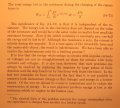
I found the attached excerpt from my linear circuits textbook by R.E. Scott. According to the footnote, the example of one capacitor charging another was a classic back when the book was published in 1960. It still is.
IMG_3759.JPG
 

MrAl

Joined Jun 17, 2014
13,722
I found the attached excerpt from my linear circuits textbook by R.E. Scott. According to the footnote, the example of one capacitor charging another was a classic back when the book was published in 1960. It still is.
View attachment 180040
We could look at that i guess and see if the limit brings the same results with zero resistance.
The question then is does it matter because that would not be practical anyway.
 

MrAl

Joined Jun 17, 2014
13,722
In case nobody figured it out yet, the increment in voltage for the 100v cap is related to the ratio:
100*C1/(C1+C2)

where C1 is the higher voltage cap and C2 the 100v cap.
This helps calculate the energies required to know to solve this.

The argument for any resistor value could be made in this manner.
A typical time function for this transfer of energy would be like this:
Vc=3/2-e^(-(2*t)/R1)/2

and now looking at the exponent ratio t/R1 we see that since our main goal is to calculate the voltage at t toward infinity, we can allow R1 to be absorbed into the time variable 't' and thus declare time 't' to be scaled time T:
Vc=3/2-e^(-(2*T))/2

Now we see the limit here as T goes toward infinity is the same as before because:
a*T=T
when we allow T to go to infinity.
Thus, the limits are the same if we include R1 or not.
In fact, even if we let R1 go toward zero we still get +inf in the exponent so we get the final value the same as before also.
So the value of R1 doesnt matter, even if it is zero.
The only exception might be if we let R1 go toward infinity. Then we'd have to deal with inf/inf which might be hard to determine. There would be two cases:
1. The distance between caps is finite.
2. The distance between caps is infinite.
I guess we could reason that in case 1 there is still some conduction between the two caps, and thus eventually we'd get the same result as with any resistance.
In case 2, with infinite distance we might reason that there is no conduction so nothing ever changes.
 
Last edited:

crutschow

Joined Mar 14, 2008
38,549
In case nobody figured it out yet, the increment in voltage for the 100v cap is related to the ratio:
100*C1/(C1+C2)
It's easier to do it from a conservation of charge approach, as I mentioned in post#5.
  • Calculate the charge in coulombs on each capacitors for their separate charge voltages.
  • Calculate the parallel capacitance of the two.
  • Calculate the voltage that the sum of the charges will cause with the parallel capacitance value.
From the above it's then easy to calculate the total energy of the two before being joined and the energy after they are paralleled.
 

RBR1317

Joined Nov 13, 2010
715
It's a field fight.
I don't see the analogy. With the water example one can see mass (water) moving through a gravitational field. But with capacitors there is no movement of charge through an electric field. Charge moves through the conductor, however there is no electric field in a conductor.
 

MrAl

Joined Jun 17, 2014
13,722
It's easier to do it from a conservation of charge approach, as I mentioned in post#5.
  • Calculate the charge in coulombs on each capacitors for their separate charge voltages.
  • Calculate the parallel capacitance of the two.
  • Calculate the voltage that the sum of the charges will cause with the parallel capacitance value.
From the above it's then easy to calculate the total energy of the two before being joined and the energy after they are paralleled.
Hi,

You mean it is easier than 100*C1/(C1+C2) ?
Please then post your math. I'd be happy to take a look.

Something like this actually takes place in the real world sometimes.
One application is where we want an ADC input that is filtered to get up to the right DC level fast.
Another application which i actually ran into in the early 1980's is where we have a potentiometer that needs a noise cap across two of it's terminals. What we found out though, was durying power turn on of the converter the pot arm would take a while to reach the final voltage. The solution was to provide a second cap on top to the power rail. This is not exactly the same thing, but similar. The two caps there make up a dynamic voltage divider where the arm voltage shoots up much faster than with just the one cap.
In the voltage divider, we have to get the values of the caps right so that the starting voltage at the junction is a typically needed voltage at the arm. Here the ratio of caps helps to find the solution quickly. With equal caps, the voltage shoots up to 1/2 of the power supply rail voltage for example.

When i talk about this stuff i miss working, strange as that might sound. Retirement is cool, but i feel we miss out on the real action then.
 

BR-549

Joined Sep 22, 2013
4,928
RBR1317.......You say you can get the gravity model. The first bucket has to oppose gravity to fill the second. There are three energies here. The energy potential of the first bucket. The energy of moving half of that potential against gravity, and the final energy potential of the two buckets. The moving energy and the final potential energy must come from the first bucket potential energy.

Same with a cap. When the cap starts to fill,(empty bucket) an opposing internal field builds up. Just like bucking the gravity.

A portion of the first cap's potential is spent, moving a portion of the first cap's potential, against the opposing field of the second cap.

The energy needed to move the charge is equal the the final charge potential. And that does make sense. How could you push a potential higher? Everything is used up and accounted for.

Thus.....an opposing field fight expended the missing energy. One field was opposing the other's fall, and the other field was opposing the other's rise. One could get dizzy.

Three energies. The energy of the 1st cap's potential, and the energy needed to move and establish that ending potential, and the final potential.
 

MrChips

Joined Oct 2, 2009
34,897
In case nobody figured it out yet, the increment in voltage for the 100v cap is related to the ratio:
100*C1/(C1+C2)

where C1 is the higher voltage cap and C2 the 100v cap.
This helps calculate the energies required to know to solve this.
I don't know how you arrived at this.

Q1 = C1*V1
Q2 = C2*V2
Q = Q1 + Q2 = C1*V1 + C2*V2
V = Q/C = (C1*V1 + C2*V2) / (C1 + C2)

Change in voltage for C1 is V - V1.
Change in voltage for C2 is V - V2.

Loss in energy is (0.5*C1*V1^2 + 0.5*C2*V2^2) - 0.5*(C1 + C2) * V^2
 

MrAl

Joined Jun 17, 2014
13,722
I don't know how you arrived at this.

Q1 = C1*V1
Q2 = C2*V2
Q = Q1 + Q2 = C1*V1 + C2*V2
V = Q/C = (C1*V1 + C2*V2) / (C1 + C2)

Change in voltage for C1 is V - V1.
Change in voltage for C2 is V - V2.

Loss in energy is (0.5*C1*V1^2 + 0.5*C2*V2^2) - 0.5*(C1 + C2) * V^2

The 'increment' in voltage on C2 is:
(v1-v2)*C1/(C1+C2)

The total voltage on C2 is therefore:
(v1-v2)*C1/(C1+C2)+v2

factoring, we get:
(v2*C2+v1*C1)/(C2+C1)

Look familiar? :)
 

Zeeus

Joined Apr 17, 2019
616
Irrelevant? sure?


Just quoted M. She said that in first post
I don't know how you arrived at this.

Q1 = C1*V1
Q2 = C2*V2
Q = Q1 + Q2 = C1*V1 + C2*V2
V = Q/C = (C1*V1 + C2*V2) / (C1 + C2)

Change in voltage for C1 is V - V1.
Change in voltage for C2 is V - V2.

Loss in energy is (0.5*C1*V1^2 + 0.5*C2*V2^2) - 0.5*(C1 + C2) * V^2
Me still thinking like a school noob..Guess the only one here with a calculator "punching" numbers
Loss in energy does not seem to agree with TS's answer. Maybe mistake
I must be slow today. How did you arrive at this?
Sir, are you ever fast?o_O
 

crutschow

Joined Mar 14, 2008
38,549
You mean it is easier than 100*C1/(C1+C2) ?
Since that doesn't give the correct answer for two capacitors originally charged to different voltages, yes.
Please then post your math.
You don't know how to calculate charge from the voltage on a capacitor?

Q1 = V1*C1
Q2 = V2*C2
Cp = C1+C2 (Cp = parallel capacitance)
Vp = (Q1+Q2)/Cp (Vp = parallel voltage)

Can't get much simpler than that. :)
 

Ylli

Joined Nov 13, 2015
1,092
Please then post your math. I'd be happy to take a look.
I calculated an answer early in this thread, in a manner similar to chutschow. Since this is the Homework forum, I didn't want to post it, but I am waiting for a final answer to see if I am correct.
 

MrAl

Joined Jun 17, 2014
13,722
I must be slow today. How did you arrive at this?
Hello,

In a word, the capacitive voltage divider formula. Oh that's 5 words sorry :)

I think it goes like this (C2 at the bottom):
1/Cx=1/C1+1/C2

and the voltage at the junction is:
Vj=Vs*Cx/C2

In our case, we have the differential voltage v1-v2 so Vs=v1-v2 and the rest factors into the incremental formula. Once we have the incremental voltage, we just add it to the initial voltage of C2.
 

MrAl

Joined Jun 17, 2014
13,722
Since that doesn't give the correct answer for two capacitors originally charged to different voltages, yes.
You don't know how to calculate charge from the voltage on a capacitor?

Q1 = V1*C1
Q2 = V2*C2
Cp = C1+C2 (Cp = parallel capacitance)
Vp = (Q1+Q2)/Cp (Vp = parallel voltage)

Can't get much simpler than that. :)
Hi,

Sometimes when i ask questions i dont like to assume anything i like to see what the person who might answer the question would do. Sometimes we see surprising things that way possibly some method we never used before.
 

crutschow

Joined Mar 14, 2008
38,549
Sometimes when i ask questions i dont like to assume anything i like to see what the person who might answer the question would do. Sometimes we see surprising things that way possibly some method we never used before.
Fair enough.

It's probably obvious, but I forgot to mention that, after the calculations I posted, it's then easy to calculate the difference in energy between the total of the separate capacitors, and when they are in parallel, using 1/2 CV² for the energy stored on a capacitor.
 
Last edited:

MrAl

Joined Jun 17, 2014
13,722
Hi again,

Here is another interesting way to do it.

We use circuit analysis like nodal or something to calculate the time response of each cap, call them
Ft1 and Ft2.

We then have the time functions at both ends of the 'wire'.
Next, subtract Ft2 from Ft1:
Ft3=Ft1-Ft2

Now Ft3 is the voltage across the wire.
The power then is:
P=Ft3^2/R
where R is the assumed resistance of the 'wire'.

integrate the power over times zero to infinity.
That's the energy dissipated in the wire.

Fun right? :)
 
Top