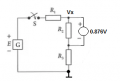
I always found it easier to solve these problems, and check my answer, if I first examined the two extremes of t=0 and t=infinity. At t=0, the capacitor is a short. At infinity it's not passing current and is charged to the voltage across R2. Both of these are easy to calculate.
In between, you know that the transition from one state to the other HAS to follow the RC curve for the capacitor. The only wrinkle in this problem is calculating what R is relevant to charging the capacitor.
Yes thanks that's what I got with my calculations also
So now I know that the Voltage across R2 at t=0.001 is 0.87 V, and that at t=0, the voltage is 3.43 across R3 or Ux.
But what is the voltage at R3 at t=0.001?
I need that also since Ux is R2 + R3 at t = 0.001 :/
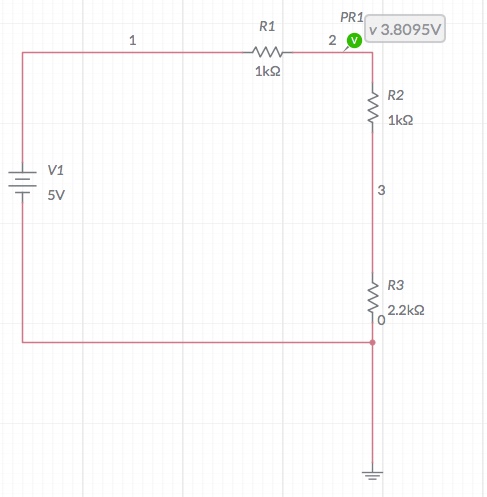
To get the supply voltage for the capacitor, Vs , I look at the circuit at t = infinity
R(total) = 4200, I(total) = 1.19 mA
V(R2) = 1000 * 1.19 mA = 1.19 V
V(R1) = Vs
The voltage across the capacitor is then: (at t = 0.001)
Vc = Vs(1-e^(-t/RC))
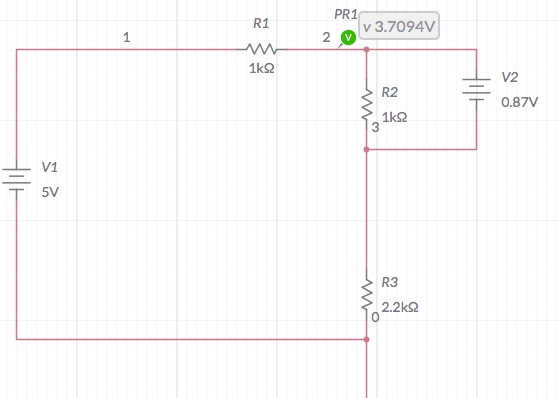
Vc = 0.87 V
To get the Voltage Ux I want to calculate the voltage across R1 at t=0.001, then subtract that voltage from 5V.
I use superposition to remove the voltage source 0.87 V (the capacitor).
With current division I(R1) = 762 / (3200 + 762) * 0.00656 = 0.00126 A
I don’t know how to get the current across R1 if I remove the voltage source 5V.
However if I take 0.00126 * 1000 = 1.261
5V - 1.261V = 3.738
So maybe I’m thinking right here? My guess is if I also could do the superposition without the 5V (and subtract the currents across R1 at t = 0.001) I would be closer to 3.71?
Try to use the superposition and try to find Vx for two cases. The first one without 5V source (short circuit) and the second one without Vc1 source (short circuit instead).

 Facebook
 Google
 GitHub
 Linkedin