Find the closed-loop transfer function

Thread Starter

KaiL

Joined Aug 30, 2014
69
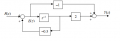
upload_2017-2-24_1-12-4.png
How do I find the closed loop transfer function?

Can anyone give me some hints?

Do I do the closed-loop for the small feedback(the one with -0.5) then follow by the big feedback(the one with -1)?

If so , the small feedback loop is it equal to z^-1 / (1-0.5z^-1) ?
 

WBahn

Joined Mar 31, 2012
32,703
The diagram is simply a way of expressing mathematical operations. So carry out the math operations shown. Do it node by node. Let's call the unlabeled node in the middle A(z).

You have

Y(z) = (-1)*E(z) + (2)*A(z)

Now you try to go from there. Show your work and we can look to see where you go wrong (if you do).
 

MrAl

Joined Jun 17, 2014
13,667
View attachment 121169
How do I find the closed loop transfer function?

Can anyone give me some hints?

Do I do the closed-loop for the small feedback(the one with -0.5) then follow by the big feedback(the one with -1)?

If so , the small feedback loop is it equal to z^-1 / (1-0.5z^-1) ?
Hi,

I think you meant to ask, "How do i find the transfer function".
When you ask how to find the closed loop transfer function that implies that the loop is not yet closed, yet i think it is for this problem. You can verify this though.

Also, you can not simplify a feedback loop if there is a takeoff point in the middle somewhere. Just a hint.
 

Thread Starter

KaiL

Joined Aug 30, 2014
69
The diagram is simply a way of expressing mathematical operations. So carry out the math operations shown. Do it node by node. Let's call the unlabeled node in the middle A(z).

You have

Y(z) = (-1)*E(z) + (2)*A(z)

Now you try to go from there. Show your work and we can look to see where you go wrong (if you do).
Hi Thanks for your reply.
So E(z) = R(z) - A(z)*0.5 and A(z) = z^-1 *E(z) then I proceed to sub it into the equation Y(z) = (-1)*E(z) + (2)*A(z) ? am i correct?
 

MrAl

Joined Jun 17, 2014
13,667
Hi,

You could use substitutions or just solve the two, three, or more equations simultaneously.
You could then double check your result by transforming the resulting equation and checking that result against a direct sequence calculation using the equations you find from the block diagram. Choose a convenient clock period like 1 second.
 
Top