Film capacitors for AUDIO, in SMD?

Thread Starter

rpschultz

Joined Nov 23, 2022
808
It is generally understood that, when designing audio circuits, that any capacitor in the direct audio path should be a film capacitor. But for SMD, how does that work? Are there SMD film caps? A quick co-pilot check:

1757879180558.png

Which ones are best, and how do I find those type of SMD capacitors within EasyEDA?
 

nsaspook

Joined Aug 27, 2009
16,271
What values are you talking about and in what types of devices? Effects boxes for musical instruments (vs top end audio gear) are designed to distort signals, having the 'best' capacitor in the direct audio path seems to be, IMO, a misplaced requirement and is more of a bling statement.
C0G/NP0 capacitors will work just fine.

https://www.digikey.com/en/products...DmIAL4EAtNQQhkkaQFd8RUiACsIPstWmtgqLSG3I1E5aA

https://www.ti.com/lit/an/slyt796a/slyt796a.pdf?ts=1757855271342

A lot of considerations go into capacitor selection. This article focused primarily on capacitors in ACcoupling applications for audio data converters, but the data presented is applicable to other applications as well. MLCC capacitors are very popular, but they can significantly degrade the performance of an audio signal chain. It is possible to minimize the distortion from MLCC capacitors by using larger-value capacitors and increasing the load impedance that the capacitor sees. For high-performance applications, use C0G/NP0 capacitors when available and film capacitors when practical.
 

drjohsmith

Joined Dec 13, 2021
1,579
It is generally understood that, when designing audio circuits, that any capacitor in the direct audio path should be a film capacitor. But for SMD, how does that work? Are there SMD film caps? A quick co-pilot check:

View attachment 355866

Which ones are best, and how do I find those type of SMD capacitors within EasyEDA?
Why do you say
" It is generally understood that, when designing audio circuits, that any capacitor in the direct audio path should be a film capacitor"
 

hrs

Joined Jun 13, 2014
523
Why do you say
" It is generally understood that, when designing audio circuits, that any capacitor in the direct audio path should be a film capacitor"
Because of linearity. Some capacitor types have varying capacitance with applied voltage. Film caps and C0G/NP0 types do not have this problem. For large capacitance values you'll need electrolytics. I think @Ian0 mentioned somewhere on here that non-polar electrolytics are superior to polar electrolytics in the audio path.
 

schmitt trigger

Joined Jul 12, 2010
2,056
Also because they are available in tight tolerances and low TEMPCO, which make them ideal for filters or oscillators.

While the NPO/COG also possesses those desirable characteristics, the film caps are available with orders of magnitude higher capacitance value ranges.
 

drjohsmith

Joined Dec 13, 2021
1,579
Also because they are available in tight tolerances and low TEMPCO, which make them ideal for filters or oscillators.

While the NPO/COG also possesses those desirable characteristics, the film caps are available with orders of magnitude higher capacitance value ranges.
Filters / oscillators I get the stable qualities of cog / npo
But why the general quote about film in the audio path ? This sounds , pardon the pun , like "golden ears", but does an AC coupled microphone input need to be film ?
 

Ian0

Joined Aug 7, 2020
13,112
You should read Cyril Bateman's articles if you want the real answers.
NPO ceramic are actually one of the best which suits surface mount, but other types of ceramic are some of the worst and should only be used for decoupling. Some are so piezoelectric that you can use them as a microphone.
Polypropylene is regarded as being the best film type, and as @hrs said, bipolar electrolytics are actually pretty good, but it's all in Cyril Bateman's work.
NPO ceramics get expensive and tricky to get over about 47nF. When you need capacitors between 100nF and 1uF the choice gets tricky. Probably best to use through-hole polypropylenes.
 

drjohsmith

Joined Dec 13, 2021
1,579
You should read Cyril Bateman's articles if you want the real answers.
NPO ceramic are actually one of the best which suits surface mount, but other types of ceramic are some of the worst and should only be used for decoupling. Some are so piezoelectric that you can use them as a microphone.
Polypropylene is regarded as being the best film type, and as @hrs said, bipolar electrolytics are actually pretty good, but it's all in Cyril Bateman's work.
NPO ceramics get expensive and tricky to get over about 47nF. When you need capacitors between 100nF and 1uF the choice gets tricky. Probably best to use through-hole polypropylenes.
Thanks @Ian0
That's what I was wondering
Yep , I get things like microphonic ceramics , had fun with them when someone used a y5 in a circuit a d they certainly put mechanical related colour into the output .
I'll read up on Cyril's article.
Thanks
 

Ian0

Joined Aug 7, 2020
13,112
You should also use thin film not thick film resistors. Thick film are Ruthenium Oxide which is slightly non-linear. Thin film are metallic, but they are in the MELF case which roll away as you try to solder them. (This is in Doug Self's book)[Edit] but not the bit about rolling away as you solder them
 
Last edited:

Ian0

Joined Aug 7, 2020
13,112

Ian0

Joined Aug 7, 2020
13,112
Also, he tested 10u electrolytics. Am I to assume a 10u smd Aluminum electrolytic is better than an 0805 MLCC?
Yes. No NPO types available at that size.
Could you design it out? For instance, could it be DC coupled? Does it need to be as big as 10uF? Could you put a servo round it instead? Could you increase the resistances in the circuit (although would introduce more noise)?
 

Thread Starter

rpschultz

Joined Nov 23, 2022
808
OK I found that 100n C0G/NP0 you suggested at lcsc.com. Thanks. Also found this 10u, which isn't too big. I'll have to think about how we got this particular part of the circuit. I think it has something to do with output impedance. Also found this thin-film 47R, thanks for the tip.

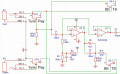
In buffer bypass (BB) mode, the audio goes through C1, IC1.2 and then C8 || C7 and out. These are the caps I'm talking about.
(for reference, C2 goes onto the esp32 that is processing (tuner) the audio, which isn't audible).

1758026469132.png
 

Ian0

Joined Aug 7, 2020
13,112
THAT is a great resource. The Bateman articles (from 2003) linked earlier in this thread mentioned a lot of inconsistency with some types of PET. If using C0G/NP0 (and 1u X5R) are those consistency concerns not applicable? Or outdated?
If I remember correctly, Bateman said how good small ceramics were - that NP0s. I don't think that the X5Rs were popular when the article was written - I don't remember there being any ceramics above 100nF, but they are dreadful. So NP0s in the signal: X5R for decoupling.
When the article was written, there weren't many alternatives to polyester (PET, polyethylene terephthalate) as polypropylene seemed confined to power factor correction, and polyphenylene sulphide hadn't been invented.
 
Top