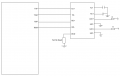
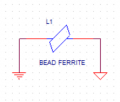
Ferrite bead connected series with Ground (or) Chassis Ground, instead of capacitor

ericgibbs

Joined Jan 29, 2010
21,390
Hi pp,
That IMO is a bad idea, you want a low impedance path to Common.

E

I guess you know a ferrite ring with a wire passing through its centre is an inductive circuit.?
 

Thread Starter

pinkyponky

Joined Nov 28, 2019
373
In what way do you expect an inductor to be a substitute for a capacitor?
Sorry! I'm wrong.

I suppose to ask like, Is that good idea to connect the ferrite bead series with the Ground (or) Chassis Ground, instead of directly connecting to the ground?
 

Thread Starter

pinkyponky

Joined Nov 28, 2019
373
hi pp,
How do you think the ferrite will affect the behaviour of the LED.

E
Ferrite beads on the ground line are not zero impedance; in fact, they increase the return path impedance, which could lead to ground bounce. So, I'm expecting that the LED behaviour might be effet, like somtimes it will not lit or blink. What I understand is correct?.

Thank you!
 

MisterBill2

Joined Jan 23, 2018
27,159
To make the explanations even more specific, the purpose of a capacitor to ground is to provide a low impedance path for higher frequency currents, while blocking DC current.
The purpose of a ferrite bead on a wire is to block high frequency currents while allowing DC current to flow.
So the purposes are exactly opposite.
 

Thread Starter

pinkyponky

Joined Nov 28, 2019
373
To make the explanations even more specific, the purpose of a capacitor to ground is to provide a low impedance path for higher frequency currents, while blocking DC current.
The purpose of a ferrite bead on a wire is to block high frequency currents while allowing DC current to flow.
So the purposes are exactly opposite.
Thank you so much for the explanation.

Is that good idea to use ferrite bead to ground or not?.
If I use the ferrite bead then is it affect the influence of the LED functionality like stop blinking, not lighting sometimes, and so on...

Could you provide me the answer for the above two questions.

Thank you!
 

MrChips

Joined Oct 2, 2009
34,626
Thank you so much for the explanation.

Is that good idea to use ferrite bead to ground or not?.
If I use the ferrite bead then is it affect the influence of the LED functionality like stop blinking, not lighting sometimes, and so on...

Could you provide me the answer for the above two questions.

Thank you!
Your question has already been answered.
Do not put a ferrite bead at ground.

It has no effect on the functioning of the LED.
 

sparky 1

Joined Nov 3, 2018
1,218
In mixed signal an analog ground and a digital ground might use a ferrite bead in tying together AGND and DGND
The bead is frequency selective reducing a particular high frequency component. Some improvement has been reported by
essentially blocking or at least lowering the high frequency. It is more common to find a ferrite bead on the positive.
Not very likely between positive and ground. In the picture below it is a good idea in maintaining digital signal compliance.
The digital component can have an intermittent spike, a power on event or other analog switching event sometimes
not easy to capture a quick event without advanced triggering methods. Dropping some ferrite after trouble shooting can be one remedy.


1743540663750.png
 
Last edited:

nsaspook

Joined Aug 27, 2009
16,249
In mixed signal an analog ground and a digital ground might use a ferrite bead in tying together AGND and DGND
The bead is frequency selective reducing a particular high frequency component. Some improvement has been reported by
essentially blocking or at least lowering the high frequency. It is more common to find a ferrite bead on the positive.
Not very likely between positive and ground.

View attachment 345868
I've used back to back Schottky diodes as AGND and DGND isolators.
https://forum.allaboutcircuits.com/threads/confusion-regarding-ground-loops.166740/post-1473389

https://www.ti.com/lit/an/slyt499/slyt499.pdf
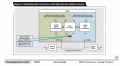
Grounding in mixed-signal systems demystified, Part 1

Connecting analog and digital ground planes Figures 2 and 3 show optional back-to-back Schottky diodes connecting the analog and digital ground planes.
The Schottky diodes prevent large DC voltages or lowfrequency voltage spikes from developing across the two
planes. These voltages can potentially damage the mixedsignal IC if they exceed 0.3 V, because they appear directly
between the AGND and DGND pins.
As an alternative to the back-to-back Schottky diodes, a
ferrite bead can provide a DC connection between the two
planes but isolate them at frequencies above a few megahertz where the ferrite bead becomes resistive. This protects the IC from DC voltages between AGND and DGND,
but the DC connection provided by the ferrite bead can
introduce unwanted DC ground loops and may not be suitable for high-resolution systems. Whenever AGND and
DGND pins are separated in the special case of ICs with
high digital currents, provisions should be made to connect them together if necessary.
Jumpers and/or strap options allow both methods to
be tried to verify which gives the best overall system
performance.

1743541183244.png
 

MisterBill2

Joined Jan 23, 2018
27,159
Consider that we are given NO CLUE as to what is in the block, and consider that the original design called for a capacitor in the "ground" connection, I would assert that the operation will be different than intended, if it functions at all.
Providing a low resistance "solid ground" connection in place of a bypass capacitor to ground will certainly alter the internal circuit functioning.
 

ericgibbs

Joined Jan 29, 2010
21,390
hi pp,
Did the original circuit design state that the Gnd pin had to be connected to ground via a capacitor, or was it something you decided was required???
E
 

atferrari

Joined Jan 6, 2004
5,001
The way the OP says it, makes me think he is guessing if the bead should be soldered between the pin and ground. Never heard of a ferrite bead "connected".
 

MisterBill2

Joined Jan 23, 2018
27,159
The normally accepted application of a ferrite bead has always been around a conductor. There are also a few UNaccepted applications for ferrite beads that yield undesirable results. That includes putting them on one or more leads of 3-terminal regulators, based on the mistaken belief that they will prevent oscillations.
 

Thread Starter

pinkyponky

Joined Nov 28, 2019
373
hi pp,
Did the original circuit design state that the Gnd pin had to be connected to ground via a capacitor, or was it something you decided was required???
E
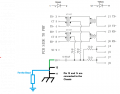
I have connected chassis ground (Pin 11 and 12) and Pin 10 together and then connected to the normal ground through the ferrite bead, as shown below. Is it correct?.

1743602820982.png
 
Last edited:
Top