Why a resistor is placed in series with ferrite bead which is powering an ADC

Thread Starter

hoyyoth

Joined Mar 21, 2020
528
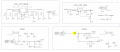
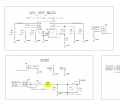
I will be using AD5941 in my design.When I check the reference design ,in the power supply section it contains an LDO,it's output is connected to a ferrite bead,then a small resistor and decoupling capacitors as shown below.

May I know why that 2.2 ohm resistor
1752749446636.png
 

Irving

Joined Jan 30, 2016
4,996
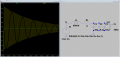
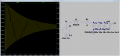
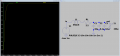
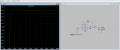
Because the ferrite bead is an inductor with virtually no series resistance the added resistor is there to dampen any ringing due to switch on transients or load transients:

Without resistor...due to step voltage input.

1752759580694.png

Without resistor...due to step current output.

1752759911645.png

With resistor

1752759629266.png


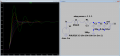
The resistor value isn't critical, anything above 1 ohm or so is fine, depending on current load. Here is the result for r = 0.1 - 1 ohm

1752760734901.png
 
Last edited:

panic mode

Joined Oct 10, 2011
4,864
circuit is a low pass filter. basically it is a series oscillator circuit so without resistance, oscillations would decay much slower.
on the other hand resistance value is low enough... practically a short circuit when compared to impedance of ADC inputs which are in the 100s of kOhms or greater.
 
Last edited:

Irving

Joined Jan 30, 2016
4,996
on the other hand resistance value is low enough... practically a short circuit when compared to impedance of ADC inputs which are in the 100s of kOhms or greater.
True, though this is in the supply rail to the ADC. Because the operating current is so low there's virtually no damping from the load, so extra series damping is needed.
 

Thread Starter

hoyyoth

Joined Mar 21, 2020
528
I kept 100m resistor in parallel with the ferrite bead.My response is given below.

May I know any equation for calculating the value of resistor

1752775922187.png
 

MisterBill2

Joined Jan 23, 2018
27,159
The TS needs to know the current draw of the AD IC and then do the math to calculate that voltage drop. And understand that on many occasions it is important to keep noise out of sensitive components.
 

0ri0n

Joined Jan 7, 2025
160
drop is very very less in simulation I am getting 3.3 at output
In applications were the voltage drop across the series damping resistor (2.2 Ohm in this case) becomes an issue, replace the resistor with a short and shunt the supply line with a damping network consisting of a large (electrolytic) cap in series with a small resistor instead.
 

MisterBill2

Joined Jan 23, 2018
27,159
It will not be so simple to actually shunt the ferrite bead with the resistor. In addition, I have never seen it done.
ALSO, I suggest actually doing the math to calculate the actual voltage drop: Vdrop=current x resistance=0.020A x 2.2 ohms =0.044 volts . That is much less than the specified supply voltage tolerance on the A/D converter.
 

Irving

Joined Jan 30, 2016
4,996
The TS needs to know the current draw of the AD IC and then do the math to calculate that voltage drop. And understand that on many occasions it is important to keep noise out of sensitive components.
Which means reading, understanding and applying the content of the data sheet, a task that seems to be 'difficult' for some aspiring designers I've come to realise. Not helped by poor detailing in some datasheets. Anyway, worst case for this device with all high-power options enabled (but excluding high-level current output from DAC), appears to be around 10mA on AVDD, ie 22mV drop. If the high-power DAC output was shorted to ground, adding 12mA to the AVDD power budget, that would only add another 26mV, So worst case the AVDD would be 3.3 - 0.048 = 3.25v. Since the device is spec'd from 2.8v up, this is a non-issue, and needs no further discussion.

[edit]@MisterBill2 and I posted the same thinking...
 

Thread Starter

hoyyoth

Joined Mar 21, 2020
528
I can see that they have put a 2.2 ohm resistor in series with DVDD power rail also.But they have not provided any ferrite bead for DVVD rail.May I know why.

1752843547988.png
 

MisterBill2

Joined Jan 23, 2018
27,159
The reason is most likely that the problem does not exist in that area.
Understand that making a detailed system analysis with only tiny snippets of the system drawing is rather difficult. THAT is why I often challenge the value of this format of presentations.
 

MisterBill2

Joined Jan 23, 2018
27,159
OK, now I see that the entire system is shown only in tiny snippets , and in addition, I now see that the references to "shield" do not mean shield as commonly understood, but rather to a plug-on sub assembly. So the language is "arduino-speak", not the same meanings as common use.

I finally traced the power feed from the connection with that ferrite bead and the 2.2 ohm resistor to the analog AD5940 IC, which appears to be an I/O device, either on the main PCB or on the add-on.

Certainly keeping even low level noise off of the power feed to an analog portion of the system is an additional requirement that the digital portions of the system do not require. And it only took me about ten minutes to trace that analog power, because I was able to recognize the block.
Drawings that show a whole circuit are much easier to follow.
 
Last edited:

Irving

Joined Jan 30, 2016
4,996
I suspect the 2R2 on the digital rail is to limit the rise time and peak current flow on power up to match the startup curve of the AVDD feed and avoid any latchup issues in the A2D v D2A subsystem.
 

panic mode

Joined Oct 10, 2011
4,864
Sorry for my mistake.This is the complete reference design.
Actually that is only a schematics. While it does show values and circuit connections, it does not cover how connections are routed, how large the pcb tracks are, where the decoupling capacitors are actually placed, etc.

What is the actual problem that you are trying to solve? Did you make own board that performs differently from Evaluation board?
 

Thread Starter

hoyyoth

Joined Mar 21, 2020
528
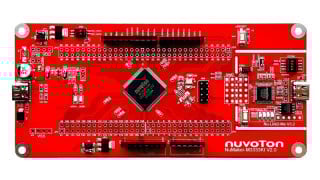
I am making something similar to refrence board.Instead or Arduino we are using STM32.This is for measurement from electrochemical tatoo sensors.This is the complete reference design where you will get some information about PCB also (In the bottom of the page).If want I can do a cut copy paste of the schematic, and close my job.

I am trying to leran from experts in this community.
 
Top