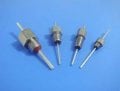
When you use the term "feed through" are you referring to Bypass and Decoupling capacitors? When I think of a feed through capacitor I think about through the bulkhead capacitor designs like these capacitors. The capacitors I see as most commonly found in power supplies I view as filter capacitors.
Feed-through capacitors provide a low impedance path to ground for high frequency signals.
This allows any undesirable high frequency noise to bypass the functional circuit.
They also act as small power supplies laid out all over a PCB. So, after the initial power up, this allows current to be transferred from the capacitors to the components that need the power, rather then having the current travel all the way from the power supply to the component needing the power. This not only provides cleaner energy for the component that needs the power, but it also reduces the number of large current loops traveling through the whole PCB.
This doesn't make sense to me. How can Feed-through capacitors shunt high frequency but also store voltage & current to be transferred
I don't know what the ffff is going on here, but I'm pretty sure I don't care. Most of what is described in post #4 are the functions of a decoupling capacitor, what used to be called a bypass capacitor. A decoupling capacitor works to prevent a debice from injecting noise onto a power supply, and to keep noise already on the power supply from entering the device. A feedthrough capacitor is entirely different.
For a filtering type it gives you a very low inductance to ground allowing for much better insertion loss at high frequencies. At high currents even a small amount of ground lead inductance is significance when the circuit DC resistance is extremely low.
A three terminal cap can also be used on a circuit board but then the ground lead inductance can effect the insertion loss but it's better than a simple bypass cap.
There are the axial type designed to penetrate the walls of a shielded box. The idea is to pass low frequency signals through the walls (power, control signals, etc) while blocking RF from getting in or out.

 Facebook
 Google
 GitHub
 Linkedin