That's what I thought.
Try tapping the PWM wire to ground rather then rubbing it sideways. It's also possible that the frequency of the waveform from the module is important.
By all accounts, if striking the white wire to ground and scratching it on ground makes the fan run then momentarily striking the white wire to ground via PWM should also make the fan run. Based on your first video.
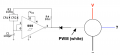
Pin 3 is providing a square wave. HIGH then LOW then HIGH then LOW (repeat). When low it should be providing pathway for the signal to reach ground. If you want to forego the diode then connect the white wire to pin 7 of the 555. It does not provide any "HIGH's", only "LOW" and "Open" (or floating). Which is the same thing you're doing with striking the white wire to ground.
There seems to be a bit of confusion here...I was asking to be sure the diode was connected to the module correctly...not the custom build.
The OP said nothing about trying the custom build.
Also, the OP was talked into buying a module that doesn't have pin 7 available, then constantly told that pin 7 would be better.
In my opinion the OP should have been shown a PWM module that has an NMOS output transistor, but I said nothing because I don't really like conflicting with other people's advice unless it is blatantly wrong in my opinion.
Because you posted after Tony's reply without referencing whom you were speaking to I thought you were referring to Tony's schematic. Which BTW I posted back in #14 using pin7 as the output before the module was suggested.
Ok, you're right I should have quoted the reference...a bad habit of mine.
But you could have given me the benefit of the doubt of whom I was speaking to, because it is quite obvious that your circuit doesn't need the diode and the OP had just stated that the module didn't work.
But ok, let's just chalk this up to miscommunication on my part, and get back to trying to help the OP.
Sure no big deal.
I had a private conversation with the TS and he is going to send me the fan and module if a few previous suggestions made do not work.
Apparently it needs to pull the PWM line to ground to work but not at a 100% duty cycle.
Here's my version of a 555 circuit with an appx 90% fixed duty cycle using pin7 to drive the PWM input. View attachment 294974
Because you posted after Tony's reply without referencing whom you were speaking to I thought you were referring to Tony's schematic. Which BTW I posted back in #14 using pin7 as the output before the module was suggested.
Apparently yes, you did. Sorry I overlooked that part. Pin 7 would be the way to go IF the TS was building from scratch. As for a module? One would have to know for a certain what they want and what the module can do. As far as I could tell, those modules were designed to power a fan that would run at full speed when powered with 12V on red and ground on black. The TS has a fan that requires a signal to run. Likely the blue wire is for a tach or feedback to a controlling circuit. Unfortunately the TS isn't up on electronics terms and lacks a common understanding of the same. Not putting anyone down - just saying that we could be given some clearer information. When asked "What's 2 + 2?" the TS response didn't really address the problem in the way we were asking.
I figured the same but the TS clearly stated the blue wire was grounded in post #21. It probably is a tach output but not used or not needed in this application apparently.
There seems to be a bit of confusion here...I was asking to be sure the diode was connected to the module correctly...not the custom build.
The OP said nothing about trying the custom build.
Also, the OP was talked into buying a module that doesn't have pin 7 available, then constantly told that pin 7 would be better.
In my opinion the OP should have been shown a PWM module that has an NMOS output transistor, but I said nothing because I don't really like conflicting with other people's advice unless it is blatantly wrong in my opinion.
1. In the OEM configuration it is captured by a screw to the metal part the fan is attached to.
2. I am presuming this fan is custom made for Chrysler and there would be no reason for an extra wire if they had no intent on using it. It is rare for a car mfg to use an off the shelf part. The very specific connector that was on it indicates it is made specifically for Chrysler.
3. The blue wire doesn't go through the loom to the connector, where they could have put it in the connector female side and no connect / no pin on the male side.
Apparently yes, you did. Sorry I overlooked that part. Pin 7 would be the way to go IF the TS was building from scratch. As for a module? One would have to know for a certain what they want and what the module can do. As far as I could tell, those modules were designed to power a fan that would run at full speed when powered with 12V on red and ground on black. The TS has a fan that requires a signal to run. Likely the blue wire is for a tach or feedback to a controlling circuit. Unfortunately the TS isn't up on electronics terms and lacks a common understanding of the same. Not putting anyone down - just saying that we could be given some clearer information. When asked "What's 2 + 2?" the TS response didn't really address the problem in the way we were asking.
You are correct, about me not being "up on electronics terms and lacks a common understanding of the same" and my apologies to this group for that. I sincerely appreciate the patience, comments and desire to find a solution for a person you don't know. That is what forums are all about. I am a member of other forums, where I am fortunate to have done the same for others with lesser knowledge about a subject matter.

 Facebook
 Google
 GitHub
 Linkedin