expanding BW using feedback question

Thread Starter

yef smith

Joined Aug 2, 2020
1,459
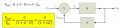
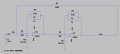
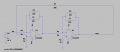
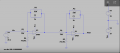
Hello,I have built the following two stage amplifier as shown bellow.
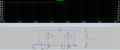
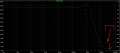
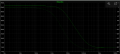
In open loop i get 63dB gain and BW about 3Khz.
when i tried to add a feedback resistor to lower the gain and increase the bandwidth as shown in the formula below i get no change at all.
two stage amplifier with feedback is shown in the end.
Where did i go wrong in implementing the feedback effect of feedback ressistor to lower the gain and increase the bandwidth?
Thanks.
1686935905834.png
1686935932810.png

1686935955626.png
1686935975468.png
 

crutschow

Joined Mar 14, 2008
38,507
Where did i go wrong in implementing the feedback effect of feedback ressistor to lower the gain and increase the bandwidth?
Two ways:

First, the feedback is around two inverting stages, so the feedback would be positive, not negative (you want negative, note the (-) sign on the feedback to the summing junction).

Second, the ideal input voltage source has zero impedance, so there is no summing of the feedback, as the feedback signal is shorted to ground through the input source.
 
Last edited:

Thread Starter

yef smith

Joined Aug 2, 2020
1,459
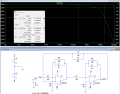
Hello crutschow, i have implemented your advice and got increased of BW from 3K to 30K as shown bellow.
Is there some alternative OPAMP i can use to increase much more my BW?(to 5MHz)
Thanks.
1686984511160.png1686984356506.png
 
Last edited:

crutschow

Joined Mar 14, 2008
38,507
For 30db of gain at 5MHz you need a gain-bandwidth of at least 150MHz.
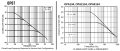
So look for op amps with 200MHz gain-bandwidth or more, such as the LTC6269.

Note that using resistors with a value such as 732.82 makes no practical sense.
Use the nearest 1% value (click the Select Resistor option when the resistor popup is open).
 

Thread Starter

yef smith

Joined Aug 2, 2020
1,459
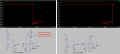
Hello Audioguru because i have double pole i get a section far away wherei got 180 degrees and 0db amp.
So at 20MHz i could get aucilations.
two question:
1. if i put an input signal at this area of 20MHzhow what problematic phenomena i would see in my sectrum analyzer /scope?
2.how do i add here a component so i will get another poler and elinimate this area where i have 180 degrees and 0db area
1687016129703.png1687016061197.png
 

Thread Starter

yef smith

Joined Aug 2, 2020
1,459
Hello cruthow,My asc simulation file is attached.
1. if i put an input signal at this area of 20MHzhow what problematic phenomena i would see in my sectrum analyzer /scope?
2.how do i add here a component so i will get another poler and elinimate this area where i have 180 degrees and 0db area
 

Attachments

crutschow

Joined Mar 14, 2008
38,507
Below is the sim where I added C3 to give an added dominate pole, and reduced the values of R6, R7, C1, and C2.
The result is a smooth rolloff with no amplitude or phase anomalies.
At 20MHz the response is down about 11.5dB from the midband gain, which is what you should see on a spectrum analyzer.

1687020859722.png
 

Audioguru again

Joined Oct 21, 2019
6,826
Opamps in series with overall negative feedback are usually unstable and oscillate.
You have both opamps with a 500kHz lowpass filter that adds some phase shift to make even more instability.

Why use opamps for such high gain and high frequency?
 

Attachments

Thread Starter

yef smith

Joined Aug 2, 2020
1,459
Hello Audioguru,what is the meaning of oscilation in real life.
We have our 0db 180 at 20MHZ
how would i recognize an oscilation?
 

crutschow

Joined Mar 14, 2008
38,507
how would i recognize an oscilation?
If the Bode plot shows no signs of instability, then use the transient analysis to apply a small, fast, input pulse (e.g. 100mV, 1µs) and look for excess ringing or overshoot on the leading and trailing edges of the output signal (example below, which shows an acceptable single overshoot).
Sometimes there can be a large-signal (transient) instability, even though the Bode plot looks okay.

1687026695112.png
 
Last edited:
Top