ESD Foot Strap Test Circuit design

Thread Starter

jfour

Joined Oct 12, 2017
6
I'd like to create a circuit such that a person can wear a foot strap, stand on a metal plate, and touch another metal plate, and have a red LED light up if their resistance is outside the range of ESD-safe conductivity, which, if the information I've found is accurate, is between 1MOhm and 10MOhms (for an individual wrist strap, foot strap, etc.). I've found a lot of vague instructions (such as "make a circuit with a window comparator"), but I have not found ANY complete circuit diagrams for this purpose.

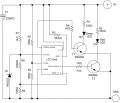
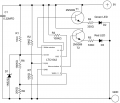
I found the attached circuit, that I think I've re-created accurately, which I believe is intended for testing power supplies. It seems like something similar, using the LTC1042 Window Comparator, might be able to test for the window of 1-10 MOhms.
As I understand it,
- LTC1042 will light up the LED D2 when V(IN) (pin 3) is within Width/2 (pin 5) of Center (pin 2), otherwise it will light up LED D3.
- D1 is a bandgap diode that produces a constant voltage of 2.5V. Considering that my power supply is 5V, this seems like a good place for the center of the window.

The two big missing pieces of information that I know that I'm missing are:

1) Where would a human -- finger to foot strap, or wrist strap to opposite hand, etc -- be inserted into this circuit, safely? Between the resistors and V(IN)?

2) If the window comparator is in fact appropriate for this application, the resistors will need to be adjusted for the specific window. I gather that there is a way to calculate the resistance required in any given part of a circuit, but I don't understand how the formulas work. I'm assuming that at the very least the resistors connected to Width/2 need to be changed.

If anyone has any answers, advice, direction, etc -- I'd really appreciate it!
Screen shot 2017-10-12 at 12.07.51 PM.png
 

Deleted member 115935

Joined Dec 31, 1969
0
have you thought of just using an off the shelf dvm ? many on the web very cheap and just work. I did the same in my home 'lab' ,
 

Thread Starter

jfour

Joined Oct 12, 2017
6
I've used a DVM to test a wrist strap on myself, but I'd like to have an automated solution as an "idiot-proof" device that coworkers can use on a regular basis. If I can get this working, I'd also want to experiment with additional applications that are more difficult to test with the voltmeters that I have access to.

It also seemed like a good excuse to learn how to make a circuit. :)
 

GopherT

Joined Nov 23, 2012
8,009
I'd like to create a circuit such that a person can wear a foot strap, stand on a metal plate, and touch another metal plate, and have a red LED light up if their resistance is outside the range of ESD-safe conductivity, which, if the information I've found is accurate, is between 1MOhm and 10MOhms (for an individual wrist strap, foot strap, etc.). I've found a lot of vague instructions (such as "make a circuit with a window comparator"), but I have not found ANY complete circuit diagrams for this purpose.

I found the attached circuit, that I think I've re-created accurately, which I believe is intended for testing power supplies. It seems like something similar, using the LTC1042 Window Comparator, might be able to test for the window of 1-10 MOhms.
As I understand it,
- LTC1042 will light up the LED D2 when V(IN) (pin 3) is within Width/2 (pin 5) of Center (pin 2), otherwise it will light up LED D3.
- D1 is a bandgap diode that produces a constant voltage of 2.5V. Considering that my power supply is 5V, this seems like a good place for the center of the window.

The two big missing pieces of information that I know that I'm missing are:

1) Where would a human -- finger to foot strap, or wrist strap to opposite hand, etc -- be inserted into this circuit, safely? Between the resistors and V(IN)?

2) If the window comparator is in fact appropriate for this application, the resistors will need to be adjusted for the specific window. I gather that there is a way to calculate the resistance required in any given part of a circuit, but I don't understand how the formulas work. I'm assuming that at the very least the resistors connected to Width/2 need to be changed.

If anyone has any answers, advice, direction, etc -- I'd really appreciate it!

View attachment 137118

Why are you connecting the collector of NPN transistor “switches” to the positive rail? Normally, the LED-resistor are connected to the positive rail and then collector and emitter is connected to negative rail. Otherwise, you’ll have trouble getting then transistor to turn all the way on. In that case, you’ll need some current limiting resistor between the base and the chip (1k to 10k is typical).
 

Thread Starter

jfour

Joined Oct 12, 2017
6
Why are you connecting the collector of NPN transistor “switches” to the positive rail? Normally, the LED-resistor are connected to the positive rail and then collector and emitter is connected to negative rail. Otherwise, you’ll have trouble getting then transistor to turn all the way on. In that case, you’ll need some current limiting resistor between the base and the chip (1k to 10k is typical).
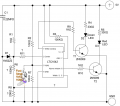
I didn't design the circuit, so I don't know what the original justification was; my guess, based on research inspired by your question, would be that the creator assumed that the base and emitter voltages would always be such that the LEDs would light; as I said, I believe the original circuit was for testing power supplies. I've redrawn the circuit to follow the common-emitter model as you suggest, which seems safer being as I don't know what will happen to the rest of the circuit yet.
Does this look better?
Screen shot 2017-10-17 at 10.25.00 AM.png

I'm still looking for:
1) Where to insert the strap/human/etc that I want to test
2) How to calculate the resistors needed for the window comparator to test for 1-10MOhms
 

GopherT

Joined Nov 23, 2012
8,009
It does look better.

The problem with testing people for static charge, you need to maintain the static charge while measuring it. MOSfETs are susceptible to static damage because they can build static charge without dissipation at their Gate and input resistance can be in the range of 10^12 to 10^15 ohms.

Your circuit allows all charges to dissipate before any significant charge builds up. And the most charge this can measure is equal to the supply voltage. I have not found an application note that shows how you could use this for static charge measurements.
 

Thread Starter

jfour

Joined Oct 12, 2017
6
@GopherT I have no illusions that I'm testing static charge; I want to measure resistance, so, if I were testing *only* a typical wrist strap with a voltmeter, I would expect the resistance to be very close to 1MOhm, but that doesn't take into account whether the wrist strap is making good contact with the user's skin, nor a few other environmental variables. Which is why I expect the range to be between 1MOhm and 10MOhms, because of the added resistance of the human body. Below 1MOhms, the resistor in the wrist strap isn't a part of the circuit; above 10MOhms, and either the skin contact isn't good enough, or the person's skin is too dry, or the wire in the strap is compromised.

It may be that the type of circuit I posted won't ever get me the result I'm looking for, but hopefully I've explained the end result well enough that someone can point me in the right direction.
 

Thread Starter

jfour

Joined Oct 12, 2017
6
Ok, here's an updated drawing that might be a little more clear... I think I might have figured out where to put the strap to be tested (as shown). If the resistance of the foot strap will reliably set the voltage at V(in), then I need to calculate the difference in voltage at V(in) between the minimum (1MOhm) and maximum (10MOhm) resistance values for the footstrap. Additionally, I need to set the Center voltage appropriately, and the Width/2 input as well. While I've found explanations of how to calculate resistance, current, and voltage, they all have very simple examples, and I'm having difficulty figuring out how to calculate these values. I also don't know if I'm applying basic electrical principles incorrectly...
Screen shot 2017-10-23 at 3.16.17 PM.png
 

Thread Starter

jfour

Joined Oct 12, 2017
6
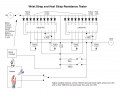
So I wound up going about this in a different way. The "answer" to my question was to use variable resistors, and not bother calculating the resistance values at all. More specifically, I wound up using more complicated chips, LM3914, which are set up to light up a set of 10 LEDs each. I chained two of them together as per the instructions in their data sheet, then put a 1MOhm resistor into the circuit and set the variable resistors going to one of the LM3914 chips so that all but one of the LEDs were lit; then put a 10MOhm resistor into the circuit and set the variable resistors going to the other chip such that only one of the LEDs were lit. I left these resistors in the test box, connected to switches, so that the accuracy of the test box can be checked throughout the life cycle of the 9V battery powering the circuit.
esd test circuit v4.png
This test box has been working quite well.
 

Danko

Joined Nov 22, 2017
2,149
Human resistance very depends on voltage, therefore, for right results you can use high voltage power supply and resistor connected in series with human body.
For V_ps=300V and resistor 10Meg you should measure current from 27.3uA to 15uA for human body resistance from 1Meg to 10Meg.
For safety resistor 10 Meg must be composed of 10 resistors 1Meg, connected in series.
Power supply may be DC-DC HV Boost Converter.
 
Last edited:
Top