One rarely speaked knowledge is that Faraday Cage principle is working unidirectionally. Faraday principle is that all the charges from closed structure INNER wall is automatically running to outside so the E at inside wall is identical to zero voltage. Most of students never hear what own have said. From inside to outside. But not from outside to inside. Yes, particularly shell MAY make an attenuation even to out-going EM waves but only in the case when it is brilliantly earthened (what rarely is possible). Thus, inside the F Cage one never hear the radio or phone, but if one put the radio-transmitter, then the signal will be rather brightly heard outside with minor weakening. The practical case study - I had to install the LORA telegraph radiating the once the minute "telegrams" about temperature, rpm, moisture etc info about 100 kW power station into sea container. I know, the normal far-beating of my system is about 3 km, and here we needed only 1 km to that firm boss cabinet where internet input to the cloud. But when we undersigned the contract, none informed us that this machinery stays into the hermetic steel container what is 2 mm thick well earthened walls and if one drills the hole for antenna wire out-sprucing they may loss the warranty for that machine. So, I thoughtit will turn to full blamage for us, but decided to try at least. Yes, Lora was completely unable to receive anything but all what it "speaked outward" was "laud" enough to cover about 200 meter distance. Thus we attached 10 meters off the container one retranslation LORa and now already 5 years as it works with success. So... remember always that out-going signal have no effect by Faraday Cell, but ONLY by earthening.
I understand that. I have seen cases where you can short out the opto and the micro still gets an interrupt. The signal came into the board another way. Example; capacity coupling from a hot trace to another.
Your problem might be due to electrical noise getting into the controller via an I/O pin.
About 40 years ago I was designing the controller for an image recorder that used a Polaroid (remember them?) filmback. After each exposure the controller, an MC68705, would eject the print from the filmback then wait for the next exposure command. Every Nth exposure the filmback would get stuck in the "ON" mode and empty the entire film pack on the lab floor.
The problem was eventually tracked down to noise from the motor getting into the output pin on the controller and crashing the controller. The motor had very crude brush and armature and sparked like crazy. The unlikely tactic of filtering the I/O pin solved the problem.
about testing - remove all external sensor wiring. test what happens when optocoupler input is:
a) connected low (0mA)
b) connected high (5-24mA)
c) not connected (floating, 0mA)
d) connected to piece of free hanging wire (antenna) of some 3ft length
do you still see interference? in which cases?
case a and b should be done with as short as possible external wires so they are not acting as antenna. goal is to see if the board itself is the culprit, or the interference is already on the wire connected to board.
next, connect 100nF cap across optocoupler diode and repeat the tests
about board design, new version is making use of ground planes, that is a good idea. 1k resistor on optocoupler input may be a bit small. normally that current should be in 5-10mA range, 24mA is a bit high.
about testing - remove all external sensor wiring. test what happens when optocoupler input is:
a) connected low (0mA)
b) connected high (5-24mA)
c) not connected (floating, 0mA)
d) connected to piece of free hanging wire (antenna) of some 3ft length
do you still see interference? in which cases?
case a and b should be done with as short as possible external wires so they are not acting as antenna. goal is to see if the board itself is the culprit, or the interference is already on the wire connected to board.
next, connect 100nF cap across optocoupler diode and repeat the tests
about board design, new version is making use of ground planes, that is a good idea. 1k resistor on optocoupler input may be a bit small. normally that current should be in 5-10mA range, 24mA is a bit high.
I will surely check these but before that I would like to share my test results which I made with bare UNO.
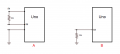
1) Set-up A using interrupt - Interference detected (on Serial Monitor).
2) Set-up A using polling - Interference detected.
3) Set-up B using polling - No interference.

 Facebook
 Google
 GitHub
 Linkedin