Facebook
 Google
 GitHub
 Linkedin

Some time ago, I noted down this example of an EMI filter in my notes.
Unfortunately, I cannot remember which paper I took it from.
The paper began with these two requirements:
- Set an attenuation greater than 10dB at frequencies [10k .. 150kHz]
- Set an attenuation greater than 20dB at frequencies [150k .. 30MHz]
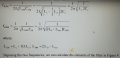
Let's focus on the last sentence of the second image:
"Imposing the two frequencies, we can calculate the elements of the filter in Figure 4"
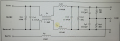
If I understand correctly (English not being my native language), the author set the two frequencies f_rcm and f_rdm in the formula, then did some calculations to find the values of Cx, Cy and Ld that you see in the first photo.
So, to summarise, the requirements (in theory) should be satisfied with the following values:
Lc = 2.4mH
Cy = 3300pF
Ld = 180uH
Cdm = 0.47uH (I think he means Cx (?))
(values shown in the first photo, I have only reproduced them here)
The problem is that when I substitute these values into the formulas, I get:
f_rcm = 40kHz
f_rdm = 12kHz
(..I did not consider Closs in the formula!)
How did the author manage to satisfy the requirements?
..40kHz and 12kHz do not seem very similar to the requirements to me.
Correct me if I'm wrong, but the only thing that comes to mind is that those calculated frequencies are cut-off frequencies, so they have 3dB attenuation... perhaps by plotting the Bode diagram with LTSpice, it might turns out that the two requirements (10dB and 20dB attenuation) are actually satisfied.
Unfortunately, I cannot remember which paper I took it from.
The paper began with these two requirements:
- Set an attenuation greater than 10dB at frequencies [10k .. 150kHz]
- Set an attenuation greater than 20dB at frequencies [150k .. 30MHz]
Let's focus on the last sentence of the second image:
"Imposing the two frequencies, we can calculate the elements of the filter in Figure 4"
If I understand correctly (English not being my native language), the author set the two frequencies f_rcm and f_rdm in the formula, then did some calculations to find the values of Cx, Cy and Ld that you see in the first photo.
So, to summarise, the requirements (in theory) should be satisfied with the following values:
Lc = 2.4mH
Cy = 3300pF
Ld = 180uH
Cdm = 0.47uH (I think he means Cx (?))
(values shown in the first photo, I have only reproduced them here)
The problem is that when I substitute these values into the formulas, I get:
f_rcm = 40kHz
f_rdm = 12kHz
(..I did not consider Closs in the formula!)
How did the author manage to satisfy the requirements?
..40kHz and 12kHz do not seem very similar to the requirements to me.
Correct me if I'm wrong, but the only thing that comes to mind is that those calculated frequencies are cut-off frequencies, so they have 3dB attenuation... perhaps by plotting the Bode diagram with LTSpice, it might turns out that the two requirements (10dB and 20dB attenuation) are actually satisfied.