I cannot for the life of me understand how voltage can lead current or current can lead voltage. Aren't they linked, don't they work in unison simultainiously. NM/culomb x culombs/sec = power. Is there a fluids example that might help me to see this.
I cannot for the life of me understand how voltage can lead current or current can lead voltage. Aren't they linked, don't they work in unison simultainiously. NM/culomb x culombs/sec = power. Is there a fluids example that might help me to see this.
Interesting joeyd, I can see having voltage potential across points without having current flow. I can see that existing in a pressurized vessel. But being out of phase, I dont get it.
I cannot for the life of me understand how voltage can lead current or current can lead voltage. Aren't they linked, don't they work in unison simultainiously
So, you've just disproved your premise that current and voltage "work in unison simultaneously" (which they do, but different than your intuition is telling you).
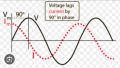
Actually, the case of zero current and non-zero voltage (actually peak voltage) represents a snapshot in time of a 90° phase difference between current and voltage in a steady-state AC circuit through and across a cap or an inductor.
If you can get past that, the rest is easy.
Oh, and stop with the fluid analogies. It'll just make comprehension harder.
Actually, the case of zero current and non-zero voltage (actually peak voltage) represents a snapshot in time of a 90° phase difference between current and voltage in a steady-state AC circuit through and across a cap or an inductor.
If you can get past that, the rest is easy.
Oh, and stop with the fluid analogies. It'll just make comprehension harder.
And, btw, purely reactive circuit elements (ideal caps and inductors) do not dissipate power, even while exhibiting the phase shifts (actually, because of the phase shifts!). Power is a different animal. Save that for later.
I cannot for the life of me understand how voltage can lead current or current can lead voltage. Aren't they linked, don't they work in unison simultainiously. NM/culomb x culombs/sec = power. Is there a fluids example that might help me to see this.
In a fluid undergoing harmonic motion, you have similar relationships between pressure and flow.
Think of a capacitor and the relationship between voltage and charge. Now imagine the applied voltage is a sinusoid, going both positive and negative. When the voltage is the at the extreme valued, the charge on the capacitor is also at a max, but at that moment the charge isn't changing (it just went from increasing and is about to start decreasing, but at that moment, it is static). Since the current IS the rate at which the charge is changing, that means that when the voltage is at its extreme values, the current is zero. Now image as the voltage is dropping toward zero. The charge is changing and the faster the voltage changes, the faster the charge is changing, which means that the faster the voltage changes, the higher the current at that same time. The voltage is changing the fastest as it passes through zero, hence that is also the moment where the current is at a max.
Understanding the relationship comes in the AC circuit theory class. Using only DC circuit theory it is a lot more complicated.
This IS a case where studying the circuit theory does help. Just wait until you get to LC resonant circuits.
The books allow learning and understanding without having to do the experiments, which do not always work out as intended.
Actual technical theory books can provide a whole lot of amazing knowledge and insight. BUT ONLY thru reading them.
When you fist apply voltage to a cap it is a short (0V) and has max current ( current leads voltage), with a coil it starts with voltage and starts to build a current through it (Voltage leads current)
In a capacitor, current must flow in to provide the charge, which is the stored electrons in the capacitance. THAT should be easy to remember and simple to understand. In an inductance, the voltage pushes the current to store energy in the magnetic field..
Like I already said, it is all explained when you get to the AC CIRCUIT THEORY chapters..
We always should remember that the mentioned phase relations between I and V are valid under steady state conditions only (when all transients have disappeared).
More than that, working with parts which are capable to store energy like an ideal capacitance (resp. an ideal inductance), we have a circuit with two energy sources which must be taken into account when we try to understand what is happening.
And finally (for a better understanding) - a positive phase shift of +90 deg is equivalent to a negative phase shift of -270deg.
And of course, some of the forces motivating the electrons could be non-coulombic (not voltage) but bringing that up would only serve to confuse the issue.
So of course, convention says that we should always consider any "volts" as voltage.
Valuable insights have been provide by @MisterBill2, @LvW and others. Here are the important points:
1) DC and AC inputs make a difference.
2) Phase shifts are to be considered under AC conditions at steady-state.
3) Inductors and capacitors are energy storage devices.
1) When a DC voltage is applied to an uncharged capacitor, the capacitor voltage is zero while the charging current is non-zero. Conversely, when a DC voltage is applied to an inductor, the current is zero while the voltage is non-zero. Hence, already they are not in phase.
2) At DC steady-state, the reverse conditions occur. The voltage on the capacitor has reached its maximum value and the current is zero. For an ideal inductor with zero DC resistance, the voltage across the induction would be zero and the current would be infinite.
3) Since C and L are energy storage devices, these current and voltage sources must be taken into consideration after the initial application of voltage has passed. Hence, when AC voltage is applied to a capacitor, for example, at the peak of the applied voltage, the capacitor stops charging. Beyond the peak voltage, the capacitor itself delivers current in the opposite direction. This current peaks (in the negative direction) when the applied voltage is zero. You can see this in the current and voltage graphs shown below.
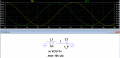
Below is the LTspice sim of an oscillating ideal LC resonant circuit showing the 90° phase-shift between the node 1 voltage (yellow trace) and current (green trace).
Note that when the voltage is maximum (all circuit energy stored in the capacitor voltage, ½CV²), the current is zero, and when the current is maximum (all circuit energy stored in the inductor current, ½LI²) the voltage is zero.
So basically the resonant circuit alternately transfers (bounces) the circuit energy between the inductance and the capacitance.
Yes.
A common mechanical analogy is an inertial mass (which is the analogy of inductance) and a spring (which is the analogy of capacitance).
And friction, of course, is the analogy of electrical resistance.
My thought is that in charging/ discharging a reactive component (capacitor or inductor) there results at some point a maximum of voltage and a minimum of current and vice versa. However at all times both voltage and current are present.
If you apply a voltage from a source with zero source resistance to a capacitor without a resistor in series with it, and the capacitor itself has no resistance, how long does it take for the voltage drop across the capacitor to be equal to the applied voltage? According to the equation t = R*C, the charging should be instantaneous, but that implies that the current went from a maximum to zero current also instantaneously which is impossible.

 Facebook
 Google
 GitHub
 Linkedin