Facebook
 Google
 GitHub
 Linkedin
electronics waste recycling idea - would like your input please.
- Status
- Not open for further replies.

Scroll to continue with content

I saw the taking back to the seller statement. In Australia at least, the only expectation from manufacturers of TVs and Computers is provide funding to companies willing to be involved in the repurpose and recycling of their products. There is no expectation for them to take stuff back. Maybe the legislation is different in the USA.
Back to my business idea. I believe people want to see their electronics goods recycled responsibly but there are few facilities which are willing to take anything other than TVs and Computers because they are paid to take them. I believe it should be extended to all electronics manufacturing companies to foot the bill. If not, then some incentive for consumers is needed.
We should have been recycling tech since the beginning but we didn't. Now, our dumps hold valuable resources in the ground. Maybe mining our dumps is something to consider. Another forum topic for another day and probably not on AAC.
Back to my business idea. I believe people want to see their electronics goods recycled responsibly but there are few facilities which are willing to take anything other than TVs and Computers because they are paid to take them. I believe it should be extended to all electronics manufacturing companies to foot the bill. If not, then some incentive for consumers is needed.
We should have been recycling tech since the beginning but we didn't. Now, our dumps hold valuable resources in the ground. Maybe mining our dumps is something to consider. Another forum topic for another day and probably not on AAC.
Last edited:

I've often pondered whether if someone were to drill a core down into a dump, thinking it was just native ground, if they would get all excited because they had hit high-grade ore for all kinds of things.We should have been recycling tech since the beginning but we didn't. Now, our dumps hold valuable resources in the ground. Maybe mining our dumps is something to consider. Another forum topic for another day and probably not on AAC.

There are two different things going on here. One is business and the other is what (currently) lies in the domain of government. Thanks of the current Weltanschauung, pretty much everywhere in the world, bottom line profits define the floor of corporate ethics. As things stand, anything that effectively increases the profits of stockholders is "good" and things that reduce them are "bad".I am calling BS on the option to not go ahead with recycling e-waste on the basis of profitability. Management of e-waste should be the responsibility of the manufacturer not dumped on the consumer. Consumers have a huge role to play but it ought to be easier to find a facility to take your stereo and other equipment once they break or become "old". My dream is that it becomes normal practice to take e-waste to a recycling facility rather than to the local tip.
In Australia we have a national television and computer recycling scheme but it ought to include all electronic equipment. Hence, businesses won't touch stereos etc because there is no money handouts from manufacturers. We can do better.
Whether this is an appropriate state of affairs is a matter of opinion, it seems. The simplified-to-doctrine standard economic model imagines (for reasons that don't comport with reality) that the foundation of all economic systems is a group of rational actors (consumers) chasing scarce resources. The existence of rationality and scarcity are axiomatic but can't really be measured in the real world.
The advent of behavioral economics and the actual measurement of cognitive bias puts a lie to the rational actor idea. It turns out that Hume had it right,
The is bit of this can be measured, and has been. People act rationally in pursuit of goals but not in their selection. Instead we act on irrational impulse, choosing what is—or ins't—"right", and then employing our rational facility to both justify and accomplish these things. Hence, "rationalizing", generally seen as a sin in the sight of rationality, is how things are actually done.In A Treastise of Human Nature (1740): David Hume said:Reason is, and ought only to be the slave of the passions
The should bit is not something that can be measured, it falls into the realm of ethics and morality that has no rational basis and so no measurable aspect. You can only measure it after you've decided what a thing like what you are examining should do. It is not a fact, it is a value, and this fact-value distinction is very basic, underlying all of our attempts to understand morality.
So, in the case of "corporate morality", the values that underly analysis of the facts hold bottom line profit above all else. One might hope "do anything so long as it is legal" could be the floor for this, but in practice it is "do anything as long as the net result means increased profits".
What might be called enlightened self interest can make corporations behave in ways that seem to sacrifice profits to the greater good, but save a few exceptional cases unpacking these things will find cold, hard calculations concerning the bottom line are the driver rather than a concern for people, the planet, or anything else. In fact, it is only the possible blowback that prevents corporations from ignoring the law. If it can be calculated to be more profitable to break it than respect it, breaking it is the "right" thing to do. The many examples of this that actually come to light are not deviations, they are normative.
So a corporation "going green" can calculate that people will be more likely to purchase their products if they perceive products come form a corporation who "cares" about the planet, and that the products will contribute to a better world. Things like carbon offsets and other completely bogus measures of improved ecological outcomes show something else.
So, you are not wrong that there should be something done about the impending chaos of a climatic shift, but this depends entirely on the sentiment of the consumer which drives the profits of the corporations. You can sometimes entrain the corporations using this sentiment by making it impact their bottom line—positively or negatively—but you will not move them using values based arguments from outside the corporate domain where the latter (bottom line) is the key principle of value.
So this leaves only government to take up the mantle of non-corporate values. Of course, corporations seek to perpetuate the idea that government regulation is always bad, that the (mythical) free market is an unfailing mechanism to produce the best outcome for everyone, and that any hint of government regulation of dangerous corporate behaviors (from labor practices, to product safety, to consumer protections) is "communism". On top of this, they effectively write most of the regulations that must live under through lobbying and regulatory capture.
In my opinion, the rôle of government is to set the boundaries on what "demand" can be "supplied", while the market is a great mechanism for supplying that demand, efficiently and innovatively. When people say that limiting profits will also eliminate incentive, I have to call it nonsense. Are you telling me that the profit-minded corporations will not do business if the profit margin shrinks?
Clearly this is not correct. If there was a segment that was operating at a traditional margin of 10%, but that included cost savings measures that were harmful (e.g.: not dealing with toxic byproducts of manufacture), and government regulation reduced that margin by half, these corporations would get out of the business?
Of course not! Profit is profit—framing a reduction of profit as a loss is nonsense. You are either operating at a profit or a loss, full stop. If these corporations did get out of the business, others would surely step in (based on that same principle of the free market and its abhorrence of a vacuum in collecting profit). Different businesses operate with different margins, but any profit will attract a collector.
All this said, you could do what many have done and make your work a cause célèbre and use the sentiments of the irrational consumer to drive the behavior of the corporations using their own ethical framework. This is dangerous if you want to make something scalable or sustainable, since fashions change and the sentiments of the consumers today will not be the same tomorrow. You could adopt the strategy of the corporations' intellectual arm and explicitly introduce your values into schools at all levels. They pushed the standard economic model that way when alternative ideas had taken hold—and it worked.
Very few people know there is an alternative to it, that isn't "communism", a generalized bogey man that will take away all of your nice things (even if you don't actually have any), take away your "choice"—but of what, in practice, and even murder you if you dare to complain. The fact that the idea of rational actors chasing scarcity might not be a good description of the world is nearly impossible to contemplate.
This is because values are axiomatic, and what has happened is the inevitable conflation and confusion of principle and practice. At first, principles are articulated and practices are crafted to support those principles. As time goes on, the practices replace the principles as the priority. The principles are repeated but the practices are not tested against them for efficacy. If this gap is ever noticed it is waved away because "we can't understand the mind of [geniuses | god] and so simply must have faith.
This is why Pragmatism, far from being the terrible philosophy of scoundrels, is actually the only way to remain principled. Pragmatism eschews orthodoxy, but really only as universal. Where the orthodoxy provides wisdom concerning what actions to take according to principles held, it is a tool for good. But when it is clear the practices of orthodoxy fail, even do harm by acting completely opposite of the stated goals, it is time to jump frames.
The Pragmatist is unfettered by the boundaries of an orthodoxy and so can choose to act always in alignment with principle, doing the next possible thing to manifest those principles in light of the limitations of reality. Does this mean anyone who acts "pragmatically" will be principled (in the sense we consider "good")? No, of course not. Not any more that the person subscribing to an orthodoxy will, even in the absence of the inevitable breakdown in the "rules".
So, rather than discouraging you from trying to do what you see as "good", all of this is an attempt to help you see where you might stand to be effective. All people who succeed in "business" are pragmatic in their approach. The key is to combine those alien values that you hold with the pragmatism that will convert them into native business values. Meeting them on their own turf, so to speak, and not "standing on principle" when that will not advance your cause.
I hope you can see that "standing on principle" is not what is happening in the cases this phrase is commonly used. It should be "standing on practice". It is the pragmatist that can "stand on principle", and to the uninformed will seem to be building a house on sand while actually building it on the most solid foundation a principled person can have—an honest assessment of, and respect for, the "good" in human terms, and not on the purely superficial practices which are part of an orthodoxy, usually controlled by those with the most power.
I know this was exceedingly long and apparently discursive. I apologize for that. If you've read this far I hope it was useful.
@Ya'akov
Thank you for taking the time for that reply. Must have taken hours. I will have to go over it a few times to comprehend all the important points.
What are my alien views?
Being resilient is a skill and I will use that to my advantage. If no one is as interested in something I have to sell, then it gets scrapped. I have not proven any of my ideas myself yet to know for sure it can be done in my area or can't be as I may find out. A small batch test will help.
Have you heard of Lean Canvas?
It is supposed to help develop a business idea and guide the next steps.
Doing due diligence first before a commitment to spend money I don't have.
Plenty of investigating to do yet.
Profit Margins. How much do I need to live on every week, plus expenses?
How much do I need to be comfortable?
Can I do enough in this business to make that much?
Am I working smart enough?
If the answer is no then I need to make changes.
How does that sound?
Thank you for taking the time for that reply. Must have taken hours. I will have to go over it a few times to comprehend all the important points.
What are my alien views?
Being resilient is a skill and I will use that to my advantage. If no one is as interested in something I have to sell, then it gets scrapped. I have not proven any of my ideas myself yet to know for sure it can be done in my area or can't be as I may find out. A small batch test will help.
Have you heard of Lean Canvas?
It is supposed to help develop a business idea and guide the next steps.
Doing due diligence first before a commitment to spend money I don't have.
Plenty of investigating to do yet.
Profit Margins. How much do I need to live on every week, plus expenses?
How much do I need to be comfortable?
Can I do enough in this business to make that much?
Am I working smart enough?
If the answer is no then I need to make changes.
How does that sound?
This is a well trodden mental path so it was about 45 minutes, I hope it really does reflect hours of effort though. There is a lot behind it to unpack, all of which I think is extremely important for someone investigating the nature of morality and the related ideas of moral obligation and ethical frameworks.@Ya'akov
Thank you for taking the time for that reply. Must have taken hours. I will have to go over it a few times to comprehend all the important points.
One of the foundational techniques in the art of philosophy is finding our self-evident truths and scrutinizing them for both the status we’ve given them (are they really axioms, or are they practices masquerading as principles?), and for the validity we otherwise unquestioningly give them.
Philosophers from Plato to the current day have relied on this unmasking to make progress, and around the time of the Enlightenment, many of what we know call self-evident truths were discovered and embedded in the Western Wetanschauung. Philosophers like Kant, Hobbes, Hume, Rousseau, Berkeley, and Descartes—among many others—argued the details among themselves both as contemporaries and commentators.
But a certain constellation of the ideas they espoused have become our “truth”, absorbed into popular culture with the original author‘s explanations and defenses absent. These ossified opinions eventually became the unquestioned and invisible authority for what is now considered normative.
It would greatly benefit society if we could evolve from this.
The alien label is a relative one. Your motivations for wanting to start this business are alien to the corporate ethical framework. In this case, as far as I am concerned, “alien” is a positive thing.What are my alien views?
So, it’s not whether you could successfully start a business but whether you could find the cooperative partners needed to make this particular business sustainable, since you need to generate income somehow and with the current state of affairs, it certainly appears the input costs will not be recovered by selling the output.
”Don’t quite your day job” is the sort of advice you might get from someone who assumes that the odds are so stacked it’s not worth trying. I would give it as a way to test the practicality without risking your own ruin, not as a chastisement or insult.
Profit margins are after salaries, which are expenses. Corporations don’t deduct salaries from profits, margins are what is left after all costs are paid. So it’s not a matter of margins, it’s a matter of cash flow—not how much you want to pay yourself but how much can you collect as a business.Profit Margins. How much do I need to live on every week, plus expenses?
How much do I need to be comfortable?
There is no reason that you can’t do whatever clever things you can come up with to reduce costs or increase income to make this balance work. But you can‘t make things work if your outgoing is bigger than your incoming. Your analysis of your own needs is important, since that is an expense for the business. And, if you are happy with a modest return that makes things easier.
I don’t know if you can make it work, but I do know it is vital to be clear-eyed about the value-fact distinction. Don’t confuse “what ought to be“ with “what is”. If something should be some way, that means it is a value; if something is some way it is a fact. No amount of “shouldness“ can turn a value into a fact. Values are always going to be tests of what pertains to see if it needs changing.
This is what you are seeking to do. Keep at it, but don’t answer the objections of others when they are about values, only when they are about facts. “This is very important to me, I believe it is an ethical necessity” is the answer to any question challenging the values. For facts, it’s a matter of judging them in the light of your goals.
I do think you are doing the proceeding, mostly. But this enterprise is fraught because of the “alien” nature of your values. Expect defenses of the normative, with few defectors, as it is nearly impossible to get people to abandon “common sense” as they don’t understand its nature or shortcomings—look at how it is conflated with wisdom and receives the praise which should be exclusive to it.
I wish you the best of luck with this. I don’t see you running blindly into ruin. You are certainly taking a measured and careful approach to it. My principal advice is to dig for the things you can’t yet question because they are hidden to you, and when you find them, let them make you wiser.
From discusions here and the few I have had with men who have attempted to make money recycling/recovering metals and so on from e-waste, I am looking at approaching the idea as a Not-For-Profit or Non-Profit Organisation. There are benifits to this approach. I am now in contact with my local council to see if it is allowed to go ahead in that capacity. It might compete too much with the councils recovery operation. Maybe I could just do something as a hobby and not call it a business. There is the chance though that I could start a business focusing on Solar Panel recycling because that will also be something needed in the near future. Apparently I could charge people a recovery fee plus receive money for the recovered raw copper, aluminium and silicon. A YouTube video shows how recovering materials from solar panels is done in India. So, it is doable, but by no means a small operation given the amount of solar panels on rooves which will eventually need replacing and are not allowed to be taken to the tip.
Thank you everyone for your input. Muchas gracias.
Thank you everyone for your input. Muchas gracias.

As someone who is primarily 'technical' it took me many years to fully appreciate that the foundation of any successful business is MARKETING.
Who is your customer? What are you offering them? Why do they need it? Why from you? Defining these will focus you and give your business a clear path.
Who is your customer? What are you offering them? Why do they need it? Why from you? Defining these will focus you and give your business a clear path.

Reselling used components would not be beneficial to you as far as a large-scale electronic waste recycling business goes. You may find used components very difficult to move. However, some pins, connectors and other components may have precious metals associated with them: gold, silver and copper for example. Recovering gold from electronic components requires the use of dangerous acids and reagents as part of the refining process. Now you have a toxic waste issue to deal with when the refining process is completed. Watch some YouTube videos by Streetips https://www.youtube.com/@sreetips for some examples of refining techniques.I am wanting to start a recycling business focusing on electronic waste such as audio equipment, test equipment, medical equipment and similar. There are plenty of businesses focusing on computer and television e-waste in Australia due to the national computer and television scheme where importers and manufacturers of TVs and computers contribute to the recycling of these products. Not a lot happening though for the other electronic products.
My 'Why' is simple.
- Less electronic waste going to landfill.
- Jobs for people who would otherwise have trouble finding work
- Being part of the solution and driving change
- Being my own boss
Scrapyards can deal with the metals recovered. Plastic can potentially be pelletised and glass can be recycled also.
Not only do I want to break down equipment into the different metals, plastic and glass, I want to sell components which are hard to find as brand new items at your local electronics store. Those components include stepper motors, CD spindle motors, gears, potentiometers, switches and relays. Okay, pots are easy to buy at the local shop but I don't always like what is on offer. Stepper motors from CD/DVD drives can be seen on YouTube videos attached to an Arduino for projects such as mini CNC machines, LASER drawing machines and 3D scanners.
I am asking you, do you believe there could be a market for components recovered from equipment?
Please let me know your thoughts.
There are other uses for some items. Art and craft folk may see bits and pieces as useful in their artwork. I have made mini sculptures from bits I have found.
The idea is to try small batches to see how they go. Plus the stock of any component item would have a maximum limit. Suppose I had motors for sale. If they did not sell they would be separated into steel and copper. Selling components was always going to be a small part not the main.
There is a business in Brisbane which actually repurpose components including solar panels and li-on batteries to make products they designed. That business is purely not-for-profit and uses volunteers.
Another business I know of, sells the off-cuts and scrap from industry to craft folk. Apparently it is quite popular. So, that is a stream of customers I maybe able to tap into. There are people here who are looking for different types of scrap for their artwork. Not a lot of people. More a trickle than a stream. Lol.
The idea is to start small. Prove the idea. Then see if I can hire equipment and a warehouse using a loan. I won't get a loan if I do not have a good enough plan to be able to pay it back. All good.
There is a business in Brisbane which actually repurpose components including solar panels and li-on batteries to make products they designed. That business is purely not-for-profit and uses volunteers.
Another business I know of, sells the off-cuts and scrap from industry to craft folk. Apparently it is quite popular. So, that is a stream of customers I maybe able to tap into. There are people here who are looking for different types of scrap for their artwork. Not a lot of people. More a trickle than a stream. Lol.
The idea is to start small. Prove the idea. Then see if I can hire equipment and a warehouse using a loan. I won't get a loan if I do not have a good enough plan to be able to pay it back. All good.
SANJAYBARC
- Joined Aug 24, 2022
- 1
Good IdeaI am wanting to start a recycling business focusing on electronic waste such as audio equipment, test equipment, medical equipment and similar. There are plenty of businesses focusing on computer and television e-waste in Australia due to the national computer and television scheme where importers and manufacturers of TVs and computers contribute to the recycling of these products. Not a lot happening though for the other electronic products.
My 'Why' is simple.
- Less electronic waste going to landfill.
- Jobs for people who would otherwise have trouble finding work
- Being part of the solution and driving change
- Being my own boss
Scrapyards can deal with the metals recovered. Plastic can potentially be pelletised and glass can be recycled also.
Not only do I want to break down equipment into the different metals, plastic and glass, I want to sell components which are hard to find as brand new items at your local electronics store. Those components include stepper motors, CD spindle motors, gears, potentiometers, switches and relays. Okay, pots are easy to buy at the local shop but I don't always like what is on offer. Stepper motors from CD/DVD drives can be seen on YouTube videos attached to an Arduino for projects such as mini CNC machines, LASER drawing machines and 3D scanners.
I am asking you, do you believe there could be a market for components recovered from equipment?
Please let me know your thoughts.
There are other uses for some items. Art and craft folk may see bits and pieces as useful in their artwork. I have made mini sculptures from bits I have found.
If you start then please use my hand also to clean environment from e-waste and also to alternate business opportunity.
my email: <removed by moderator>
PLEASE DO NOT PUT EMAIL ADDRESSES IN POSTINGS. If you want to contact a member directly, please use AAC’s conversation facility. You will need to post at least 10 messages to be elibigible. —Moderator
Last edited by a moderator:
For a surprise, check Etsy for “resistors”.The idea is to try small batches to see how they go. Plus the stock of any component item would have a maximum limit. Suppose I had motors for sale. If they did not sell they would be separated into steel and copper. Selling components was always going to be a small part not the main.
There is a business in Brisbane which actually repurpose components including solar panels and li-on batteries to make products they designed. That business is purely not-for-profit and uses volunteers.
Another business I know of, sells the off-cuts and scrap from industry to craft folk. Apparently it is quite popular. So, that is a stream of customers I maybe able to tap into. There are people here who are looking for different types of scrap for their artwork. Not a lot of people. More a trickle than a stream. Lol.
The idea is to start small. Prove the idea. Then see if I can hire equipment and a warehouse using a loan. I won't get a loan if I do not have a good enough plan to be able to pay it back. All good.
I looked up resistors on Etsy and found nothing. One 'shop' had sold out of whatever they were selling. Was that the point? I also looked up hobby motors and the prices were high. eBay has excellent prices for resistors. I could not compete with that. Used resistors are not sellable. They would be good for the shredder. Used motors are rare on eBay as well. I did however find that there are electronic Lots sold for auction. I just bid for someone's old electronics spares. Mostly linear pots.
Shame I missed copying your email. Tell us more about yourself. Where are you for starters? What interested you in this idea?Good Idea
If you start then please use my hand also to clean environment from e-waste and also to alternate business opportunity.
my email: <removed by moderator>
PLEASE DO NOT PUT EMAIL ADDRESSES IN POSTINGS. If you want to contact a member directly, please use AAC’s conversation facility. You will need to post at least 10 messages to be elibigible. —Moderator
I just watched the video in full. I wonder how one goes about replicating that and what safety equipment needs to be installed, to be approved by the environment authorities. Seems doable. Lots of acid and fumes. I wonder what permits I would need.Reselling used components would not be beneficial to you as far as a large-scale electronic waste recycling business goes. You may find used components very difficult to move. However, some pins, connectors and other components may have precious metals associated with them: gold, silver and copper for example. Recovering gold from electronic components requires the use of dangerous acids and reagents as part of the refining process. Now you have a toxic waste issue to deal with when the refining process is completed. Watch some YouTube videos by Streetips https://www.youtube.com/@sreetips for some examples of refining techniques.
Thank you for sharing.
What I had in mind were examples like these (not all resistors), they are sold as art supplies. Talk about a markup! Usually, they want "vintage" versions. Resistors are very popular, particularly wirewound since they are rugged, can take a lot of heat, and often have a vitrified coating. But, you can apparently move anything if it's colorful or you have a lot of the same thing.I looked up resistors on Etsy and found nothing. One 'shop' had sold out of whatever they were selling. Was that the point? I also looked up hobby motors and the prices were high. eBay has excellent prices for resistors. I could not compete with that. Used resistors are not sellable. They would be good for the shredder. Used motors are rare on eBay as well. I did however find that there are electronic Lots sold for auction. I just bid for someone's old electronics spares. Mostly linear pots.

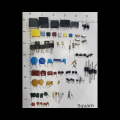
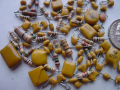
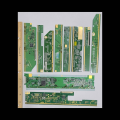
Thanks for that. I feel a bit more vindicated; that my idea of art folk looking for electronics scrap is a thing. Call something art related and suddenly the price goes up. A scalpel set sold in the hardware section will be half the price of the same one in pink, sold in the craft section of the same shop. Crazy, but that is marketing. Pinterest has examples of resistors being used for mini-sculptures. Not my thing, but some folk are into it.
I will have to do some research into who buys that sort of thing and find out what they want. Who knew? Art folk see the world a little different than engineer folk. Lol. Actually, I knew. I like making sculptures myself. I see warrior arms when I look at the reader arm inside a hard-drive. Ink Cartridge caps look like feet. The robot sculpture I made, below, had LEDs for eyes, a mobile phone speaker and I made a simple 555 timer circuit for light and sound. Alas, poor martin fell and needs putting back together.
Attachments
-
 21.2 KB Views: 4
- Status
- Not open for further replies.