electronics laboratory

Thread Starter

monika.duccoli

Joined Jan 12, 2024
72
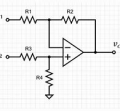
I'm making the following circuit:
Given a source that can be represented as a voltage generator that generates signals in the range of -1.5V and -1V, having a series resistance of 100 Ohms:

Design and manufacture an amplifier, even multi-stage, that meets the following characteristics:

• Non-inverting gain

• The output signal must be between 0 and 5V + 5%

• The frequency response must have a low-pass characteristic with a cut-off frequency of

40kHz ‡ 10%

I'm hesitant to use one of the following Op-Amps in the first stage :
Ua741
LM358
MCP6292
I need some advice on how to make it, thanks in advance
 

dl324

Joined Mar 30, 2015
18,326
Welcome to AAC!

Is this schoolwork? If schoolwork, post the complete text for the problem.

What type of waveform is the input signal? How are you expected to convert a negative voltage to positive if you have to use a non-inverting amplifier?

What makes you think any of the opamps you mentioned wouldn't be sufficient for a 40kHz bandwidth?
 

MrChips

Joined Oct 2, 2009
34,807
uA741 is over 50 years old and is only used in textbooks.
LM358 is a dual op amp in an 8-pin package.
MCP6292 has the same pinout as LM358 but has limited operating voltage range, ±2.75V.
LM358 would be the better choice.

Is this homework?
 

Thread Starter

monika.duccoli

Joined Jan 12, 2024
72
The text of the delivery is in Italian, would that suit you anyway? this is the full translation. no type of waveform is specified, I thought of assuming it as sinusoidal on Ltspice. I chose these three Op-amps because they are the ones we have in the laboratory
 

dl324

Joined Mar 30, 2015
18,326
The text of the delivery is in Italian, would that suit you anyway?
As this is an English language site, posting in English would be better.
I chose these three Op-amps because they are the ones we have in the laboratory
There's nothing wrong with LM741 if you know how to use it. It's commonly used in school to highlight the non-ideal nature of opamps. LM741 was the greatest thing since sliced bread when it was first available. I still use it.

The age of a design doesn't have a direct correlation to its usefulness. The LM358 is of the same era as LM741.

MCP6292 is a newer design than either the LM741 and LM358, yet it's the least appropriate for your problem.
 

MrChips

Joined Oct 2, 2009
34,807
uA741 or LM741 is ok for teaching. The problem is if you always think LM741 every time you need an op amp then you would be inadequate. LM741 is not recommended in new designs.
 

Thread Starter

monika.duccoli

Joined Jan 12, 2024
72
to create the circuit I had found that the ratio between the two resistors had to be between -4.36 and -1, but there are no negative resistors, do you have any advice?
 

MrChips

Joined Oct 2, 2009
34,807
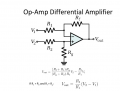
This is your basic differential op amp circuit configuration.

1705086759843.png

Study this until you have mastered it and know everything you need to know about how to apply it for numerous applications.
 

MrChips

Joined Oct 2, 2009
34,807
The basic differential op amp configuration is your starting point in learning how to use op amps.

1705098520986.png

Notice that the output is a function of (V2 - V1). If you want a single ended input amplifier, simply set the unused input to GND (or reference COMMON). Hence you can see how to turn it into an inverting or non-inverting amplifier.
 

k1ng 1337

Joined Sep 11, 2020
1,038
This is the Homework Help forum, not Homework Do.
We here to help students arrive at the correct answer, not do the work for them.
I deleted the post because I'm not sure where you folks draw the line at doing the work for them. I don't think I did but I guess we will find out once TS posts more of his confusion.
 

WBahn

Joined Mar 31, 2012
32,823
As others have said, please post a translation of the actual instructions. There is a disconnect between requiring a negative input and a positive output, and requiring a non-inverting amplifier. That forces us to guess about what is being asked, and engineering is not about guessing (when it can be avoided, which sometimes it can't).

There is an easy way to resolve the disconnect, but it might be something that you are expected to figure out. Seeing the actual problem statement will make it easier to provide appropriate guidance. But here's a hint -- the non-inverting op-amp circuit most people think of is actually a special case of a slightly more general configuration in which a second input is hard tied to 0 V. Here's another hint -- the information you gave did not say how the input voltages map to the output voltages, only what the extend of both ranges needs to be.
 

MrAl

Joined Jun 17, 2014
13,702
I'm making the following circuit:
Given a source that can be represented as a voltage generator that generates signals in the range of -1.5V and -1V, having a series resistance of 100 Ohms:

Design and manufacture an amplifier, even multi-stage, that meets the following characteristics:

• Non-inverting gain

• The output signal must be between 0 and 5V + 5%

• The frequency response must have a low-pass characteristic with a cut-off frequency of

40kHz ‡ 10%

I'm hesitant to use one of the following Op-Amps in the first stage :
Ua741
LM358
MCP6292
I need some advice on how to make it, thanks in advance
Hello there,

I can help you figure this out but you'll have to look up the parts and do the math.

The most important consideration for choosing an op amp for this application is what is often called the "Power Bandwidth" of the op amp.
You should look this up, and be aware that this does not always appear explicitly on the data sheet so you have to calculate it yourself.

The Power Bandwidth of an op amp is usually taken as the maximum frequency the op amp can handle at a give output voltage peak. Because the usual test signal is a sine wave, this would involve the maximum sine wave frequency and the peak output voltage, and the slew rate is the real limiting specification so you need that from the data sheet.
The simple formula is:
f=sr/(2*pi*A)
{and also f<GBP}
where
f is the maximum frequency in Hertz,
sr is the slew rate in volts per second (not volts per microsecond), and
A is the peak amplitude of the sine wave as in the sine wave given by V=A*sin(w*t).
Because of this slew rate limiting factor, there is only one of those op amps that may fit the bill if we relax the output voltage to plus and minus 2.5 volts. If we need plus and minus 5 volts then none of those op amps will work in real life.

This means you need to look up all three of those op amps and find the slew rate 'sr', and with the required peak amplitude 'A' calculate the max frequency for each amplifier. Comparing those three calculations will reveal if any of them can handle that 40kHz specification required by your application.

Note: Units of Volts per Second (v/s) is calculated from Volts per Microsecond (v/us) as:
v/s=(v/us)*1000000
so that's an easy calculation.

Also Note that the frequency must also be less than the Gain Bandwidth Product as shown above.
Another note is that for some amplifiers the output power output must be at least 1/2 of the full power rating when calculating or testing the Power Bandwidth.

Another little note is that if the instructor allows you to ignore the slew rate and just use the GBP, then you may be able to use either of those op amps, but you'll have to get that information from the instructor. If you have to actually build and test this as part of the assignment however, you'll have to do the above calculations and comparisons. Unfortunately, some instructors may not know of this limitation, so you'd have to talk that over with them if needed.
 
Last edited:

Thread Starter

monika.duccoli

Joined Jan 12, 2024
72
Hi, I have a further doubt, what values should I choose for the resistors, obviously the ratio I choose will help me to have the amplification I want. Furthermore, I had thought of making two stages so as to obtain an output voltage, and a possible alternative that seemed valid to me was to use a buffer at the first stage and then another LM358 amplifier at the second stage, in which I sized the resistors so as to obtain the gain I buy between 0 and 5 Vvi seems like a valid alternative
 
Top