Electric Powered Flight

Thread Starter

jpanhalt

Joined Jan 18, 2008
11,087
Apparently, the first electric powered flight was "135 years ago" (1884?) in France. The airship was piloted by Capt. Charles Renard and was named La France. It attained the speed of 13 mph (Model Aviation, March, 2019, p.12). Maybe the green revolution will allow us to experience that thrill.

What I am really writing about is the evolution of electric model flight. There is an 1909 report that is unsubstantiated, but a substantiated report from 1957 caught my eye. It is described in the same Model Aviation issue mentioned above (MA's servers are down, I cannot link). Apparently a Col. H.J.Taplin in the UK was able to maintain flight for 10 minutes using "accumulators." Here's a video link :

https://www.britishpathe.com/video/electrically-powered-model-planes/query/Birchington

Maybe someone with digital access to Model Aviation can share that link too. The quoted price in today's dollars for the "accumulators" is $924. Are they a forerunner of today's super capacitors? I began flying RC in about 1952-1953 and our batteries were no where nearly that expensive.

What is an "accumulator?"

John
 

oz93666

Joined Sep 7, 2010
742
What is an "accumulator?"
John

It's a primitive battery , silver/zinc in that particular case ,.forget it ..... we now have lithium rechargeable cells which hold more power for a given weigh and are a lot cheaper

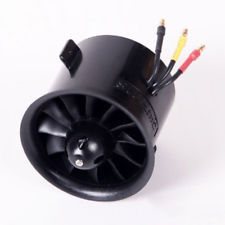
I suggest you look at modern RC model flight ... it all comes down to brush-less motor ducted fans as the most effective thrust producer .... and lithium batteries for power storage ...


Model builders use ducted fans that produce up to 50N (5Kg wt) thrust ...so perhaps 6 of these could get a person airbourn in horizontal flight
Some have done it , search Youtube ...

But the whole feasibility issue comes back to battery technology . Lithium only allows minutes of flying time so it's hardly worth it. Unless there is a 10 fold increase in battery performance manned electric flight will remain a dream.
 
Last edited:

Saluki

Joined Feb 23, 2019
80
It's a primitive battery , silver/zinc in that particular case ,.forget it ..... we now have lithium rechargeable cells which hold more power for a given weigh and are a lot cheaper

I suggest you look at modern RC model flight ... it all comes down to brush-less motor ducted fans as the most effective thrust producer .... and lithium batteries for power storage ...


Model builders use ducted fans that produce up to 50N (5Kg wt) thrust ...so perhaps 6 of these could get a person airbourn in horizontal flight
Some have done it , search Youtube ...

But the whole feasibility issue comes back to battery technology . Lithium only allows minutes of flying time so it's hardly worth it. Unless there is a 10 fold increase in battery performance manned electric flight will remain a dream.
Not to mention that Lithium batts' performance REALLY falls off in cold conditions (like if you fly very high!)

10x better batteries at reasonable cost would sure make a big difference for electric cars!
 

Thread Starter

jpanhalt

Joined Jan 18, 2008
11,087
After a little more reading, I suspect the "accumulator" was an early NiCd rechargeable battery. They apparently became available in the US as early is 1946 (according to Wikipedia) and would provide the energy density and current for flight.

@oz93666 Why do you say silver/zinc? Admittedly, I could not understand every word in the short clip. That style and design for the airplane, including the radio mounted on rubber bands was quite standard for the mid-50's. Advances were rapid.

EDIT (correction): Re-read the article more carefully. The batteries are described as silver-zinc. Interesting choice compared to what that battery is used for today.

A 10--minute flight under power was definitely an accomplishment. Our flights usually averaged about half that with glow fuel. Of course, our controls were rubber-band powered escapements, so that was a limiting factor too. My the end of the 50's servos were much more common.
 
Last edited:

ericgibbs

Joined Jan 29, 2010
21,442
hi,
In the UK during the 1930,40's an accumulator was a Lead Acid 2Volt battery that was used to power the 2V valve/tube heaters in a radio set.
The HT power was either a 90V or 120V dry battery.

Local traders used to have re-chargers for the 2V accumulators, you took your discharged battery and it was swapped for a recharged one.
Thriving little business in those days.

E
Footnote:
Some enterprising traders stripped down old 12V batteries and re-cased them as 90Vbatteries, to replace the 90V dry battery for the radio, again operating a recharge/exchange and delivery service.
 
Last edited:

Thread Starter

jpanhalt

Joined Jan 18, 2008
11,087
I considered lead-acid, but weight in those old designs was a killer. We flew similar models with 72" wingspans with nothing more than a 0.19 in^3 engine. Also. the "very high price" that was mentioned in the Model Aviation article made me think it had to be something other than lead-acid.
 

Thread Starter

jpanhalt

Joined Jan 18, 2008
11,087
Yes, that was electric. I followed that whole trip. At about the same time, a non-solar, conventional electric airplane also flew. It can be done, but it seems a long way off for practice. It is hard to imaging a 12 to 16 hour flight with current battery technology. IC engines running at constant speed are more efficient in the air than in city stop-and-go traffic.
 

oz93666

Joined Sep 7, 2010
742
Not to mention that Lithium batts' performance REALLY falls off in cold conditions (like if you fly very high!)!
You're right they don't like the cold , but remember they will be delivering very high currents so the internal resistance of the batteries will generate a LOT of heat , making overheating of batteries the problem ... electric cars need a cooling system for the batteries.
 

Glenn Holland

Joined Dec 26, 2014
703
The power density of the electric motor is also a problem for aircraft applications. In the 1950s, there were experiments with using super conductivity for electric motors and the maximum power density was about 2000 Hp. per cubic foot.To get that amount of power from a small volume, I suspect the speed was also extremely high - perhaps over a 100,000 RPM.
 

wayneh

Joined Sep 9, 2010
18,104
Unless there is a 10 fold increase in battery performance manned electric flight will remain a dream.
Battery powered jets will be commercial within a few years. Boeing and others are already flying prototypes. They make sense for short haul commuter flights. Long haul still heavily favors the energy density advantage of liquid fuels.
 

jgessling

Joined Jul 31, 2009
82
It was battery powered but I wouldn’t consider that it demonstrated much. There was a cargo 747 that flew ahead to each landing point to install the required portable hanger and maintenance equipment that were used to make the plane ready for the next leg. After the flight from Japan to Hawaii there was a 9 months hold while the plane got repairs. All the batteries were redesigned and replaced since they had been damaged on that long leg. These details were not widely reported. The PR machine was busily cranking out how successful the whole project was. If you look up the itinerary of the round the world flight you will see through the spin. Total time to circumnavigate the globe was well over a year.
 

Bernard

Joined Aug 7, 2008
5,784
From a 1944 physics book:" Accumulators, or, as they are more commonly called in this country ( USA ) ,
storage batteries ... " Lead- acid was the subject. Brings back vague 1943 memories of making with help of a MD friend & dental lab. a small 2 V, Pb-H2SO4 battery for use in U-control airplanes.
 
Top