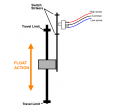
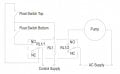
You could go to a simple switch mechanism as shown below.
The float, maybe a bottle with some water in it to weigh it down a bit, and the weight need to be heavy enough to operate the switch.
The float cord passes through a ring on the end of the switch arm and the clamps on the cord set the on and off levels.
I have seen this in use before. The hardest part is making an arm to suit an available switch.
Also ensure end stops are there to prevent the switch getting damaged if someone pulls on the cord.
An added benefit of this is you can see the tank level by the position of the weight.
I'm wondering: Do you want to pump water INTO the tank when it's too low? Or do you want to pump water OUT of the tank when it's too high?
If all you want to do is turn a pump on when the water is too high - that's very easy. Any electronic circuit as you've been shown already can turn the pump on when the water is too high and shut off when the water no longer is too high. But that precludes a low limit. Here's where a float switch would be best suited. An old toilet ball float on a long rod connected to a hinge with a microswitch can turn the pump on when it rises too high. As the water drops there will be some hysteresis to the pump and the motor won't short cycle every 10 seconds.
On the other hand, a low level system detect will require turning the pump on at a certain level and shutting off when it reaches a high limit level. A bit more complex than the toilet float system because the system has to wait till a specific (low) level is reached. Then when the pump has pumped sufficient water into the tank it needs to shut off.
I've seen sump pumps that are meant to drain a pit that consist of a float that rides up and down a rod. When the float goes high enough it flips on a switch and runs the pump. The pump continues running until the float drops low enough that the switch is then pulled off.
You can make your own easy enough using parts you probably have laying around the house. A long steel rod and a float to travel up and down. When the float reaches the bottom of the rod it shuts the pump off. When it rises to the top it turns the pump on. This sort of system can work either way, turning a pump ON when the water is too low and off when it's high enough.
To better understand where you're going with this please define how you want the system to work. Pump on when too high? Or pump on when too low?
I'm wondering: Do you want to pump water INTO the tank when it's too low? Or do you want to pump water OUT of the tank when it's too high?
If all you want to do is turn a pump on when the water is too high - that's very easy. Any electronic circuit as you've been shown already can turn the pump on when the water is too high and shut off when the water no longer is too high. But that precludes a low limit. Here's where a float switch would be best suited. An old toilet ball float on a long rod connected to a hinge with a microswitch can turn the pump on when it rises too high. As the water drops there will be some hysteresis to the pump and the motor won't short cycle every 10 seconds.
On the other hand, a low level system detect will require turning the pump on at a certain level and shutting off when it reaches a high limit level. A bit more complex than the toilet float system because the system has to wait till a specific (low) level is reached. Then when the pump has pumped sufficient water into the tank it needs to shut off.
I've seen sump pumps that are meant to drain a pit that consist of a float that rides up and down a rod. When the float goes high enough it flips on a switch and runs the pump. The pump continues running until the float drops low enough that the switch is then pulled off.
You can make your own easy enough using parts you probably have laying around the house. A long steel rod and a float to travel up and down. When the float reaches the bottom of the rod it shuts the pump off. When it rises to the top it turns the pump on. This sort of system can work either way, turning a pump ON when the water is too low and off when it's high enough.
To better understand where you're going with this please define how you want the system to work. Pump on when too high? Or pump on when too low?
actually want it to pump when too low and to stop when too high...I already implemented a bistable multivibrator(i.e with the circuit diagram i wasgiven. It actually works just fine..new to this circuit and i dont know what the float switch would beswitching..cause thhe circuit already works automatically by itsself..but even with that circuit i cant put those sensors (copper wire) into water..its absolutey not safe..i still wanted to know if the float switch can carry out the operation on its own withottheciCut
I'm wondering why you can't put copper wires into the water. All they do is provide minimal current to the 555 so that it can trigger and shut down the pump. But if you wanted to use a float and switch - yes, you can do that as well. I'll bang out a drawing in a few minutes and post it.
OK, here's ONE solution. Keep in mind that if your switch fails to shut the pump off it will continue to run and over flow the tank. Consider building in some safety backups against over filling the tank.
I'm wondering why you can't put copper wires into the water. All they do is provide minimal current to the 555 so that it can trigger and shut down the pump. But if you wanted to use a float and switch - yes, you can do that as well. I'll bang out a drawing in a few minutes and post it.
OK, here's ONE solution. Keep in mind that if your switch fails to shut the pump off it will continue to run and over flow the tank. Consider building in some safety backups against over filling the tank.
Here in America we have a lot of copper plumbing. Copper kills microbes, so our water gets a little help that way. As for rusting - or tarnishing - it has never been a problem before.
40 meters is a bit far. I really don't know if you will have issues with your system. But I recall you said it works fine. If you mean as a test bench setup - OK. But if you have field tested it and it worked then I don't see any problem. And if you're using 12 volts as a supply for your electronics, I don't think you'll run into too much trouble with the distance, but that's just a hazarded guess. I really can't say for sure. However, using a switch (as in my drawing) to operate a relay, you can have plenty of power (at 12 volts) to drive a relay to actuate the pump.
If you can place the sensor and circuit close by the tank and have the output operate the relay then the power the relay is controlling to run the pump - 40 meters shouldn't present that much concern for line loss. It'll probably work.
Here in America we have a lot of copper plumbing. Copper kills microbes, so our water gets a little help that way. As for rusting - or tarnishing - it has never been a problem before.
40 meters is a bit far. I really don't know if you will have issues with your system. But I recall you said it works fine. If you mean as a test bench setup - OK. But if you have field tested it and it worked then I don't see any problem. And if you're using 12 volts as a supply for your electronics, I don't think you'll run into too much trouble with the distance, but that's just a hazarded guess. I really can't say for sure. However, using a switch (as in my drawing) to operate a relay, you can have plenty of power (at 12 volts) to drive a relay to actuate the pump.
If you can place the sensor and circuit close by the tank and have the output operate the relay then the power the relay is controlling to run the pump - 40 meters shouldn't present that much concern for line loss. It'll probably work.
If you like learning confusion. I'll be glad to help when I can but there are a lot better teachers here than me. I'm OK with basics. But yesterday I spent a couple hours trying to figure out how my math ended up being wrong. I'm not good with decimal figures. But I'll also let you know when I don't have an answer. I won't try to BS you.
If you like learning confusion. I'll be glad to help when I can but there are a lot better teachers here than me. I'm OK with basics. But yesterday I spent a couple hours trying to figure out how my math ended up being wrong. I'm not good with decimal figures. But I'll also let you know when I don't have an answer. I won't try to BS you.
I'm sorry, but there seems to be some disconnect between our world here in the USA, and yours, and I suspect language must be a factor.
If you cannot afford a float switch, I don't know how you can afford a tank, a pump, electricity, a 555, a soldering iron, solder, wire, or water. If you know what a multivibrator is, or a bistable circuit, how can you not realize that copper oxides are good conductors, and those precise characteristics are why copper is the preferred conductive material for the vast majority of electrical devices on this planet?
You can make your own float switch from items we find littering our streets here in the US (and cities in the 4 continents I've been to).
If your sensors are 40m from the circuit, they are not part of your circuit, which may well be one of your problems.
If you have something that works fine, use it. You might tell us what it is, and does, but no need, really.
I'm sorry, but there seems to be some disconnect between our world here in the USA, and yours, and I suspect language must be a factor.
If you cannot afford a float switch, I don't know how you can afford a tank, a pump, electricity, a 555, a soldering iron, solder, wire, or water. If you know what a multivibrator is, or a bistable circuit, how can you not realize that copper oxides are good conductors, and those precise characteristics are why copper is the preferred conductive material for the vast majority of electrical devices on this planet?
You can make your own float switch from items we find littering our streets here in the US (and cities in the 4 continents I've been to).
If your sensors are 40m from the circuit, they are not part of your circuit, which may well be one of your problems.
If you have something that works fine, use it. You might tell us what it is, and does, but no need, really.
It was a missquote when i said I couldnt afford a float switch..they just dont sell in my area...I do know copper wires are good conductors but copper wires also rust when they come in contact with water time to time...
Wow using chips and complex circuits for this is an overkill and compromises its reliability over time. like a few have already noted, just get two float switches and a dpdt relay, extremely reliable and way too easy to make, will only cost you a few dollars too. make two of them, one for a fall in water level to top up automatically and one to drain automatically if level is too high. use one with a solenoid to open up a drainage channel, the other one also with a solenoid that instead opens up a water supply that fills. you can get accuracy of 1cm high and low water level without the float switches fluttering the relays open and closed. Too easy.
This is the drawing. Keep it simple and it will be reliable, this is straight forward, quick to make, very cheap to set up, and uber reliable. The pump turns on when the water reaches top switch, then it will drain until it it reaches the bottom switch. Since the top switch is cutting the circuit, the bottom switch will not constantly fiicker on and off. It will sty off until the water reaches the high switch again. For water to fill instead of drain simply turn the switches upside down.

 Facebook
 Google
 GitHub
 Linkedin