Facebook
 Google
 GitHub
 Linkedin
As Winter approaches, I figured it would be nice to know which way is South -- actually, I wanted a digital compass for my lightning detector project.
I tested three devices: 1) Bosch BMC156; 2) InvenSense MPU-9250; and 3) AsahiKasei AK8963C. Each was controlled with an SPI interface and used the same development board (below).
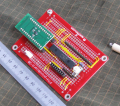
A 4X16 LCD in 8-bit mode was attached to the long header. The pot shown next to the MCU was not needed for that display and was removed. The open socket accepts a backpack switch module.
The board was initially designed for the Bosch device (pictured) and adapter boards to give the same pinout were used for the other devices. The chips are QFN packaged, so I purchased break-out boards for each. Each chip will allow either SPI or I2C communication (see exception for the MPU-9250).
The InvenSense MPU-9250 device is actually two dies in a single package. One chip provides 6-axis inertial data; the other is an AK8963C, 3-axis magnetometer. The SPI interface with the MPU-9250 is a little more complex than for the other devices, as register numbers for the two included chips overlap. One must enter a pass-through mode to get to the AK8963, which is then operated as an I2C accessory device. As best I can tell, it only allows 14-bit operation of the AK8963. Since I was only interested in the magnetometer function at this point, I did not play with the InvenSense chip further.
The Bosch BMC156 also includes 6-axis inertial data and 3-axis magnetometer data plus a Hall resistance value that can be used for temperature correction. X and Y axis's are limited to 13-bit data and have a stated maximum sensitivity of 0.3 uT/LSB . One nice aspect of the chip is the ability to do multiple readings from 1 to 511 with automatic averaging. I settled on 47 reads for each axis. One can also adjust output data rate from 0 Hz to 30 Hz. A rate of 20 Hz is common and worked well. Compared to the AK8963C, the data from the BMC156 seemed less stable. That stability did not improve noticeably by going to 511 reads. The chip tends to go to a power-down mode. With every read cycle, one must wake it up. That is not a problem once you are aware of the need. Overall, it is an easy to use chip, particularly if you need both inertial and magnetic data.
I ended up selecting the AK8963C for my current project. The interface is just as easy as for the BMC156. It offers two sensitivities: 16-bit (0.15 uT/LSB) and 14-bit (0.6 uT/LSB). One can put it in a permanently on mode. It only offers two read frequencies: 8 Hz and 100 Hz. I used 100 Hz and averaged 16 readings at 16-bit resolution. The difference between 8 and 16 readings was imperceptible. I wish I had a standard magnetic source with which to calibrate it, but the observed values seem reasonable based on my location ( http://geomag.usgs.gov/plots/ location key: http://geomag.usgs.gov/monitoring/observatories/ ).
Attached is a video of the AK8963C oriented approximately North. Had to upload it as a zip (sorry).
John
I tested three devices: 1) Bosch BMC156; 2) InvenSense MPU-9250; and 3) AsahiKasei AK8963C. Each was controlled with an SPI interface and used the same development board (below).
A 4X16 LCD in 8-bit mode was attached to the long header. The pot shown next to the MCU was not needed for that display and was removed. The open socket accepts a backpack switch module.
The board was initially designed for the Bosch device (pictured) and adapter boards to give the same pinout were used for the other devices. The chips are QFN packaged, so I purchased break-out boards for each. Each chip will allow either SPI or I2C communication (see exception for the MPU-9250).
The InvenSense MPU-9250 device is actually two dies in a single package. One chip provides 6-axis inertial data; the other is an AK8963C, 3-axis magnetometer. The SPI interface with the MPU-9250 is a little more complex than for the other devices, as register numbers for the two included chips overlap. One must enter a pass-through mode to get to the AK8963, which is then operated as an I2C accessory device. As best I can tell, it only allows 14-bit operation of the AK8963. Since I was only interested in the magnetometer function at this point, I did not play with the InvenSense chip further.
The Bosch BMC156 also includes 6-axis inertial data and 3-axis magnetometer data plus a Hall resistance value that can be used for temperature correction. X and Y axis's are limited to 13-bit data and have a stated maximum sensitivity of 0.3 uT/LSB . One nice aspect of the chip is the ability to do multiple readings from 1 to 511 with automatic averaging. I settled on 47 reads for each axis. One can also adjust output data rate from 0 Hz to 30 Hz. A rate of 20 Hz is common and worked well. Compared to the AK8963C, the data from the BMC156 seemed less stable. That stability did not improve noticeably by going to 511 reads. The chip tends to go to a power-down mode. With every read cycle, one must wake it up. That is not a problem once you are aware of the need. Overall, it is an easy to use chip, particularly if you need both inertial and magnetic data.
I ended up selecting the AK8963C for my current project. The interface is just as easy as for the BMC156. It offers two sensitivities: 16-bit (0.15 uT/LSB) and 14-bit (0.6 uT/LSB). One can put it in a permanently on mode. It only offers two read frequencies: 8 Hz and 100 Hz. I used 100 Hz and averaged 16 readings at 16-bit resolution. The difference between 8 and 16 readings was imperceptible. I wish I had a standard magnetic source with which to calibrate it, but the observed values seem reasonable based on my location ( http://geomag.usgs.gov/plots/ location key: http://geomag.usgs.gov/monitoring/observatories/ ).
Attached is a video of the AK8963C oriented approximately North. Had to upload it as a zip (sorry).
John
Attachments
-
431.8 KB Views: 18