ECG circuit giving bad signals

Thread Starter

Gregori

Joined Apr 16, 2018
17
Greetings,

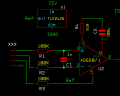
I'm working on an ECG circuit ( schematic below), I replaced the electrodes with pennies and gator clips. I followed the schematics, powered the circuit, then I attempted to test the cicruit response. Whenever I touch the left and right chest electrodes or connect them to different parts of the body together the LED (D8) is always on. I used a soundcard scope (https://www.zeitnitz.eu/scope_en) to see the ECG signal, it gave me a a sawtooth waveform that looks like a one generated from 555 timer mirrored upside down, I tried adjusting RV3 many times and measuring output voltage of the AD620, I end up with with results between 1.5v on minimum RV3 and 4.20v on maximum.

I doubt this circuit needs a dual supply instead of single supply, but i dont know why its not giving a proper response, it should be dynamic since body doesn't have the same potential difference at every two points, but this signal looks static with any input I give.

Thank you.
ECG.JPG
 

danadak

Joined Mar 10, 2018
4,057
The IA and the LM358s are not RRIO, so for starters you have a challenged design
trying to run off LV single supply.

You are DC coupled and that gains up the offsets as well.

You could do temporarily a - 5V supply in order to get an idea of
signal path offsets and wiring.

Regards, Dana.
 

DECELL

Joined Apr 23, 2018
96
Ok.
The ecg signal is in the milvolt range. However, the electrode skin interface will usually act as a basic cell generating a bias voltage of 0.3V DC.
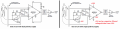
  1. 0.3*AD620Gain. Most likely, your amp is charging from the bias voltage untill the internal protection discharges. So you need to keep the DC gain under 5 (14dB). There are two basic solutions: Keep the front end gain low and ac couple to a high gain stage. Or make the AC gain of the AD620 0dB. Replace RV3 with a 100u capacitor (SMD ceramic, tanalums won't work here)) in series with a 91R resistor. Pre bias the electodes via the leg input from vcc/2. which is also Vref for the AD620. Incidently if you connect your GND to anything referenced to mains earth, your amplifier will not be safe and will probably not work. Eathing your circuit provides a return current path for interfering mains. Note 100k Patient Protection Resistors. You also want to put a 1n cap as shown to keep RFI down.
upload_2018-4-25_14-45-32.png
 
Last edited by a moderator:

Thread Starter

Gregori

Joined Apr 16, 2018
17
The IA and the LM358s are not RRIO, so for starters you have a challenged design
trying to run off LV single supply.

You are DC coupled and that gains up the offsets as well.

You could do temporarily a - 5V supply in order to get an idea of
signal path offsets and wiring.

Regards, Dana.
I'm using AD620
 

Thread Starter

Gregori

Joined Apr 16, 2018
17
sorry i misclicked, im using AD620 instead of INA, I couldn't find it available in my country. I think its RRIO , I tried using it with two batteries and giving LM358 a single supply, im still having the same results
 

Thread Starter

Gregori

Joined Apr 16, 2018
17
Ok.
The ecg signal is in the milvolt range. However, the electrode skin interface will usually act as a basic cell generating a bias voltage of 0.3V DC.
  1. 0.3*AD620Gain. Most likely, your amp is charging from the bias voltage untill the internal protection discharges. So you need to keep the DC gain under 5 (14dB). There are two basic solutions: Keep the front end gain low and ac couple to a high gain stage. Or make the AC gain of the AD620 0dB. Replace RV3 with a 100u capacitor (SMD ceramic, tanalums won't work here)) in series with a 91R resistor. Pre bias the electodes via the leg input from vcc/2. which is also Vref for the AD620. Incidently if you connect your GND to anything referenced to mains earth, your amplifier will not be safe and will probably not work. Eathing your circuit provides a return current path for interfering mains. Note 100k Patient Protection Resistors. You also want to put a 1n cap as shown to keep RFI down.
View attachment 151293
Sorry is there any alternative to the 100 uf capacitor, I cant find a ceramic one available.
for the earthing can i used a diode in the return path direction to protect it ? and how does it damage my AD620
 

Thread Starter

Gregori

Joined Apr 16, 2018
17
I'm surprised that works, since ECG frequencies of interest are < 20Hz and sound cards typically have a frequency response which drops off rapidly below 20Hz.
I'm not 100% sure about the soundcard scope quality but it was the only option i had since i cant afford an oscilloscope.
 

danadak

Joined Mar 10, 2018
4,057
However, the electrode skin interface will usually act as a basic cell generating a bias voltage of 0.3V DC.
Is this a CM voltage ? Because the IA will reject it. If the potential is same both
connections, otherwise the differential will get gained up.

Cable connections shielded, if not same length and layout ? Reason is
cabling could affect ambient CM rejection, like 50/60 Hz, and gain that
up contributing to error. Use Zeitnitz, couple that to both leads and measure
or observe if ambient pickup excessive.

Regards, Dana.
 

Thread Starter

Gregori

Joined Apr 16, 2018
17
Your problem is caused because the AD620 does not have an input DC reference voltage that is usually half the supply voltage with the common mode signal fed to the patient's right leg. Look at ECG on Google and it is like this:
thank you , I'll test it on my circuit, is there other replacement for the AD705 ? anything that would be cheaper ?
 

Audioguru

Joined Dec 20, 2007
11,248
A TL072 and an LM358 are dual opamps. Do you have stereo heartbeats?
Yes, an LM358 is very noisy. A TL071 or TL072 has a problem if its input voltage gets within a few volts from the negative supply or ground. Use an OPA134 single opamp or OPA2134 dual opamp instead.instead
 
Last edited:

Thread Starter

Gregori

Joined Apr 16, 2018
17
Is this a CM voltage ? Because the IA will reject it. If the potential is same both
connections, otherwise the differential will get gained up.

Cable connections shielded, if not same length and layout ? Reason is
cabling could affect ambient CM rejection, like 50/60 Hz, and gain that
up contributing to error. Use Zeitnitz, couple that to both leads and measure
or observe if ambient pickup excessive.

Regards, Dana.
A TL072 and an LM358 are dual opamps. Do you have stereo heartbeats?
Yes, an LM358 is very noisy. A TL071 or TL072 has a problem if its input voltage gets within a few volts from the negative supply or ground. Use an OPA134 single opamp or OPA2134 dual opamp instead.instead
Ok.
The ecg signal is in the milvolt range. However, the electrode skin interface will usually act as a basic cell generating a bias voltage of 0.3V DC.
  1. 0.3*AD620Gain. Most likely, your amp is charging from the bias voltage untill the internal protection discharges. So you need to keep the DC gain under 5 (14dB). There are two basic solutions: Keep the front end gain low and ac couple to a high gain stage. Or make the AC gain of the AD620 0dB. Replace RV3 with a 100u capacitor (SMD ceramic, tanalums won't work here)) in series with a 91R resistor. Pre bias the electodes via the leg input from vcc/2. which is also Vref for the AD620. Incidently if you connect your GND to anything referenced to mains earth, your amplifier will not be safe and will probably not work. Eathing your circuit provides a return current path for interfering mains. Note 100k Patient Protection Resistors. You also want to put a 1n cap as shown to keep RFI down.
View attachment 151293
Sorry for the late reply everyone, and thank you so much for your help, I can't thank you enough.
I figured out the problem of the bad signals that it was caused by AC frequency noise and un-shielded cables, so I added a notch fitler to the circuit and used shielded coax cables for the electrodes, the signal looks visible i could distinguish QRS complex and other intervals but it still contains a lot of noise noise, i'll consider making it on PCB and using isolated wires. However i still have a small problem, i couldn't find an OPA134 or OPA2134 in my country to replace AD705 in order to make a leg drive circuit. Can i use another AD620 instead ?
 
Top