Early effect - BJT comm emitt amp

Thread Starter

s34n

Joined Jan 1, 2024
20
This has probably been asked a bunch of times, sorry.

Been reading Learning the AOE (page 230).

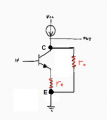
Introduces how Early effect limits gain on the common-emmiter amplifier. Mentions that the collector resistor (Rc) and the equivalent resistor for Early effect (ro) should be taken as parrellel for calculating gain.
G = ro/re, when using a current source in place of a collector resistor, and (re) being the transistors emitter resistance.

Just wondering how to visualise the path of the Early effect resistor?
canvas.png

Cheers
 

WBahn

Joined Mar 31, 2012
32,707
You need to start with the realization that the output resistance and emitter resistance of the transistor are small-signal parameters and that small-signal analysis is the application of superposition to a circuit. So you need do the analysis with any sources that were 'on' during the DC analysis turned 'off' (i.e., set to zero output) in the small-signal analysis.
 

Thread Starter

s34n

Joined Jan 1, 2024
20
Thanks WBahn.

Sorry I could have written that alot better.

I guess I was not really looking at it in a small signal analysis way, or trying to make any useful calculations.
More just to get a sort of intuition of what is happening with the circuit as it is, without creating a model equivalent circuit.
Just to make sure I'm picturing this correctly.

Is the equivalent resistor for the Early effect, basically pulling the output signal closer to the emitters level by reducing the impedance through the collector-to-emitter of the transistor?

The parrelleling of the collector resistor with the Early effect resistor. I'm picturing more of a divider, or even a parelleling of the transistor and Early effect creating a divider with a collector resistor. If using a resistor instead of a current source.

Cheers
 

WBahn

Joined Mar 31, 2012
32,707
The output resistor is in parallel with the collector resistors. Parallel resistors do not make a voltage divider, they make a current divider.
 

Thread Starter

s34n

Joined Jan 1, 2024
20
Looking at the small signal models that include the Early effect. Yer, I can see the parrellel path through the Early and collector resistors that feed the transistor.

I think my other crazy thoughts are going to be hard to translate into written form, so I'll leave it.

Thank you for your help WBahn.

Cheers
 

LvW

Joined Jun 13, 2013
1,998
This has probably been asked a bunch of times, sorry.

Been reading Learning the AOE (page 230).

Introduces how Early effect limits gain on the common-emmiter amplifier. Mentions that the collector resistor (Rc) and the equivalent resistor for Early effect (ro) should be taken as parrellel for calculating gain.
G = ro/re, when using a current source in place of a collector resistor, and (re) being the transistors emitter resistance.

Just wondering how to visualise the path of the Early effect resistor?
View attachment 311450

Cheers
May I point to the fact that it is not correct to use the commonly greed transistor symbol together with an equivalent small-signal quantity (re) in one common diagram? By evaluating the above circuitry you would consider the transconductance twice (as a transistor parameter gm as well as an external quantity re=1/gm).
The small-signal resistive symbol re must appear in an equivalent diagram for the whole transistor only (together with a current source model).
I think this is the rerason for your problem to consider the Early effect (ro) in the right way.
 

Thread Starter

s34n

Joined Jan 1, 2024
20
Thanks LvW.

I wasnt really looking at it in the small signal analysis form.
I was thinking more in my own crazy thought process kind of way.

Cheers
 

Jony130

Joined Feb 17, 2009
5,593
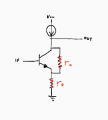
Just wondering how to visualise the path of the Early effect resistor?
You got it almost right. Here you have the corrected version:

canvas.png

And you are right the gain will be equal to:
Av = ro/re or to be exact Av = - ro/re * β/(β + 1)
 

LvW

Joined Jun 13, 2013
1,998
You got it almost right. Here you have the corrected version:

View attachment 311524

And you are right the gain will be equal to:
Av = ro/re or to be exact Av = - ro/re * β/(β + 1)
Hi Joni - didn`t you read my post #6 ?
The quantity re=1/gm is a small-signal parameter and must not be used together with the commonly used transistor symbol.
This part (re) appears in the small-signal diagram only: it is inherently contained already in the shown symbol. The transistor symbol must be replaced by a controlled current source .
 
Top