Drive current for led 0 to 100%

Thread Starter

Vindhyachal Takniki

Joined Nov 3, 2014
598
1. Need to drive a single white led, part no: 2ES103CW06000001 , datasheet: http://www.edison-opto.com/en/product/es_s_white_series

Datasheet says it has Vf=3.4V & If=700mA, Peak pulse current: 1A

Intensity needs to be varied from 0 to 100%.


2. Want to know, suppose I want to glow led at 100%, should I give maxium 3.4V/700mA or I can increase voltage or current further for high intensity? If yes, how to calcualte maximum recommended values for safe operation
 

DickCappels

Joined Aug 21, 2008
10,661
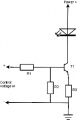
Ignore the voltage rating. The maximum luminance occurs at 100% of the rated current. The pulse current is usually for low duty cycle application such as remote control transmitters and incidental surges.

upload_2019-6-2_16-45-57.png
 

Sensacell

Joined Jun 19, 2012
3,784
LED's are current driven devices, they dictate their own voltage, YOU control the current.

As stated above, use PWM to control the brightness, trying to use current control will be more difficult.
 

Tonyr1084

Joined Sep 24, 2015
9,744
LED's (as has been said) are current dependent devices. The manufacturer lists the forward voltage (Vf) for a reason. You need to know that information before you can design a circuit for it. Here's how that works: You decide on what voltage you're going to be working with. Has to be higher than the Vf. Suppose you're using an application in a steady supply voltage. Suppose that voltage is 24 volts. You subtract Vf from the supply voltage ( 24 - 3.4 = 20.6). Working with the 20.6, next you want 700 mA. You divide 20.6 by 0.7 and you end up with a value for the resistance needed to achieve that circuit. (20.6 ÷ 0.7 = 29.43Ω) The closest best resistor would be a 30 ohm resistor. That will give you nearly full (100%) brightness. And the difference between the brightness you get at nearly full and full - your eye can't perceive the difference.

But there's one more step to be considered - the resistors wattage needed. For that you multiply 20.6 x 0.7 and you get (I'm getting) 14.42 watts. (that seems high to me - I must have done something wrong) Anyway, if that's right you need at least a 15 watt resistor. However, it's recommended you exceed the wattage rating by at least 1 1/2 times. Common rule is 2 times. The 1 1/2 rule dictates a 21.63 watt resistor. They don't make them like that. They come in standard wattages. I'd consider a 20 watt resistor to be sufficient. However, the next higher wattage is either 25 or 30 watts. At the 2X times rule, you'd go with a 30 watt resistor. The one disadvantage of going with that high a wattage rating is space. If space is not a concern then going with the higher value will cause no harm. Just consider ventilation with that high wattage. If you enclose it in a box then the heat will build and not be able to dissipate.

It was mentioned using PWM. This is the preferred method because with PWM power flows when it flows and is off when it is off. You'll still need a resistor that can handle full brightness, but when you dim the LED you will drastically reduce the amount of wasted heat. If you know what PWM is then I don't need to explain it. But if you're not totally familiar with it - PWM stands for Pulse Width Modulation. That means it's pulsing rapidly. Anywhere from 1K Hz to (I think) 20 KHz. The "Width" of the pulse (not the frequency) is varied between 0 and 100%. Or very nearly 0 and 100. The time the pulse spends "ON" versus the time it spends "OFF" dictates the average current and results in the dimming effect you're looking for.

I find it interesting, I've not seen an LED at 3.4 Vf with 700 mA capability. I'm not saying they don't exist - I'm saying I've never seen one. But then again I spend a lot of time in the garage building cabinets and doing other dumb stuff.
 

ebeowulf17

Joined Aug 12, 2014
3,307
But there's one more step to be considered - the resistors wattage needed. For that you multiply 20.6 x 0.7 and you get (I'm getting) 14.42 watts. (that seems high to me - I must have done something wrong)
I haven't checked the exact numbers, but I think you got the math right. The issue here is that for typical indicator LEDs, you're running at very low currents, typically 20mA or less, and so the wattage requirements on the resistor stay reasonably low even with high supply voltages - the same 24V supply and 20.6V drop across the resistor would be around 0.41W at 20mA current. When you enter the realm of lighting LEDs running at much higher currents, the intrinsic inefficiency in the system becomes a problem very quickly. The solutions are either:
1) use a supply voltage and a number of LEDs that more closely match each other, like a 4-5V supply for a single 3.4V LED or matching a 24V supply with a series string of 6 such LEDs. Then the voltage drop across the resistor is more reasonable and the wattage drops accordingly, although even then it's hard to find perfect matches.

2) The more common solution at these LED power levels is a dedicated current source based on switch mode (SMPS) technology. This is much, much more efficient, but very difficult to build yourself.

I find it interesting, I've not seen an LED at 3.4 Vf with 700 mA capability. I'm not saying they don't exist - I'm saying I've never seen one.
As hinted at above, this is the difference between indicator LEDs and LEDs used for lighting things. If you look at white LED light bulbs for home or automotive lighting, the stated specs are pretty common.
 

Tonyr1084

Joined Sep 24, 2015
9,744
@ebeowulf17 Thanks for the confirmation. Yeah, 20 mA is far more reasonable than 700 mA for what I'm used to playing with. And as reference only, I chose 24 volts, chosen arbitrarily just to make the point of how to calculate current for LED's. 700 mA is 35 times higher than 20 mA.
 

MisterBill2

Joined Jan 23, 2018
27,504
There are indeed some very high powered LEDs, and for those 700mAis reasonable. BUT there is the fact that the high power devices need a great deal of heat removed, or the lifetime is just a few seconds. Also, by the way, those high power devices cost a lot more. Quite a few dollars each. Thus it is important to read and understand the specifications prior to applying power. The only thing that the high power LEDs have in common with the 20mA ones is that you do need to obey ALL of those Max limits.
 
Top