double supermesh problem

Thread Starter

hunterage2000

Joined May 2, 2010
487
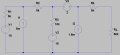
Im having problems figuring out the equations for the attached supermesh problem I've not seen many examples of these type of problems so not sure what I'm doing.

What I tried to do was:

supermesh 1

(R1+R2+R3)m1 - R3m3 = Vs1 - Vs2 - R2Is1 - R3Is1

supermesh 2

R3m2 + (R3+R4+R5)m3 = Vs2 + Vs3 + R4Is2 + R5Is2

Can someone tell me whats wrong?
 

Attachments

kira12a8

Joined Dec 31, 2010
2
With mess current method, you can ONLY use it with independant loops, you can't use it with loops that contain another loop inside it. Wish you good luck man :D
 

t_n_k

Joined Mar 6, 2009
5,455
I've attached a solution using mesh analysis. There are many ways to do this. I haven't specifically used a supernode technique.
 

Attachments

The Electrician

Joined Oct 9, 2007
2,986
Using the designations for the mesh currents and the node voltages given by t_n_k in his attachment, we can set up a matrix formulation for the problem. There are two supermeshes, a left one and a right one. With currents in mA and resistances in k ohms, we have:

\(\left[ \begin{array}{4}-1 & 1 & 0 & 0 \\5 & 15 & -10 & 0 \\0 & 0 & -1 & 1 \\0 & -10 & 10 & 55 \end{array}\right]\left[ \begin{array}{1}I_A\\I_B\\I_C\\I_D \end{array}\right]=\left[ \begin{array}{1}5\\-5\\\frac{16}{10}\\17\end{array}\right]\)

Rows 1 and 3 are the constraint equations, and rows 2 and 4 are the supermesh equations.

Solving gives:

\(I_A = \frac{-541}{120}\)
\(I_B = \frac{59}{120}\)
\(I_C = \frac{-61}{60}\)
\(I_D = \frac{7}{12}\)

You get all 4 mesh currents at once.
 

hgmjr

Joined Jan 28, 2005
9,027
Using Millman's Theorem allows one to form the formula for the voltage across RL by inspection.

\(V_{R_L} =\ \left{ \left[ \Large \frac{\frac{(V_1+R_1I_1)}{R_1+R_2}\ +\ \frac{V_2}{R_3}\ +\ \frac{(I_2(R_4+R_L)\ -\ V_3)}{(R_4+R_L)}}{\frac{1}{R_1+R_2}\ +\ \frac{1}{R_3}\ +\ \frac{1}{R_4+R_L}}\right]\ +\ V_3\ \right}\ \Large *\ \frac{R_L}{(R_4+R_L)}\)

I plugged in the circuit values and I came up with the same value for the voltage across RL as t_n_k.

hgmjr
 
Top