Double pole double throw relay

Thread Starter

Tryin2learn

Joined Nov 11, 2016
102
Hiya four someone please help me I am putting a actuator into my extractor fan to operate a backflap to keep draughts out when it is switched off .
What I need help with is I have a dpdt relay with eight terminals could you please list 1 to 8 what the terminals are so I can connect it up to my extractor and the actuator thanks Keith
 

jpanhalt

Joined Jan 18, 2008
11,087
There are two set of 3 contacts each. Therefore, 8 terminals = 2 for power plus 2x 3 for contacts.

Datasheet or an ohm meter will tell you which contacts are which. There are relatively standard configurations, but without knowing more about your relay, I am hesitant to say the exact configuration.

John
 

Thread Starter

Tryin2learn

Joined Nov 11, 2016
102
There are two set of 3 contacts each. Therefore, 8 terminals = 2 for power plus 2x 3 for contacts.

Datasheet or an ohm meter will tell you which contacts are which. There are relatively standard configurations, but without knowing more about your relay, I am hesitant to say the exact configuration.

John
There are two set of 3 contacts each. Therefore, 8 terminals = 2 for power plus 2x 3 for contacts.

Datasheet or an ohm meter will tell you which contacts are which. There are relatively standard configurations, but without knowing more about your relay, I am hesitant to say the exact configuration.

John
 

Thread Starter

Tryin2learn

Joined Nov 11, 2016
102
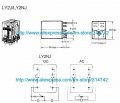
Hi'ya the relay is a ONROM. LY2N-J .I need to know which terminals are for the power which are the ones for the extractor switch and which ones I will use for the actuator thanks Keith
 

Thread Starter

Tryin2learn

Joined Nov 11, 2016
102
Thanks but I am a novice in electronics hence all the questions could you please give me more detail . what are the power in connection's neutral and live which terminals go to the manual switch on the extractor then what terminals power the appliance in this case a actuator all your help is much needed and appreciated thank's again Keith.
 

MaxHeadRoom

Joined Jul 18, 2013
30,557
That relay has a DC coil, did you want to do it all at the AC power level? Or otherwise you will need a DC supply.
Is there 24vdc control at the moment?
Max.
 
Last edited:

Thread Starter

Tryin2learn

Joined Nov 11, 2016
102
That relay has a DC coil, did you want to do it all at the AC power level? Or otherwise you will need a DC supply.
Is there 24vdc control box at the moment
Max.
Hiya max well the extractor is ac so the plan was to power the fan with ac and fit the relay to lift the backflap up and down with a 24 vdc actuator. I was going to get a dropper box to get the ac down to 24 vdc for the actuator . Keith
 

Dodgydave

Joined Jun 22, 2012
11,395
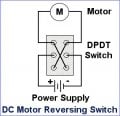
So ideally you need a 110/230Vac relay coil, that can be wired across the fan power terminals, then wire the actuator to the wipers, and cross the 24dc supply to the NO and NC terminals.

DC-motor-reversing-switch-schematic-wiring-diagram-285x275.jpg
 

Thread Starter

Tryin2learn

Joined Nov 11, 2016
102
So ideally you need a 110/230Vac relay coil, that can be wired across the fan power terminals, then wire the actuator to the wipers, and cross the 24dc supply to the NO and NC terminals.

View attachment 115467
Hiya so the relay I have is no good ?? I am more confused now if I wire the relay direct to the fan terminals that's OK got that ..Where do I put the dropper box ?? Can I also wire that to the fan power terminals . In the diagram it says dpdt switch ?? Hope you can help thanks Keith
 

Dodgydave

Joined Jun 22, 2012
11,395
The relay is fine, we need to know what voltage your fan and actuator are, if your fan is 230v ac, then i would use a 230vac coil relay?
 

Thread Starter

Tryin2learn

Joined Nov 11, 2016
102
The relay is fine, we need to know what voltage your fan and actuator are, if your fan is 230v ac, then i would use a 230vac coil relay?
Hiya the fan is UK mains voltage 220- 240 AC .The actuator I have not bought yet but going by the info on here my relay is mains and 24 v DC which is what I wanted 24 v to power a actuator .so if I connect the relay to the fan that powers the relay then use a dropper box to supply the relay with 24 v DC and run the 24v DC to the actuator is that OK .what I need to know is what connections on the relay go to the fan .Then how do I find out what terminals on the relay are n/o and which are n/c
 

Dodgydave

Joined Jun 22, 2012
11,395
Hi, yes you can use the same 24v psu to feed the relay coil, your actuator needs to be fed through the NO( normally open pin3) contact and its wiper pin5, so that when the relay activates, it puts 24v dc to your actuator, then when you turn the fan off, the relay will drop out, and disconnect the 24v to the actuator.
 

MaxHeadRoom

Joined Jul 18, 2013
30,557
If the actuator is simple in construction, (no electronics etc) you should only need a small 230v/24v control transformer and a small bridge rectifier for power.
Here in N.A. a national hardware store sells this type of transformer.
Max.
 

Thread Starter

Tryin2learn

Joined Nov 11, 2016
102
Hi, yes you can use the same 24v psu to feed the relay coil, your actuator needs to be fed through the NO( normally open pin3) contact and its wiper pin5, so that when the relay activates, it puts 24v dc to your actuator, then when you turn the fan off, the relay will drop out, and disconnect the 24v to the actuator.
I thought you had to apply current to raise the actuator and vise versa to lower it that is why I bought a dpdt relay .
 

Thread Starter

Tryin2learn

Joined Nov 11, 2016
102
If the actuator is simple in construction, (no electronics etc) you should only need a small 230v/24v control transformer and a small bridge rectifier for power.
Here in N.A. a national hardware store sells this type of transformer.
Max.
Hiya I understand about the transformer 240 AC down to 24 v dc but why do I need a bridge rectifier ??. Thanks Keith
 

Dodgydave

Joined Jun 22, 2012
11,395
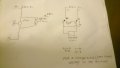
I presume the actuator needs a dc supply to open and close it, if so this diagram will do for a 230V AC coil...

DSC_0244.JPG


otherwise we need to know how the actuator works.
 
Top