Facebook
 Google
 GitHub
 Linkedin
Hi Tony,
Glad the dog problem has been solved. You raise a question in post #117 for which there is an answer.
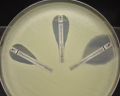
The clear zone is considered "inhibition." One may or may not be able to recover viable organisms from within that zone. Tests for killing are usually done in samples of broth medium containing increasing dilutions of the antimicrobial. Starting with an innoculum of, say 10^5 organisms per ml and incubation for a prescribed period (usually 18 to 24 hours for common bacteria), one subcultures the media that remain clear (i.e., show inhibition). If the test is done using 100-ul cultures (e.g., in a Microtiter plate), then the most you can subculture is 100 ul = 10^4 original organisms. More typically, one subcultures 10 ul = 10^3 original organisms.* Obviously, statistics of sampling and counting come into play to set a confidence interval. The common term is a "three-log decrease," which equals 0.001 of the original innoculum (e.g., 0.001 x 10^3 =1). Thus, for samples with no growth on subculture, the term 99.9% killing has been widely accepted as meaning microbiocidal at that concentration.
It is not an effort to obscure the result. It is simply a reflection of the limits of the test.
John
*That protocol was developed years ago. One confounder to consider is the need for an adequate dilution to mitigate against carryover of the antimicrobial. For example, if one subcultured 0.1 ml to just 0.1 ml of broth (1:2 dilution) there would likely be enough antibiotic carried over to affect growth. On the other hand, too high a dilution of an inoculum can result in failed growth too. It is a compromise. Tests for true sterility (e.g., tests on fluids intended intravenous use) are more complex.
Glad the dog problem has been solved. You raise a question in post #117 for which there is an answer.
In standard microbiological testing, it is customary to distinguish between an antimicrobial that inhibits and one that kills. Inhibition simply inhibits growth. You may have seen a "disk diffusion" test. Here is one variant:"Product X kills 99.9 percent of germs." Why only 99.9 % ? ? ?
The clear zone is considered "inhibition." One may or may not be able to recover viable organisms from within that zone. Tests for killing are usually done in samples of broth medium containing increasing dilutions of the antimicrobial. Starting with an innoculum of, say 10^5 organisms per ml and incubation for a prescribed period (usually 18 to 24 hours for common bacteria), one subcultures the media that remain clear (i.e., show inhibition). If the test is done using 100-ul cultures (e.g., in a Microtiter plate), then the most you can subculture is 100 ul = 10^4 original organisms. More typically, one subcultures 10 ul = 10^3 original organisms.* Obviously, statistics of sampling and counting come into play to set a confidence interval. The common term is a "three-log decrease," which equals 0.001 of the original innoculum (e.g., 0.001 x 10^3 =1). Thus, for samples with no growth on subculture, the term 99.9% killing has been widely accepted as meaning microbiocidal at that concentration.
It is not an effort to obscure the result. It is simply a reflection of the limits of the test.
John
*That protocol was developed years ago. One confounder to consider is the need for an adequate dilution to mitigate against carryover of the antimicrobial. For example, if one subcultured 0.1 ml to just 0.1 ml of broth (1:2 dilution) there would likely be enough antibiotic carried over to affect growth. On the other hand, too high a dilution of an inoculum can result in failed growth too. It is a compromise. Tests for true sterility (e.g., tests on fluids intended intravenous use) are more complex.
Last edited: