Dog barking / Sonic barking deterrent device

Bernard

Joined Aug 7, 2008
5,784
I read somewhere that a 9 V rechargeable battery is really 7.5 V, composed if 6 AAAA cells, but the flatter discharge of NiCd or NiMH compensated for the V dif.
Would it be possible to use a different battery, say 8 X AAA or AA giving about 10 V ? A solar panel with open circuit V of about 16 to 20 V @ 100 mA would be about right.
 

Thread Starter

Tonyr1084

Joined Sep 24, 2015
9,744
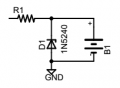
I am much less familiar with Zener's than regulators. Would you explain how a Zener works? If I'm right, a 10 v Zener would not conduct to ground until voltage rose above 10 volts, wasting (from an 18 volt solar panel 5 watt), 8 volts. Wouldn't that produce a lot of heat?

School me. Please.
 

atferrari

Joined Jan 6, 2004
5,015
Looking like I lost control of this thread.
I do not think so.:)

Other than asking a moderador to close it, I doubt you could do much more than sticking to the subject. But, honestly, in cases like this, I prefer to consider the thread as a conversation. ;) In a group of many there is always people chatting on non related matters. Do not take them/you, too seriously. Netiquette et al, life is too short. :(
 

ian field

Joined Oct 27, 2012
6,536
The bark-off device is intended to be used in short-timed bursts. Keeping it constantly on may cause it to overheat and prematurely fail. Consider using a sound trigger or a motion trigger to turn the bark-off on for a short period of time (use a 555 timer).

BTW, what is your electronics skill level?
Most car alarms are loosely based on SMPSU methods (basically a crude class-D design), using that on the end would give *REAL* power - but the TS would probably have to revise the plans for a power source.....................

An alternative is the CO2 alarm method - a flyback driver with auto-transformer and piezo sounder.

The sounder disks get smaller above the audible range which limits the power. Some tweeter drives go high enough - and you can give it beanz.

Sounder disks are resonant at a specific frequency - a tweeter drive probably means you have to do all the tuning in the amplifier.
 

dl324

Joined Mar 30, 2015
18,360
I am much less familiar with Zener's than regulators. Would you explain how a Zener works? If I'm right, a 10 v Zener would not conduct to ground until voltage rose above 10 volts, wasting (from an 18 volt solar panel 5 watt), 8 volts. Wouldn't that produce a lot of heat?
It doesn't matter what you use to reduce the voltage from the solar panel; voltage regulator, series diode/resistor, zener regulator. That power will be wasted and it will generate heat.

Your understanding is correct. The zener won't conduct until, in this case, around 10V.
upload_2017-3-14_11-59-25.png

If you wanted to avoid power loss in the series resistor, you could use a TVS diode instead. The closest to your needs is a 9V which has a minimum breakdown voltage of 10.0V and a max of 11.1V (which could be problematic with no resistor).
 

Thread Starter

Tonyr1084

Joined Sep 24, 2015
9,744
For those who've lost sight of where I'm going with this, it's my plan to use an 18 volt solar panel to drive a 9 volt sonic dog barking arrester (SDBA). Of course 18 volts is too much, but during the day there will be plenty of power to run the unit. The sun angle can change and the voltage output of the PVP can drop. But as long as my SDBA is powered during the day time the dogs will hear the deterring chirp of the device. At night when you actually want a dog to alert you to the presence of danger, I'd rather not stop them barking. Usually they don't bark much at night anyway. So it's better to let them bark at night but stop the annoying droaning on of them barking at every leaf that passes by - or when they just sit bored at the fence and bark at each other for no other reason than to exercise their vocal cords.

SO: Problem: Dog barking during the day.
DESIRED RESULT: Dogs deterred from barking during the day time.
SOLUTION: Sonic Dog Barking Arrester (SDBA) powered by solar power. Varying voltage regulated to maintain operation during the day and silenced at night.

Proposed solutions: Use a Zener. I'm not familiar with how to use them. My SDBA doesn't use much power. Typically it will run about 10 days, depending on the level of noise it detects and responds. It's responding current - I don't know what that is. I suppose I could test that on the bench, but it's not likely going to be very much. The PVP (Photo Voltaic Panel) produces 18 volts (peak) at 5 watts. That's 278 mA. Likely more than enough to power the SDBA.

Thought of using a variable buck converter to maintain 9 VDC during the day. As the sunsets output from the PVP drops and the buck keeps the voltage steady until there's insufficient voltage being provided by the buck converter. ORIGINALLY I thought about a rechargeable battery and a photo resistor to control when the unit is powered. But that's more materials. The buck converter solves the problem. Still, I'd like to learn more about using Zener's and what factors need to be considered along with how the changes affect the output voltage feeding the SDBA.

Sounds complex but it's not. I just want the damned dogs to shut up during the day. I don't much care at night. And if a nuisance dog is barking at night - I'll call the police and let them deal with it.
 

Kjeldgaard

Joined Apr 7, 2016
476
With 5 Watt solar panel and a consumption of a few milliwatts, then shunt regulation with a zener diode is not practical or energy efficient - the zener diode must Shunts all "4.95" Watt excess power.

So it's a series regulator, either LM78L09, a slightly more efficient newer type voltage regulator, or nearly as effective discrete build with a low power zener diode, low power transistor, a resistor and a pair of capacitors.
 

ian field

Joined Oct 27, 2012
6,536
With 5 Watt solar panel and a consumption of a few milliwatts, then shunt regulation with a zener diode is not practical or energy efficient - the zener diode must Shunts all "4.95" Watt excess power.

So it's a series regulator, either LM78L09, a slightly more efficient newer type voltage regulator, or nearly as effective discrete build with a low power zener diode, low power transistor, a resistor and a pair of capacitors.
A word of caution with the 78xx regulators - any reverse current is instant death. With no sunlight the battery will hold the output higher than the input.

Normal practice with the regulators is to strap a reverse flow bypass diode from output to input. The simplest arrangement of solar charging a battery requires a series feed diode so current can flow from the panel into the battery - but not back the other way.

The regulator protection diode will put the battery voltage less Vf on the input, so the panel backflow diode is still required.

You can dispense with the regulator protection diode if you trust the panel backflow diode to have low leakage.
 

AnalogKid

Joined Aug 1, 2013
12,156
Late to the party, some thoughts:

A buck-boost regulator (from ebay) will take a voltage either above or below the output setpoint and make it the desired output voltage. So a 12 V panel can drive a 9 V charger circuit throughout the day. Next, a comparator to disconnect the panel from the regulator input when the panel voltage is so low that the converter will start to look like a short. Then a charger, maybe something relatively simple for a 9 V nicad or small SLA, like a couple of comparators switching in small and large current limiting resistors based on the battery terminal voltage. So, ebay buck-boost, one LM339 quad comparator doing the housekeeping, one or two small transistors. Or something like that.

ak
 

Thread Starter

Tonyr1084

Joined Sep 24, 2015
9,744
A word of caution with the 78xx regulators - any reverse current is instant death. With no sunlight the battery will hold the output higher than the input.
Using solar battery to power system. No battery installed. No battery to charge. When the sun shines the SDBA will be on. When sun sets - unit shut down. No back flow.

Don't make it to hard. It's open loop charging of a NiCd battery - kind of like a power tool. So use a panel of the right voltage and power.
http://www.ebay.com/itm/Radioshack-...780046?hash=item1a21890ece:g:CX0AAOSwHgVW7dBl
Missing the point: Sun down - unit off. No battery.

Next, a comparator to disconnect the panel from the regulator input when the panel voltage is so low that the converter will start to look like a short.
This may be pertinent. The buck I'm getting from Amazon is https://www.amazon.com/dp/B01ECB4TP4/ref=nav_timeline_asin?_encoding=UTF8&psc=1 By the time the panel voltage (18 volt peak) should be so low that I don't need to worry about dead shorting it at 4 volts. I'm open to correction on my thinking. If I'm wrong - point me in the right direction. If necessary I'll build a comparator circuit to cut power from the panel when voltage drops too low. I'm as inexperienced with bucks as I am with zener's. All help is greatly appreciated AND greatly needed.
 

ronv

Joined Nov 12, 2008
3,770
Someone recommended a 10 V Zener. Do you concur? What wattage? Should there be a resistor between the panel and the zener?
Yes, 10 volt zener rated higher than the solar panel output. I think I would look for a 2 or 3 watt panel one at 9 volts. 9 volts is just the maximum power point the voltage will be higher at low or no load. Then you could use a readily available 5 watt zener. No resistor should be required. I would then add the largest Electrolytic cap you can find rated at 12 volts or more. A quick look came back with 33000 ufd. This will act as a small battery so your device may still "chirp" on a cloudy day.
 
Top