Direction of current flow

wayneh

Joined Sep 9, 2010
18,110
Engineers and Physicists write the First Law as dU = q-w, whilst Chemists write it as dU=q+w
Chemical engineers are screwed. I don't recall which convention I follow (pretty sure it's the latter). I'm doomed to think about what I'm doing and keep it straight, convention be damned.
 

WBahn

Joined Mar 31, 2012
32,883
I have been following this esoteric "discussion" with some confusion and still in a confused state I note studiot's assertion in his/her post that current direction in his/her little circuit is in one direction in RC and reversed in Ra Rb. I fail to see how this could be as from my meager years of electrical/electronic experience the current should be the same direction in all resistors. Where does it suddenly change direction?
WBahn, I note your little capacitor charging circuit and that confuses me also. My years long convention of current flow would have the current flowing in the opposite direction. I don't want to get in between your in depth discussion with studiot but I would like to know where/if I have gone wrong all these years.

I'll let studiot address the uncertainty with his post.

For mine, you can assign the symbolic current direction however you choose. If the numerical current comes out to be negative, then the actual current is flowing in the opposite direction.

Remember that I am using examples specifically from the "electron current" viewpoint, which means that positive current is current flowing in the direction that electrons flow. So from this convention, the "current" I would be positive because, in that circuit, electrons are flowing in the direction indicated by the symbolic current. The whole crux of things is that while that is the direction that the charge carriers (the electrons) actually flow in, it is not the direction that charge flows in because electrons are negatively charged (even in the "electron current" world). Thus, in order to get correct answers to certain questions, such as how much charge is on a particular plate of the capacitor, you either have to use different formulas (namely Q=-I·t) or you do what the electron current crowd usually does is that you use the same formulas, namely Q=I·t, but you somehow magically multiply a positive current and a positive time and end up with a negative charge. This happens because, usually, the electron current guy will only care about the magnitude of the charge and will assign the sign based on what they know the answer must be.
 

WBahn

Joined Mar 31, 2012
32,883
Re post 112 I note the polarity of the supply is fixed by the battery terminals. ( my convention, long dash is positive) no need to guess. Most circuit analysis does not have to guess what supply polarity is(in my humble experience)
That's correct, the symbol for a battery cell is a long line and a short line with the long line being positive voltage relative to the short line. That's very long established and agreed upon symbology.
 

profbuxton

Joined Feb 21, 2014
421
WBahn, so you say that you may have assigned symbolic current direction in your charging circuit arbitrarily and that depending on the numerical current value sign the current may actually be in the other direction. I do not understand how that would relate to the polarity of the supply(battery) in that case. Surely you have to take into account the polarity of the supply.
From my humble experience with circuitry, if I wish to measure this current I would connect an ammeter such that the positive terminal was connected to the positive of the supply and the negative terminal to the positive(assuming polarized) terminal of the capacitor. This would give me an upscale reading(till charged) indicating a current flow from positive supply to positive capacitor. Conventional current flow.
I realise that actual electron flow is not in this direction but theoretically the reverse. I must bow to your greater wisdom regarding the issue of charge flow in this regard as I do not follow your reference to electrons as charge carriers but charge actually flowing in the reverse direction in your example.
 

MrAl

Joined Jun 17, 2014
13,711
Hello again,

I think that the discussion has boiled down to making a distinction between theory and practice. We use theory as a measuring tool but the application of that theory depends on the experience of the individual. For me i think that Q=I*t is adequate because if we make I negative then we make Q negative too. And we cant distinguish between a positive charge moving to the right and a negative charge moving to the left when we measure current.

But anyway, another interesting issue regarding current and voltage is the discussion about what comes first, voltage or current?
In a purely resistive circuit, we apply a voltage, then assume that sometime later, no matter how short a time, a current appears. So in other words, we connect a battery FIRST and then perhaps a very very very short time later a current appears. This means it appear that there is some sequence to the actions, first the voltage, then the current, and it cant be the other way around. Apply 1v and later we see a charge move.

Although that appeals to the common sense i think this is because we normally think of things in succession, and maybe assume that there is some tiny capacitance, and that is reasonable. But with s circuit that contains only resistance, is this still true, that there is some tiny tiny delay?
More to the point, what is the delay between the time the voltage is first applied (assumed to be applied in a perfectly instantaneous manner) and the force on the first charge occurs?
After that if you care to, how long after that does the charge actually start to move?
 

studiot

Joined Nov 9, 2007
4,998
Chemical engineers are screwed. I don't recall which convention I follow (pretty sure it's the latter). I'm doomed to think about what I'm doing and keep it straight, convention be damned.
Wayne, I will answer this separately and then return on topic.

The difference arose because Engineers originally developed Thermodynamics for heat engines.
They put heat (coal) in and got work out.

They considered both these as positve, so heat input is positive and work output (ie work done by the system) is positive.

Theoreticians later realised that a tidier convention would be to consider all forms of energy input as positive and all forms of energy output as negative so the First Law could be recast as the principle of conservation of energy.
So work out became negative and the work term in the equation changed sign.

Considering energy in as positive and energy out as negative (or the other way round) is equivalent to the clockwise/anticlockwise choice in circuit theory.
 

profbuxton

Joined Feb 21, 2014
421
MrAl, I do not believe there is any lag between applied volts and current flow. True in an inductive circuit current lags volts by about 90 degrees but the effect of starting the current should be immediate if small. Maybe someone will correct me with some relativistic description at quantum level physics but for my purpose it is immediate.
 

cmartinez

Joined Jan 17, 2007
8,775
MrAl, I do not believe there is any lag between applied volts and current flow. True in an inductive circuit current lags volts by about 90 degrees but the effect of starting the current should be immediate if small. Maybe someone will correct me with some relativistic description at quantum level physics but for my purpose it is immediate.
That's a very interesting statement... can there be current with zero voltage? in theory, yes ... in practice, I doubt it ...
 

WBahn

Joined Mar 31, 2012
32,883
Hello again,

I think that the discussion has boiled down to making a distinction between theory and practice. We use theory as a measuring tool but the application of that theory depends on the experience of the individual. For me i think that Q=I*t is adequate because if we make I negative then we make Q negative too. And we cant distinguish between a positive charge moving to the right and a negative charge moving to the left when we measure current.
But you have missed the entire point. Yes, if I is negative than Q is negative. But the electron flow guys get a negative Q with they use a positive I !!! That's why I have been saying that, to be consistent, they need to conclude that the current in the direction of electron flow is negative.

Again, if you have 1A of current (per the electron current crowd) flowing into a capacitor plate, they will tell you that the charge on the plate ends up being negative even though they will claim that they use Q=I·t. Inconsistent. They only get the right answer by the application of a magical mystery minus sign.
 

WBahn

Joined Mar 31, 2012
32,883
That's a very interesting statement... can there be current with zero voltage? in theory, yes ... in practice, I doubt it ...
It happens all the time -- and not only in superconductors. Just look at an AC signal in a capacitor or an inductor. When you have zero voltage across the device is when you maximum current flow!
 

cmartinez

Joined Jan 17, 2007
8,775
It happens all the time -- and not only in superconductors. Just look at an AC signal in a capacitor or an inductor. When you have zero voltage across the device is when you maximum current flow!
Well... I already knew about that! ... but I was referring to @profbuxton statement "the effect of starting the current should be immediate if small" ... sorry if I didn't make myself clear
 

MrAl

Joined Jun 17, 2014
13,711
Hi,

Ok i'll have to look at the Q=I*t question again.

As to the voltage before current question, the question isnt about a circuit with inductance or capacitance, it's about a pure resistance. It's also about a step change in the voltage, not an AC steady state signal. It's also not about having a voltage and not a current, or having a current and not a voltage, and this is mostly because these are situations that are considered to be past the initial state already so they are not part of the question. For example, we know that a current can flow in a superconductor without any voltage, but that's only after that current has already been established by some previous application of some energy. This question is about starting with zero energy everywhere, and just applying a step voltage to a resistance.
It is interesting to think about what happens because it seems that there might be a delay between the time the voltage is applied and the time the charge feels the force of the voltage, but i think it was back in 2010 that it was proven experimentally that there is no delay, and later i think in 2012 it was confirmed.
The reason i brought this up is first of all because we were talking about the fine points of current flow, and because my own personal idea about this has been that neither current nor voltage can do anything by itself. That is, it can not affect anything physically until both appear even if one is in some small quantity. It can affect the propensity for something to happen (ie the field) but it can not actually do anything physical until both occur simultaneously. An example is in the control of bipolar transistor, where some have said that the transistor is voltage controlled because of the field inside the transistor. But saying it is voltage controlled is just a matter of convenience i think the same way saying it is current controlled is for convenience. If there is no voltage or no current (ie not both) then nothing can actually change, and voltage can not magically appear at the base, it has to be brought in via a current, and the current cant flow without a voltage, etc.
Maybe this is getting too far off base here, but i thought that was an interesting topic too which brings into question the dynamics of current flow and voltage and their relationship.
I think it is the same case in an inductor (voltage first ?) and capacitor (current first ?) but i didnt want to get into that yet (and again please keep in mind we are not talking about the steady state response).
 

cmartinez

Joined Jan 17, 2007
8,775
Hi,

Ok i'll have to look at the Q=I*t question again.

As to the voltage before current question, the question isnt about a circuit with inductance or capacitance, it's about a pure resistance. It's also about a step change in the voltage, not an AC steady state signal. It's also not about having a voltage and not a current, or having a current and not a voltage, and this is mostly because these are situations that are considered to be past the initial state already so they are not part of the question. For example, we know that a current can flow in a superconductor without any voltage, but that's only after that current has already been established by some previous application of some energy. This question is about starting with zero energy everywhere, and just applying a step voltage to a resistance.
It is interesting to think about what happens because it seems that there might be a delay between the time the voltage is applied and the time the charge feels the force of the voltage, but i think it was back in 2010 that it was proven experimentally that there is no delay, and later i think in 2012 it was confirmed.
The reason i brought this up is first of all because we were talking about the fine points of current flow, and because my own personal idea about this has been that neither current nor voltage can do anything by itself. That is, it can not affect anything physically until both appear even if one is in some small quantity. It can affect the propensity for something to happen (ie the field) but it can not actually do anything physical until both occur simultaneously. An example is in the control of bipolar transistor, where some have said that the transistor is voltage controlled because of the field inside the transistor. But saying it is voltage controlled is just a matter of convenience i think the same way saying it is current controlled is for convenience. If there is no voltage or no current (ie not both) then nothing can actually change, and voltage can not magically appear at the base, it has to be brought in via a current, and the current cant flow without a voltage, etc.
Maybe this is getting too far off base here, but i thought that was an interesting topic too which brings into question the dynamics of current flow and voltage and their relationship.
To simplify things a bit, maybe what you're saying is related to P=V*I , if either current or voltage is zero... then power is also zero
 

studiot

Joined Nov 9, 2007
4,998
This was posted in electronic circuits, not clever physics.

The OP is about steady state circuit theory.
Not the transient that WBahm introduced
Nor about physics at the molecular, atomic, subatomic or quantum level.

With respect, WBahn's example is pretty uninteresting in circuit analysis. A single decreasing current charges a capacitor once only
(He also specified he wanted to only discuss DC).


The steady state current for this circuit is zero!

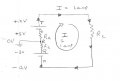
My circuit is steady state and I have updated it with some values to show exactly what I mean and why I advise against this 'rule'

post#95
Scenario of current flow is something like it flows from negative to positive terminal .. But conventional current flows from positive to negative terminal..

Post#1
When I went to the university to get my BSEE we were taught current flows from positive to negative and we did all of our calculations with this convention.
dir3.jpg

The conventional current of 1 amp is flowing from point T to point P, from +12V to -12V.

But wait

I amp of conventional current is flowing fom Q to R, from -3 volts to 0 volts and 1 amp is also flowing from R to S at 0V to +3 volts.

A little consideration will note that reversing the current arrow to satisfy electron current addicts will not help.

The current flows from + to minus in part of the circuit and from - to + in another part.

This is because, as I keep saying, the sign of the current flow has nothing to do with + and - in the circuit.
It would also be true if electricity was a magic fluid that had no + and -.
Doesn't AC look rather like this?

This is what I mean when I say the current flows in the 'opposite' direction in half the circuit because it is going in a loop.

The sign of the current as + or - means that it is flowing with or against the direction specified, not that it is flowing from positve to negative or whatever.
 

ErnieM

Joined Apr 24, 2011
8,415
This was posted in electronic circuits, not clever physics.

The OP is about steady state circuit theory.
Not the transient that WBahm introduced
Nor about physics at the molecular, atomic, subatomic or quantum level.

With respect, WBahn's example is pretty uninteresting in circuit analysis. A single decreasing current charges a capacitor once only
(He also specified he wanted to only discuss DC).


The steady state current for this circuit is zero!

My circuit is steady state and I have updated it with some values to show exactly what I mean and why I advise against this 'rule'


View attachment 79199

The conventional current of 1 amp is flowing from point T to point P, from +12V to -12V.

But wait

I amp of conventional current is flowing fom Q to R, from -3 volts to 0 volts and 1 amp is also flowing from R to S at 0V to +3 volts.

A little consideration will note that reversing the current arrow to satisfy electron current addicts will not help.

The current flows from + to minus in part of the circuit and from - to + in another part.

This is because, as I keep saying, the sign of the current flow has nothing to do with + and - in the circuit.
It would also be true if electricity was a magic fluid that had no + and -.
Doesn't AC look rather like this?

This is what I mean when I say the current flows in the 'opposite' direction in half the circuit because it is going in a loop.

The sign of the current as + or - means that it is flowing with or against the direction specified, not that it is flowing from positve to negative or whatever.
There is no magical reveral of voltage between Ra and RB, merely a change in the convention of how the voltage is reported.

Both resistors respect the passive sign convention where the terminal that "conventional" current enters is given a + sign. Thus an equal voltage in magnitude and sign exists across both resistors when a common sign convention is applied.

Of course, here is an example of an arbitrary definition of voltage leading to corrections in the sign of the measurement.

It's the same thing as making two voltage measurements of the same device, but with the leads swapped in between. You get two different readings of the same voltage, yet the voltage has not changed.
 

WBahn

Joined Mar 31, 2012
32,883
This was posted in electronic circuits, not clever physics.

The OP is about steady state circuit theory.
Not the transient that WBahm introduced
Nor about physics at the molecular, atomic, subatomic or quantum level.

With respect, WBahn's example is pretty uninteresting in circuit analysis. A single decreasing current charges a capacitor once only
(He also specified he wanted to only discuss DC).


The steady state current for this circuit is zero!

My circuit is steady state and I have updated it with some values to show exactly what I mean and why I advise against this 'rule'


View attachment 79199

The conventional current of 1 amp is flowing from point T to point P, from +12V to -12V.

But wait

I amp of conventional current is flowing fom Q to R, from -3 volts to 0 volts and 1 amp is also flowing from R to S at 0V to +3 volts.

A little consideration will note that reversing the current arrow to satisfy electron current addicts will not help.

The current flows from + to minus in part of the circuit and from - to + in another part.

This is because, as I keep saying, the sign of the current flow has nothing to do with + and - in the circuit.
It would also be true if electricity was a magic fluid that had no + and -.
Doesn't AC look rather like this?

This is what I mean when I say the current flows in the 'opposite' direction in half the circuit because it is going in a loop.

The sign of the current as + or - means that it is flowing with or against the direction specified, not that it is flowing from positve to negative or whatever.
Huh?

How on earth do you get that the voltage at point Q is -3V or that the voltage at point R is +3V?????

The voltage at point T will only be 12V if there is ZERO current flowing in Ra.

Using conventional current:

You don't say what the resistor values are, but to satisfy the 1A specification the total resistance of all three resistors needs to be 24Ω. In order to get a 3V drop (each) across Ra and Rb they need to be 3Ω each, making Rc equal to 18Ω.

The voltage at point R is 0V (by definition due to the ground reference).

The voltage at point S is V_s = 0V - (3Ω)(1A) = -3V

The voltage at point T is V_t = Vs + 12V = 9V

The voltage at point Q is V_q = 0V + (3Ω)(1A) = 3V

The voltage at point P is V_p = Vq - 12V = -9V

The current in Ra is Ia = (V_s - V_p)/Ra = (9V - -9V)/18Ω = 1A

In the case of each resistor, current is flowing through the resistor from positive to negative.

If you EVER have a current in a resistor going from negative to positive (actual voltage, not symbolic) then that resistor is PRODUCING electrical energy.

The only time that current is flowing from negative to positive is when it is going through the batteries and this is no mystery as chemical potential energy is being used to force the "current" to go "uphill".

The electron current flow guys have no problem with this situation either. Their terminology is different but is consistent with their convention.

But ask how much charge is entering each terminal of the battery each second and the conventional current guys can show you the equation, perform the calculation by plugging in the numbers, and give you the answer. The electron current guys will show you the equation, perform the calculation by plugging in the numbers, do some hand-waving to justify the application of a magical mystery minus sign, and give you the answer.
 

WBahn

Joined Mar 31, 2012
32,883
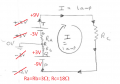
There is no magical reveral of voltage between Ra and RB
Especially if the correct voltages are used!

correctV.png

If anyone doesn't believe me, build the circuit and make the measurements (but maybe use resistors that are 100x or 1000x larger).
 
Last edited:

WBahn

Joined Mar 31, 2012
32,883
Or, I just realized, you may be specifying that the voltage at T is +12V and the voltage at P is -12V and not specifying that the sources are 12V each.

Fine. Let's use that as a given. Then the value of Rc is 24Ω but the values of Ra and Rb remain 3Ω in order to get the requisite 3V drop across them. That just means that now the two sources are 15V each, giving a total of 30V driving current through a total of 30Ω.
 
Top