I don't assign a sign to charge, the international body that defined the charge did that and, more to the point, it is the SAME sign that the electron current people use.
As I have said repeatedly, the people that use electron current have the option of redefining the charge on the electron if they want to, but they don't (do you disagree?). Since they don't, then they either have to redefine the ampere, which they don't (do you disagree?), or they have to redefine several fundamental equations, which they don't (do you disagree?), or they have to massage their work with magical mystery minus signs that pop up out of nowhere when they need them to, which is what they do.
As for wasting enough time, that's entirely up to you to decide -- I'm not forcing you (or anyone) to participate in this (or any) discussion, am I?
I don't want to get involved in this discussion, since I think it's above my skills... I just wanted to say that so far I've understood (or at least I think I do) what WBahn has been arguing all along... that is, that there is no consistency in the way we've been taught calculations should be made. He's made his case with simple and clear examples. To me at least, this sign issue is a customary thing, but it's also a contradiction that has pervaded the fields of science and engineering from time immemorial... and it doesn't look like anyone with sufficient authority (a scientific or engineering association) is willing to fix it anytime soon.
I don't want to get involved in this discussion, since I think it's above my skills... I just wanted to say that so far I've understood (or at least I think I do) what WBahn has been arguing all along... that is, that there is no consistency in the way we've been taught calculations should be made. He's made his case with simple and clear examples. To me at least, this sign issue is a customary thing, but it's also a contradiction that has pervaded the fields of science and engineering from time immemorial... and it doesn't look like anyone with sufficient authority (a scientific or engineering association) is willing to fix it anytime soon.
Thank you. To clarify a bit, the use of conventional current does not suffer from these inconsistencies. Also, many of the people that are often cited as being people that use electron current flow, namely physicists and people that deal with applications in which the nature of the particle is important, do so in an internally-consistent way. For instance, they would draw a current arrow from cathode to anode and label it as -3.2mA to indicate that a charge of -3.2mC was going from cathode to anode each second. The person I worked for thinks in terms of majority and minority carriers which are sometimes electrons and sometimes holes. But his calculations are always in terms of charge flow, not carrier flow, so when he is talking about electron flow he refers to the current in the direction of the electron motion but labels that current as being negative (when there is a value as opposed to a symbol).
Where the inconsistent use usually (not always) arises is with people that are working at a level that does not rely as heavily on mathematical computations that are complex and need to scale. If you are calculating something small and simple and then taking a numerical result and using that to calculate something small and simple, then you can learn to apply the magical mystery minus signs where needed without even realizing that you are doing it. If your mathematical tool back does not include complex numbers, for instance, and you are stuck working with reactances then you are often working at this level. But if you are working at a level that needs general analysis of larger systems, then it becomes very important that you be able to apply and rely on an internally consistent mathematical representation of everything.
I understand and have concurred with much of what WBahn is saying.
But I have added material no one appears to appreciate or wish to discuss.
When you have a simple equation that contains the product (or quotient) of two signed quantities you have four possibilities
+*+ or +/+
-*+ or -/+
-*- or -/-
+*- or +/-
Which leads to two possibilitoes for the product or quotient to be + and two possibilities for it to be -
Choosing a current direction as + and a voltage direction as + has the same characteristics.
There are four possible sign convention combinations.
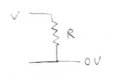
Here is a very simple circuit.
A voltage V drives a current through a resistor R to zero or earth.
Suppose V is 5 volts so V = IR
Now suppose that V is increased to 10 volts
Now we want a convention where (for ease) I to increases to 2I, not decrease to -2I since
10 is mathematically greater than 5 and 2I is mathematically greater than I, so long as I is positive.
This is the problem with reversing the direction of conventional current flow.
I understand and have concurred with much of what WBahn is saying.
But I have added material no one appears to appreciate or wish to discuss.
When you have a simple equationt hat contains the product (or quotient) of two signed quantities you have four possibilities
+*+ or +/+
-*+ or -/+
-*- or -/-
+*- or +/-
Which leads to two possibilitoes for the product or quotient to be + and two possibilities for it to be -
Choosing a current direction as + and a voltage direction as + has the same characteristics.
There are four possible sign convention combinations.
I see your point. What also comes into play is context-sensitive interpretation, at which humans excel but which math doesn't. So if a voltage supply is putting out -10V and someone is told to increase it by 5V, nearly everyone will make it -15V because nearly everyone will understand that the context of the use of "increase" in this case means to increase in magnitude. But if you are working math or writing a program, then "increase" means to "make more positive (or less negative)".
Good example. Notice that both groups have not only chosen a different sign convention, but both have adjusted their equations so as to be consistent with the convention chosen.
I'm glad we are talking again.
Yes and the whole point of conventional current is that the equations are all set up to play nicely with each other, and not to end up with the need for say negative resistance in my first example.
I was also talking about current directions in a circuit, about some point P in the circuit.
I was not trying to catch you out, but meant this.
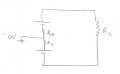
Whichever direction you choose the current in Rc must be opposite in direction to the current in Ra and Rb.
This circuit can also be used for other more detailed convention discussion if a few voltage nodes are labelled.
A trick question about the definition of current in relation to charge might be
Two generators, an alpha particle and a beta particle generator, have their beams directed down common path, past point P.
What is the current registered by the detector at the end?
I'm glad we are talking again.
Yes and the whole point of conventional current is that the equations are all set up to play nicely with each other, and not to end up with the need for say negative resistance in my first example.
I was also talking about current directions in a circuit, about some point P in the circuit.
I was not trying to catch you out, but meant this.
Ah, but that gets into another one of those language semantics. I understand that, in this context, you mean that if it travels upward in Ra and Rb that it must travel downward in Rc. But we often talk about current being clockwise or counterclockwise and, in that case, the current must be in the same direction in all three.
Aside from that, the physical current must behave as you've described, but the symbolic currents can be whatever and the values of them must just be positive or negative so as to adhere to the behavioral constraints on the physical currents. I've been focused on the inconsistent treatment of symbolic currents resulting in the need for adhoc adjustments, at times, to get the results to match the physical world when direct application of the (inconsistence) equations that are claimed to be used won't accomplish that when applied rigorously.
[/QUOTE]
A trick question about the definition of current in relation to charge might be
Two generators, an alpha particle and a beta particle generator, have their beams directed down common path, past point P.
What is the current registered by the detector at the end?[/QUOTE]
I think you are making the same point that I was trying to illustrate in Post #67, namely that flow of charge carriers is not the same as flow of charge and that to get flow of charge you need to multiply by the charge per carrier, a quantity that can be positive or negative and may or may not have a magnitude of 1.
Note that your question is actually indeterminate unless I make assumptions about the relative particle flux from each generator.
Yes of course the direction chosen is characterised as clockwise or counterclockwise in a circuit.
That means if you assign voltages to the nodes a clockwise current travels from positive to negative through Rc, but from negative to positive through Ra and Rb.
This is why I council against offering this rule.
Clockwise/anticlockwise is self consistent.
Talking about flowing from positve to negative is a question of
'Heads you loose, Tails, they win'
An assumed direction of current that is self consistent is to do with the circuit topology alone, not potentials or charge values.
It should also be noted that circuit topology is not the same as MrAl had it positve from left to right or what ever, but to do with connectivity.
This ties in with your comment about mathematical consistency for larger systems that would require a computer and perhaps matrix methods to solve.
And yes I think I tried to agree with the gist of your post#67 and several others.
Yes of course the direction chosen is characterised as clockwise or counterclockwise in a circuit.
That means if you assign voltages to the nodes a clockwise current travels from positive to negative through Rc, but from negative to positive through Ra and Rb.
Here I think we are talking about two different things. What I've been talking about is independent of voltage (with a caveat that doesn't apply since no one in the electron current crowd flips the voltage signs on all the sources so everyone is on the same page as far as that goes). The issue I'm talking about is independent of whether you use clockwise or not, either.
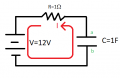
If asked what the current initial current is, the conventional current guys will say -12A and the electron current guys will say 12A. Okay on the surface, but the conventional current guys are saying that 12 C/s of charge are coming OFF of plate b while the electron current guys are saying that 12 C/s of charge are flowing ON to plate b.
And yes I think I tried to agree with the gist of your post#67 and several others.
I don't recall if you did or didn't -- I'm pretty sure you didn't disagree with it, but I don't recall you chiming it on this one (which can be interpreted as silent agreement).
I have been following this esoteric "discussion" with some confusion and still in a confused state I note studiot's assertion in his/her post that current direction in his/her little circuit is in one direction in RC and reversed in Ra Rb. I fail to see how this could be as from my meager years of electrical/electronic experience the current should be the same direction in all resistors. Where does it suddenly change direction?
WBahn, I note your little capacitor charging circuit and that confuses me also. My years long convention of current flow would have the current flowing in the opposite direction. I don't want to get in between your in depth discussion with studiot but I would like to know where/if I have gone wrong all these years.
My years long convention of current flow would have the current flowing in the opposite direction. I don't want to get in between your in depth discussion with studiot but I would like to know where/if I have gone wrong all these years.
No you got it correct. When analyze an unknown circuit you are free to literally guess at some things like the direction of the current or the polarity of voltages.
In the example of post #112 (!) the initial guess was backwards, but doing the math leads one to say that current is negative, or it is in the direction you think it is.
As Ingeo Montoya never said "you keep using that word. dothink it means what you think it means."
Re post 112 I note the polarity of the supply is fixed by the battery terminals. ( my convention, long dash is positive) no need to guess. Most circuit analysis does not have to guess what supply polarity is(in my humble experience)

 Facebook
 Google
 GitHub
 Linkedin