direction of current flow in a circuit

LDC3

Joined Apr 27, 2013
924
Why is it that I can never get anyone from the "electron current" crowd to answer a question like this. It should be easy.

Let's make it one step easier.

From an electron current perspective, which of the following properly describes the physical movement of charge when an electron beam is fired at the circular object shown?

View attachment 82543

This is not some trick question. If I were to ask this of anyone from the "conventional current" and ask which is the proper depiction from that perspective, they would say that (b) and (c) are equivalent and either is accurate. According to the E-book and nearly every other source that favors electron current as depicting the "true" current, they would say that the answer is (a). Do you agree?
Although C is consistent with the current flow, it does not reflect what you stated an electron beam is fired at the circular object.
 

WBahn

Joined Mar 31, 2012
32,994
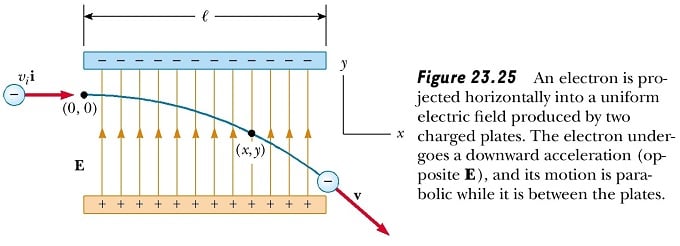
I would ask how is the electron beam deflected in a electric field so I could see the physical movement of the electrons.
http://sun.iwu.edu/~gspaldin/DeflectionByE-field.pdf
How the electron beam is formed is immaterial. We have a beam of electrons coming from the left and directed at the object. If you would like, we can focus on the initial instant in which the object has no net charge and therefore the beam is not in the presence of any electric field (other than that created by the beam itself and, by symmetry, this results in no beam deflection). As the object charges it develops an electric field that is oriented radially and, as a result, causes no deflection in the beam but does accelerate it along the path of the beam (and hence either speeding up or slowing down the electrons). Let's assume that this field never grows strong enough to halt the electrons or, even better, to ever significantly slow them down. We can always adjust parameters to make this assumption reasonable without changing the nature of the problem.
 

WBahn

Joined Mar 31, 2012
32,994
Although C is consistent with the current flow, it does not reflect what you stated an electron beam is fired at the circular object.
As long as we are talking about total net charge (which is almost always the case) then it is completely consistent. The charge on the object is being reduced by 2 C/s which is entirely consistent with a current of 2 C/s leaving the object, which is option (c).

Now, if we want to talk about absolute charge, the we have to be more careful with the book keeping because now we need to track positive and negative charge flows separately and keep them separate. In general, we need to do more than that because we probably need to track the flow of different ion species separately, but let's assume that we just want to know how many protons and how many electrons are in the volume. In that case, we need to specify two different currents, Ie and Ip for instance, and we need to track Qe and Qp separately. In that case we can still use charge flow and case (c) is still just fine. The alternative would be to use carrier flow, which is fine, but then our units are not charge/second, but charge_carriers/second and, hence, we can't use amperes to describe the flow because amperes is defined as the flow of charge, not the flow of charge carriers.
 

WBahn

Joined Mar 31, 2012
32,994
how about the way that electrons move off the cathode of a crt to the screen? repelled by the more negative charge on the cathode to the positive charge on the phospor screen? and focused by the other electrodes. and deflected by the + or- charge on the deflection plates? or by moving through the changing magnetic field of the deflection coils? how about the circuar path of the electrons in the magnetic field of a magnetron? tubes have the electrons emitted by the cathode and attracted by the plate.
What about it?

In a CRT let's say e-beam current between the gun and the screen is 1 mA (just making up a number). Is that a current of 1 mA toward the screen or away from the screen, from the "electron flow" perspective?
 

LDC3

Joined Apr 27, 2013
924
As long as we are talking about total net charge (which is almost always the case) then it is completely consistent. The charge on the object is being reduced by 2 C/s which is entirely consistent with a current of 2 C/s leaving the object, which is option (c).
I agreed with this, but what I want to point out is that C indicates (at least to me) that there are particles moving away from the object, which is inconsistent with your statement. If you didn't state that you had a beam of electrons, then C would be fine. Yes, I'm nit-picking. ;)
 

WBahn

Joined Mar 31, 2012
32,994
I agreed with this, but what I want to point out is that C indicates (at least to me) that there are particles moving away from the object, which is inconsistent with your statement. If you didn't state that you had a beam of electrons, then C would be fine. Yes, I'm nit-picking. ;)
But, given the labels as being measured in amperes, the arrows are not showing the flow of particles at all, but rather the flow of charge.
 

MaxHeadRoom

Joined Jul 18, 2013
30,726
how about the way that electrons move off the cathode of a crt to the screen? repelled by the more negative charge on the cathode to the positive charge on the phospor screen?
Actually the final anode is on the HV Aquadag coating on the inside of the CRT, the front is just a phosphor layer that the accelerated beam strikes..
Max.
 

nsaspook

Joined Aug 27, 2009
16,373
How the electron beam is formed is immaterial.
"From an electron current perspective, which of the following properly describes the physical movement of charge when an electron beam is fired at the circular object shown?"
The point was not how the beam was formed but how the charges of that beam were deflected as they would be in a real device so a student looking at the arrows of b and c from your question would then believe they were equivalent with the actual trajectory of deflection when we know the physical direction of the electron from the cathode to anode and its charge.
 

studiot

Joined Nov 9, 2007
4,998
By now both the two beginners must be thoroughly confused and appear to have left the thread.

The final sign of the current direction is the product of two entirely independent sign conventions.

You will never resolve the issue discussing only one of them.

(-1) x (-1) = +1

and so on.
 

profbuxton

Joined Feb 21, 2014
421
For goodness sake, how often do we have to go through this. Conventional current flow is from positive to negative. If anyone wants only consider it as "electron flow" they are welcome to do so, just lets not get hung up over what has been accepted since Franklin et al was a lad.
 

ErnieM

Joined Apr 24, 2011
8,415
The definition does not state that the charge carriers need to be positive. In fact, the definition is for the amount of charge moving, not the direction or what the charge carrier is.
Two out of three ain't bad.

Obviously the direction is important.
 

BR-549

Joined Sep 22, 2013
4,928
The problem is the way we use math to analyze circuits.
Using the strict definition for current...the current we use is always negative. This is because the charge carrier(the coulombs that are flowing) are negative.

But when we analyze circuits, we use the source potential as the polarity of current.....in which it is not.....current is always negative.

So when we calculate current using source charge instead of carrier charge, we get a plus and negative sign....but those signs show direction of current.....not polarity of current.

Direction and polarity is not the same thing. The math shows the direction, not the polarity of current. The polarity of current does not change.....only the direction.

A positive current is coulombs of negative charge flowing in one direction.

A negative current is coulombs of negative charge in the other direction.

So if you want to know the polarity of current.....it is always negative.

If you want to know the direction of current....consider the source potential polarity.

It's using + and - for two different things.....polarity and direction.
 

nsaspook

Joined Aug 27, 2009
16,373
It is obviously important to these people, but the definition doesn't care. :)
It's not important in 99% of types of modern electronic circuits as taught in school (the actual movement of electrons are irrelevant to signal flow) and won't help you pass a test about KCL but for someone has to create those electronics at the chip level using applied physics where it does matter and you need to the 1% to be correct about what charge in what atom that gets accelerated where , collides and interacts with other charges.

In my case the convention is fine as most of the things I worry about move correctly with the
arrows + --> -

Today is a time of choice, you can select which version of electronics to learn.

http://www.amazon.com/Electronic-Devices-Electron-Version-Edition/dp/0132549859
http://www.amazon.com/Electronic-De...d_sim_b_2?ie=UTF8&refRID=0QN1G75ZB22QM7MPQJW7
 
Last edited:

WBahn

Joined Mar 31, 2012
32,994
Again, if someone wants to define the reference direction for their currents in the direction that the electrons physically drift, that's fine. I just ask that they be consistent, which means that they have to do one of the following: change the sign on all of the voltages (which they never do -- or at least I have yet to see a single case of them doing so); write the currents in the direction of the electron movement as negative values (which they almost never do); use a different unit for current other than the ampere -- they can call it Bob and define it such at 1 bob is equal to -1 ampere (which they never do -- or at least I have yet to see a single case of them doing so); change the definition of the ampere to be the flow of negative charge in the reference direction and then change many of the fundamental mathematical relationships to reflect this (I have seen this done, and as near as I can tell it always leads to chaos). Since they won't do any of these and want to pretend that a current of 1 ampere is in the direction of electron flow has meaning and also want to pretend that they are using the same mathematical relationships, they have to resort to using magical mystery minus signs here and there to make things work out.
 

ErnieM

Joined Apr 24, 2011
8,415
Again, if someone wants to define the reference direction for their currents in the direction that the electrons physically drift, that's fine. I just ask that they be consistent, which means that they have to do one of the following: change the sign on all of the voltages (which they never do -- or at least I have yet to see a single case of them doing so); write the currents in the direction of the electron movement as negative values (which they almost never do); use a different unit for current other than the ampere -- they can call it Bob and define it such at 1 bob is equal to -1 ampere (which they never do -- or at least I have yet to see a single case of them doing so); change the definition of the ampere to be the flow of negative charge in the reference direction and then change many of the fundamental mathematical relationships to reflect this (I have seen this done, and as near as I can tell it always leads to chaos). Since they won't do any of these and want to pretend that a current of 1 ampere is in the direction of electron flow has meaning and also want to pretend that they are using the same mathematical relationships, they have to resort to using magical mystery minus signs here and there to make things work out.
I have to admit the last time this topic went thru pages and pages of discussion you actually changed my thinking that electron current, while a minority view far less useful than conventional current, was still a mathematically consistent viewpoint of the world.

It is not, and not even close. It is literally as bad as mistaking the accelerator pedal for the brake pedal in your car. You get to replace the right hand rule mnemonic for 3 dimensi9nal vectors with the left hand rule while trying not to look too silly, and other bad things. However, since the proponents of electron current seem to think they have the superior system based upon a lack of understanding they are just never going to see the point.

Thus let me define ErnieM's conjecture: "Those who use electron flow will have other bad habits."
 

WBahn

Joined Mar 31, 2012
32,994
I have to admit the last time this topic went thru pages and pages of discussion you actually changed my thinking that electron current, while a minority view far less useful than conventional current, was still a mathematically consistent viewpoint of the world.

It is not, and not even close. It is literally as bad as mistaking the accelerator pedal for the brake pedal in your car. You get to replace the right hand rule mnemonic for 3 dimensi9nal vectors with the left hand rule while trying not to look too silly, and other bad things. However, since the proponents of electron current seem to think they have the superior system based upon a lack of understanding they are just never going to see the point.

Thus let me define ErnieM's conjecture: "Those who use electron flow will have other bad habits."
Agreed. In my experience (and this is a broad generalization that does NOT apply to everyone by any means), people that use electron current typically (not always) lack the mathematical skills to see how inconsistent their usage is. There is a high overlap (not complete, by any means) with people that want to have capacitive and inductive reactance as two distinct quantities both of which are positive. In doing so, they often cripple themselves to only being able to work in small chunks and having to frequently stop and apply a bunch of memorized rules in order to patch things up and "reset the clock" before they can proceed with the next chunk.
 
Top