DIP IC's disappearing !

Thread Starter

MaxHeadRoom

Joined Jul 18, 2013
30,562
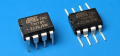
I have noticed recently many IC Manuf, DIP package part No's are disappearing, just the SOIC etc versions offered.
The most recent I discovered is the IR21xx packages. !
I guess I will have to learn to be more adept at mounting them.
The mini-SOIC are a challenge however! :(
 

crutschow

Joined Mar 14, 2008
38,323
Nobody makes PCBs with DIP packages anymore since they are large and require plated-through holes, and the trend is to smaller and smaller IC packages, so when the present stocks of DIP ICs are depleted, the DIP package will likely be no more.

That will obviously make it rather difficult for a hobbyist to make breadboard circuits with ICs.
 

Ian0

Joined Aug 7, 2020
13,097
Nobody makes PCBs with DIP packages anymore since they are large and require plated-through holes, and the trend is to smaller and smaller IC packages, so when the present stocks of DIP ICs are depleted, the DIP package will likely be no more.

That will obviously make it rather difficult for a hobbyist to make breadboard circuits with ICs.
Are there more holes on surface-mount pcbs or through-hole pcbs?
Because you can no longer take tracks between IC pins, there are fewer routing options available so more vias are required.
 

Ian0

Joined Aug 7, 2020
13,097
The mini-SOIC are a challenge however! :(
This is my technique for dealing with solder bridges.
First, add some flux. Then using a 3mm screwdriver soldering iron tip tilt the board, and move all surplus solder downhill to the end of a row of pins. Clean the tip. Then apply the tip to the remaining solder bridge and tilt the board so that gravity moves the spare solder onto the tip. (Technique invented when I found I had run out of solder-braid)
Alternatively, use lots of solder braid.
But I find that using solder braid and pressing too hard can delaminate tracks.
 

Thread Starter

MaxHeadRoom

Joined Jul 18, 2013
30,562
This is my technique for dealing with solder bridges.
First, add some flux. Then using a 3mm screwdriver soldering iron tip tilt the board, and move all surplus solder downhill to the end of a row of pins. Clean the tip. Then apply the tip to the remaining solder bridge and tilt the board so that gravity moves the spare solder onto the tip. (Technique invented when I found I had run out of solder-braid)
I did read about that method someplace, and intended to try it out on my next SOIC board item.
I guess for now, my boards will be a combination of both device types. :rolleyes:
 

nsaspook

Joined Aug 27, 2009
16,251
Nobody makes PCBs with DIP packages anymore since they are large and require plated-through holes, and the trend is to smaller and smaller IC packages, so when the present stocks of DIP ICs are depleted, the DIP package will likely be no more.

That will obviously make it rather difficult for a hobbyist to make breadboard circuits with ICs.
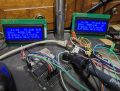
The chip shortage put a temporary dent in that trend as people used (or added PCB capabilities) a lot of old stock DIP chips and controllers with or without board respins.
1708287981843.png
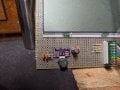
Some people were pretty creative.
1708288377445.png
Q84 controller, DIP and SMD PCB spins.
Stock: https://www.mouser.com/c/?q=PIC18F47Q84
 

LowQCab

Joined Nov 6, 2012
5,101
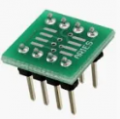
I'm sure that the more popular Chips will become available pre-soldered to an "Adapter-Board",
unfortunately, that probably means that the price will triple.
.
.
.
 

Jon Chandler

Joined Jun 12, 2008
1,560
will become available pre-soldered to an "Adapter-Board",
unfortunately, that probably means that the price will triple.
I have to disagree with this statement – usually a "breakout board," which often include all the support components to put the IC to use, are often available significantly cheap than just the chip itself.
 

ApacheKid

Joined Jan 12, 2015
1,762
I recall the hobby as it was in the 1970s, we'd use veroboard and often we'd use IC sockets for many ICs. Of course this was a cost and reliability concern for manufacturers but for a hobbyist was no big deal and it was easy to reuse chips in some other circuit, just by pulling them out of some existing one. Also the use of an IC socket eliminated the risk of overheating the IC as is the case when one solders these into a board.
 
Last edited:

strantor

Joined Oct 3, 2010
6,875
That will obviously make it rather difficult for a hobbyist to make breadboard circuits with ICs.
Maybe there is money waiting for whoever can come up with a new system to replace breadboard. Breadboard for SMD components, no breakout boards required. Not sure what that would look like but maybe worth thinking about.
 

WBahn

Joined Mar 31, 2012
32,706
Are there more holes on surface-mount pcbs or through-hole pcbs?
Because you can no longer take tracks between IC pins, there are fewer routing options available so more vias are required.
Almost certainly the answer is always that the thru-hole boards have many more holes.

Yes, you might have to add vias in places where you previously used a pin to transition between layers, but that is almost always a one-for-one swap out. But you do not have to add vias for pins that do not need to transition layers, so those are direct savings in terms of hole count.
 

Ian0

Joined Aug 7, 2020
13,097
Almost certainly the answer is always that the thru-hole boards have many more holes.

Yes, you might have to add vias in places where you previously used a pin to transition between layers, but that is almost always a one-for-one swap out. But you do not have to add vias for pins that do not need to transition layers, so those are direct savings in terms of hole count.
The number seems to go up as soon as a DPAK gets involved, as thermal vias appear to transfer the heat to large areas of copper on the other side.
 
Top