Diorama LED lighting

Thread Starter

Doane2u

Joined Sep 2, 2023
42
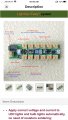
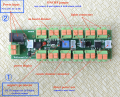
My miniature dioramas I build typically use 12-15 small SMD 3v LED lights. I’m currently using a power distribution unit that accepts 6-24v AC or DC in and has about 20 3v outputs and it’s rated at 1,000mA (example attached wit 12 outputs) I’m using it with 2x 9v alkaline batteries in Parallel for a 9v input to the board and they don’t seem to last very long. Would I be better off using 2x 2c cell battery holders in parallel for 3v output and a regular connector block for the 3v SMD lights all in parallel with the 3v supply so I’m not losing power to a power distribution board? Would this make a significant difference in run time? I have limited space under the diorama base and I want to just use battery power. Thanks for your help.
 

Attachments

KeithWalker

Joined Jul 10, 2017
3,604
My miniature dioramas I build typically use 12-15 small SMD 3v LED lights. I’m currently using a power distribution unit that accepts 6-24v AC or DC in and has about 20 3v outputs and it’s rated at 1,000mA (example attached wit 12 outputs) I’m using it with 2x 9v alkaline batteries in Parallel for a 9v input to the board and they don’t seem to last very long. Would I be better off using 2x 2c cell battery holders in parallel for 3v output and a regular connector block for the 3v SMD lights all in parallel with the 3v supply so I’m not losing power to a power distribution board? Would this make a significant difference in run time? I have limited space under the diorama base and I want to just use battery power. Thanks for your help.
Typical 9V alkaline batteries have a capacity of around 500mAHrs. which gives a total power of 4.5WHrs per cell . Two in parallel would give about 9WHrs.
Typical 1,5V C cells have a capacity of around 8,000mAHrs which gives a total power of 12WHrs per cell. 4 C cells connected in any configuration would give a total power of 48WHrs, which is more than five times the available power from two 9V batteries.
 

djsfantasi

Joined Apr 11, 2010
9,237
9V alkaline batteries are notorious for the short time they can supply power. They were made for short one-time use and only last for 500mAh
(supply 1/2 amp for an hour).

I’d be surprised if those distribution boards work with only 3V output. Do you have a link to their description (with technical specs)? Regulators require some headroom above the output voltageAnd if the SMD LEDs don’t have an internal resistor, running them directly with 3V can burn them out.

Without seeing the distribution board and LED tech specs, I’m guessing. I can improve my assessment if you could tell me how many LEDs there are and how long the 9V batteries last.

With my current knowledge, I’d put 3-4 AA cells in series and two such packs in parallel. Which would give you close to 6,000mAh in a small size. About 10-12 times the current life. C cells would likely also require 3-4 cells in series (skip paralleling thrm) for a lifetime of 8,000mAh. That’s 8 amps for an hour or around 4 times thr current lifetime.

One last point. LEDs run on current, not voltage. That’s why directly connecting them (without current regulation) to their rated voltage will burn them out quickly.
 

Thread Starter

Doane2u

Joined Sep 2, 2023
42
Typical 9V alkaline batteries have a capacity of around 500mAHrs. which gives a total power of 4.5WHrs per cell . Two in parallel would give about 9WHrs.
Typical 1,5V C cells have a capacity of around 8,000mAHrs which gives a total power of 12WHrs per cell. 4 C cells connected in any configuration would give a total power of 48WHrs, which is more than five times the available power from two 9V batteries.
That's pretty amazing, didn't know there was that much difference!
Is the power distribution unit also a big loss? IE: if I used the 2x 2C cell packs in series for 6v as the supply for the power distribution board would there be much difference in how long the lights will run? Thanks,
 

Thread Starter

Doane2u

Joined Sep 2, 2023
42
9V alkaline batteries are notorious for the short time they can supply power. They were made for short one-time use and only last for 500mAh
(supply 1/2 amp for an hour).

I’d be surprised if those distribution boards work with only 3V output. Do you have a link to their description (with technical specs)? Regulators require some headroom above the output voltageAnd if the SMD LEDs don’t have an internal resistor, running them directly with 3V can burn them out.

Without seeing the distribution board and LED tech specs, I’m guessing. I can improve my assessment if you could tell me how many LEDs there are and how long the 9V batteries last.

With my current knowledge, I’d put 3-4 AA cells in series and two such packs in parallel. Which would give you close to 6,000mAh in a small size. About 10-12 times the current life. C cells would likely also require 3-4 cells in series (skip paralleling thrm) for a lifetime of 8,000mAh. That’s 8 amps for an hour or around 4 times thr current lifetime.

One last point. LEDs run on current, not voltage. That’s why directly connecting them (without current regulation) to their rated voltage will burn them out quickly.
This is one I bought on Ebay and am using right now: https://www.ebay.com/itm/154622667353
It's handling 14 SMD 3v LED lights driven by the 2 9v batteries in parallel for 9v in. I'm not sure how long the batteries have lasted as I don't have them turned on continually, they were on and off for display briefly and maybe they were on for a few hours when I was taking photos? It just didn't seem like they lasted that long. When I took the batteries out yesterday, because the lights wouldn't come on, I measured their output and it was about 5v for each one.
Would connecting the SMD LEDs directly to a 3v battery supply burn them out... I thought they were rated at 3v?
You were saying to use 4 cells in series, that would = 6V, right? You are talking about 6v used for the power distribution board, right?
 

djsfantasi

Joined Apr 11, 2010
9,237
Would connecting the SMD LEDs directly to a 3v battery supply burn them out... I thought they were rated at 3v?
You were saying to use 4 cells in series, that would = 6V, right? You are talking about 6v used for the power distribution board, right?
Eventually they would burn out. They might work for while but their life would be limited. Like I mentioned, LEDs are run on current, not voltage. By directly connecting “3V” LEDs to a 3V source, there is nothing to limit the current. This concept is often difficult to grok. “Rated at 3V” says nothing about the current required. The simplest way of limiting current (there are others) to an LED is with a series current limiting resistor. The 3V is called the “forward voltage”. This voltage is used to calculate the value of the current limiting resistor.

This has all been done for you in the design of the distribution board. But since it takes some power to run the distribution board and to control the current without a resistor, you need to supply more than the target output voltage.

The product description says that it’s lowest input voltage is 3V. This being a Chinese product, I’d have to confirm that it works with only 3V. I have my doubts. Note that when using 9V batteries, it stopped working close to 5V. To me, 6V would then be the minimum input voltage. Which is 4 AA or C cells.
 

BobTPH

Joined Jun 5, 2013
11,484
Would connecting the SMD LEDs directly to a 3v battery supply burn them out... I thought they were rated at 3v?
Most likely not if the LEDs are white. White LEDs typically need 3.3 to 3.6V to operate at their rated current, so powering at 3.0V would operate the somewhat below their typical level.
 

Thread Starter

Doane2u

Joined Sep 2, 2023
42
Eventually they would burn out. They might work for while but their life would be limited. Like I mentioned, LEDs are run on current, not voltage. By directly connecting “3V” LEDs to a 3V source, there is nothing to limit the current. This concept is often difficult to grok. “Rated at 3V” says nothing about the current required. The simplest way of limiting current (there are others) to an LED is with a series current limiting resistor. The 3V is called the “forward voltage”. This voltage is used to calculate the value of the current limiting resistor.

This has all been done for you in the design of the distribution board. But since it takes some power to run the distribution board and to control the current without a resistor, you need to supply more than the target output voltage.

The product description says that it’s lowest input voltage is 3V. This being a Chinese product, I’d have to confirm that it works with only 3V. I have my doubts. Note that when using 9V batteries, it stopped working close to 5V. To me, 6V would then be the minimum input voltage. Which is 4 AA or C cells.
Okay, very helpful, I’m going switch the 2x 9v for 2x 2 c cell holders in series and run the board with that 6v and see how it does. Thanks
 

Thread Starter

Doane2u

Joined Sep 2, 2023
42
Most likely not if the LEDs are white. White LEDs typically need 3.3 to 3.6V to operate at their rated current, so powering at 3.0V would operate the somewhat below their typical level.
Okay, thank you, they are warm white bulbs.
 

Thread Starter

Doane2u

Joined Sep 2, 2023
42
Okay I tested out using 4 fresh c cells in series = 6v to supply the power regulator board and the lights are really dim. It appears this regulator board needs at least 9v, even though it is advertised as only needing 3v this is with 14x white SMD LED lights. Also, I was taking photos for about an hour and the two 9v batteries are already down to about 7.5v
I’m thinking again that a 2 cell battery holder putting out 3v connected directly to all the lights connected in parallel on a distribution block is a better option.. or 2 c cell holders in parallel for 3v ?
Thanks
 

Ya’akov

Joined Jan 27, 2019
10,226
Welcome to AAC.

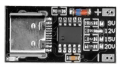
I would suggest you use a USB PD-capable power bank and a 9 or 12V trigger board. The trigger board will negotiate with the power bank to get a robust 9 or 12V supply.
1693732508849.png
This allows you to use a rechargeable supply, and to replace it by simply plugging any PD power bank into the board. The board is tiny and would be easy to fit.

The capacity of even the smallest power banks would be very competitive with alkaline cells and take up far less room. That it would work with any PD power bank means instant replacement of the power supply, or, if you choose, the ability to use a mains-powered charger.

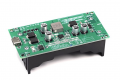
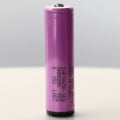
An attractive alternative is something like this "UPS" board. While you don't have an application for the UPS functionality, the rest of it is very nice. It uses two common 18650 Li-Ion cells and provides 9 or 12V (according to the board you choose).

1693733378522.png
The board provides over- and under-voltage protection, as well as temperature and over-current protection. The board will go into protection mode when an over-current condition occurs, such as a short circuit, and is reset by connecting 5V to the charging input.

This solution makes your diorama standalone, and the 18650 cells can be replaced. Each of these options has advantages. I lean towards the later because it is neater and I have a lot of scavenged 18650 cells. It is also much cheaper in the end even if you have to purchase cells.

While I am very comfortable purchasing the board from AliExpress, I wouldn't buy 18650 cells from AE sellers. The reason is because of the high incidence of fraud concerning the sells in particular and the fact that I don't personally know of a reputable seller on AE. If you can find one with a good reputation, there's really no other reason not to buy from them but I have other suppliers.

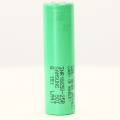
One really excellent source is the 18650 Battery Store. Their prices are good, they sell genuine, high quality cells with a large selection, and their service has been excellent,. You can choose from a range of options from an unprotected, highly regarded Samsung cell offering a (real) capacity of 2500mah for about four dollars each , to a belt-and-suspenders approach protected Samsung offering 3000mah at about 10 bucks a pop.

1693734345540.png1693734443351.png
unprotected 2500mah protected 3000mah
Which ever way you choose to go, using a good quality secondary (rechargeable) battery will give you better performance for less money and less landfill fodder. With care, these cells should last indefinitely.

By the way, very nice work on the model. I like the attention to detail and careful work.

Now you just have to learn a bit about MCUs (Microcontrollers) like the Arduino range and you will be able to include animated sunrise and sunset events with RGB LEDs which would be very cool. You could mount the LEDs in front and behind so you can do the sunrise and sunset from different angles, and you can control the internal and external lighting as well.

Good luck with your dioramas, please do let us know what your ultimate solution turns out to be.
 

BobTPH

Joined Jun 5, 2013
11,484
Okay I tested out using 4 fresh c cells in series = 6v to supply the power regulator board and the lights are really dim.
What this means is that the board is not regulating the voltage to 3V. It is most likely just a board with the resistors needed for a an LED with specific requirements. Do you have any documentation on what this board actually is supposed to do? I have no idea.

In any case, you do not need that board. You just need a resistor in series with each LED and then connect them all in parallel. 4.5V would be preferable to 6 since 6 would just waste the extra energy that it has.

Ask us to fix the problem, not your sub-optimal solution. Had you asked how to light 12 LEDs with a battery, no one here would have suggested using a board like the one you have.
 

Ya’akov

Joined Jan 27, 2019
10,226
What this means is that the board is not regulating the voltage to 3V. It is most likely just a board with the resistors needed for a an LED with specific requirements. Do you have any documentation on what this board actually is supposed to do? I have no idea.

In any case, you do not need that board. You just need a resistor in series with each LED and then connect them all in parallel. 4.5V would be preferable to 6 since 6 would just waste the extra energy that it has.

Ask us to fix the problem, not your sub-optimal solution. Had you asked how to light 12 LEDs with a battery, no one here would have suggested using a board like the one you have.
The board does have regulation, as well as rectification which male be part of the problem. See 1 on the image (bottom) where you can select regulation on or off; and 2 at the top where it says "AC or DC". The voltage drop across the bridge could be the problem with a 3V source as input.

The board also has a dimmer option, which is very nice for the application, not to mention acting as a terminal strip for terminating the LED leads and multiple options for power input termination. I don't know how good the board actually is, but for this application it looks pretty nice—so I might recommend it assuming it works as expected.

1693743799199.png
 

Ya’akov

Joined Jan 27, 2019
10,226
Well, we have proof that it doesn’t. We have no description of how it is supposed to work except the the assertion by the TS that it outputs 3V on each output.
We do have the image above which definitely suggests that it can pass through or regulate to 3V. The components on the board are consonant with this.
 

Thread Starter

Doane2u

Joined Sep 2, 2023
42
What this means is that the board is not regulating the voltage to 3V. It is most likely just a board with the resistors needed for a an LED with specific requirements. Do you have any documentation on what this board actually is supposed to do? I have no idea.

In any case, you do not need that board. You just need a resistor in series with each LED and then connect them all in parallel. 4.5V would be preferable to 6 since 6 would just waste the extra energy that it has.

Ask us to fix the problem, not your sub-optimal solution. Had you asked how to light 12 LEDs with a battery, no one here would have suggested using a board like the one you have.
Bob: I’m not an electronics expert, I’m basically an artist looking for some help here. I saw this power regulator
What this means is that the board is not regulating the voltage to 3V. It is most likely just a board with the resistors needed for a an LED with specific requirements. Do you have any documentation on what this board actually is supposed to do? I have no idea.

In any case, you do not need that board. You just need a resistor in series with each LED and then connect them all in parallel. 4.5V would be preferable to 6 since 6 would just waste the extra energy that it has.

Ask us to fix the problem, not your sub-optimal solution. Had you asked how to light 12 LEDs with a battery, no one here would have suggested using a board like the one you have.
Welcome to AAC.

I would suggest you use a USB PD-capable power bank and a 9 or 12V trigger board. The trigger board will negotiate with the power bank to get a robust 9 or 12V supply.
This allows you to use a rechargeable supply, and to replace it by simply plugging any PD power bank into the board. The board is tiny and would be easy to fit.

The capacity of even the smallest power banks would be very competitive with alkaline cells and take up far less room. That it would work with any PD power bank means instant replacement of the power supply, or, if you choose, the ability to use a mains-powered charger.

An attractive alternative is something like this "UPS" board. While you don't have an application for the UPS functionality, the rest of it is very nice. It uses two common 18650 Li-Ion cells and provides 9 or 12V (according to the board you choose).
The board provides over- and under-voltage protection, as well as temperature and over-current protection. The board will go into protection mode when an over-current condition occurs, such as a short circuit, and is reset by connecting 5V to the charging input.

This solution makes your diorama standalone, and the 18650 cells can be replaced. Each of these options has advantages. I lean towards the later because it is neater and I have a lot of scavenged 18650 cells. It is also much cheaper in the end even if you have to purchase cells.

While I am very comfortable purchasing the board from AliExpress, I wouldn't buy 18650 cells from AE sellers. The reason is because of the high incidence of fraud concerning the sells in particular and the fact that I don't personally know of a reputable seller on AE. If you can find one with a good reputation, there's really no other reason not to buy from them but I have other suppliers.

One really excellent source is the 18650 Battery Store. Their prices are good, they sell genuine, high quality cells with a large selection, and their service has been excellent,. You can choose from a range of options from an unprotected, highly regarded Samsung cell offering a (real) capacity of 2500mah for about four dollars each , to a belt-and-suspenders approach protected Samsung offering 3000mah at about 10 bucks a pop.

View attachment 301972View attachment 301973
unprotected 2500mah protected 3000mah
Which ever way you choose to go, using a good quality secondary (rechargeable) battery will give you better performance for less money and less landfill fodder. With care, these cells should last indefinitely.

By the way, very nice work on the model. I like the attention to detail and careful work.

Now you just have to learn a bit about MCUs (Microcontrollers) like the Arduino range and you will be able to include animated sunrise and sunset events with RGB LEDs which would be very cool. You could mount the LEDs in front and behind so you can do the sunrise and sunset from different angles, and you can control the internal and external lighting as well.

Good luck with your dioramas, please do let us know what your ultimate solution turns out to be.
Thank you for the suggestions, sounds like a good solution, and you have some very creative ideas, but I have to keep this fairly simple and any buyer might have a hard time dealing with non standard charging batteries... I have one large diorama that handles about 10 SMD lights using the same power distribution board I mentioned above in #5 and it has a switch and an input jack on the side so that the user can use any wall outlet power supply. It works great with a 12v DC supply but the hassle of having a wall supply is an inconvenience so I want to keep them simple and just be able to use readily available batteries from now on; just a matter of figuring out the best setup for the longest run time with my limited space of about 3/4" depth under the diorama. I didn't realize the 9v batteries were so limited in capacity.
 

Thread Starter

Doane2u

Joined Sep 2, 2023
42
The board does have regulation, as well as rectification which male be part of the problem. See 1 on the image (bottom) where you can select regulation on or off; and 2 at the top where it says "AC or DC". The voltage drop across the bridge could be the problem with a 3V source as input.

The board also has a dimmer option, which is very nice for the application, not to mention acting as a terminal strip for terminating the LED leads and multiple options for power input termination. I don't know how good the board actually is, but for this application it looks pretty nice—so I might recommend it assuming it works as expected.

Yes, it looked very convenient and not that expensive at about $14 I bought one the first time to use with a 12v wall supply but have since decided using a wall cord is inconvenient. I also found that the dimmer control is not that useful, it causes flickering of the SMD bulbs. Then I ran into the problem of the 2 9v packs not lasting that long driving the 14 white SMD lights in my current diorama I am just finishing. That got me back to thinking I should just go to a simple connection block and power it straight with 3v from batteries, and it seemed like using 4 c cells in two containers in parallel for 3v would make the lights last a lot longer.. from the conflicting comments about current limitations, I'm still not sure if this is problamatic.
 

djsfantasi

Joined Apr 11, 2010
9,237
Let me put it straight. To light an LED (or several), you need three things. 1) a power source. 2) an LED. And 3) “something” to limit the current to the LED.

Batteries will satisfy #1. You have the LEDs. The board you have satisfied #3.

With a little education and some math, a resistor for each LED will also satisfy #3.

Here’s the math. Given your power source (Vs represents its value), the LED’s “forward voltage” (Vf) and the current required by the LED (Id), use this formula:

R = (Vs-Vf) / Id​

The LED values can be gotten from their description, datasheet or even by common knowledge.

You’d think that if Vs equals Vf, you don’t need the resistor. As mentioned several times, you need “something” to limit the current to the LED. Which can be a resistor in your simple case. Yes. I said simple.

It should also be apparent that Vs needs to be greater than Vf. You might be be able to run several LEDs in one string but replace Vf with n*Vf in the formula I gave. Current remains the same, Vd. And Vs must then be greater than n*Vf.
 

BobTPH

Joined Jun 5, 2013
11,484
The board you have satisfied #3
What makes you say that? I see nothing to indicate it does current control.

And if the Vf is greater than the 3V output (which it usually is for white LEDs) you cannot control the current with an added resistor. As I see it, that board is clearly the wrong thing to solve this problem.

Can I ask you and @Ya’akov what you think the board is doing and how you arrived at that? Because the only clue I see is that it runs the LEDs well with 9V input and not with 6V input.
 
Top