Of course, it is understood that the sound (digital) coming out from the 555 siren circuit could be heard using speaker. But, the quality of that sound is not smooth.
It's not smooth because it's a square-wave but that doesn't mean it's not a "real analog sound" when run through a speaker.
You could run it through a high-order low-pass filter to remove the harmonics that generate the harsh sound, leaving only the fundamental sine wave.
Clarity and precision are foundational especially when discussing technical subjects but that should not prevent them from being highly important of all communications.
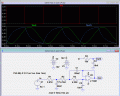
Below is the simulation of a 1kHz squarewave into a 3-pole 1kHz low-pass active filter.
The filter removes most of the squarewave high frequency components, leaving the fundamental sinewave with reasonably low distortion V(out).
For comparison the output is also shown from a 1-pole passive 1kHz RC LP filter V(out2). As you can see it looks more like a rolled off squarewave rather than a sinewave.
Note that the filter is basically for a single frequency and the output amplitude will be reduced as the squarewave frequency is increased.
If the frequency is reduced the distortion will increase.
If you don't mind some distortion in the output then you can use a simpler filter.
Here is the website I used to generate the filter component values.
Below is the simulation of a 1kHz squarewave into a 3-pole 1kHz low-pass active filter.
The filter removes most of the squarewave high frequency components, leaving the fundamental sinewave with reasonably low distortion V(out).
For comparison the output is also shown from a 1-pole passive 1kHz RC LP filter V(out2). As you can see it looks more like a rolled off squarewave rather than a sinewave.
Note that the filter is basically for a single frequency and the output amplitude will be reduced as the squarewave frequency is increased.
If the frequency is reduced the distortion will increase.
If you don't mind some distortion in the output then you can use a simpler filter.
Here is the website I used to generate the filter component values.
Okay, now for example if there are two tones with different frequencies to be mixed; do they need two separate low-pass filters before mixing or only one after mixing?
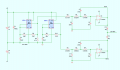
Please see this schematic. Did I understood the subject correctly?
Okay, then which of the techniques mentioned in the link should I start with to have a harmonic-free final signal? And again, do I need to introduce two sine-wave generators for each frequency and then mix them?
Please bear with me, as I already mentioned I am absolutely new to this subject.
A low-pass filter will certainly modify the harmonic content of a square waveform, but perhaps abuhafss wants to retain a bit of the siren sound, and sirens don't put out sine waves. I'd suggest hooking a 100k pot in series with the output, and a 0.01uF cap on the far side of that. Then he could play with the sound and determine if even more filtering might be desirable.
I'd go before the OUT-MIX. That's already low-pass filtered by two separate filters. Forget those filters for now. From each of the 555 outputs, connect a 1k resistor to a common point. We'll call that the 'combining' point. Connect that common (combined) output to one end of a 100k pot, and from the wiper, put a 0.01uF cap to ground. Because the 555s give an output between the supply rail and ground, cap-couple from the top of the 0.01uF to your amplifier, or whatever you're feeding. That will remove the DC offset. Now start up your 555s and crank on the pot to see if you can get a sound you like. What this will do is remove the 'edge' from the sound (some of the way-out harmonics), and give you mostly the 3rd and 5th harmonics.
Now if you want to get really fancy, stuff some current into the 555 so that the output is not a symmetrical square wave. Once you destroy the symmetry, you'll have even-order harmonics in there too. Most people feel that even-order harmonics (2nd, 4th, etc.) sound less strident than the odd-order ones. You'll have both, even and odd, in this case, but you might like the sound better.

 Facebook
 Google
 GitHub
 Linkedin



 Perhaps, I didn't put my question clearly.