I agree, if this is used for a critical condition shut down, the normal procedure is to place it in series or in circuit with the E-Stop or other shut down circuit.
But as it is only appears to be a single contact, two wire device, using it to operate a relay would be preferred in order to satisfy the critical shut down and also advise the PLC that an external shut down condition has occurred.
A proper display of the circuit section that is involved would have made it easier to give a definitive answer.
Max.
Is the sensor a simple pressure switch?
Why not get one in exactly the same configuration and avoid all the logic confusion?
Or am I missing something?
All oil pressure switches for unattended engine operation short to ground on low or no oil pressure. In many cases the switch is an integral part of an oil pressure gauge. They may also have a temperature gauge with a kill switch if over temperature condition.
I'm guessing the new oil pressure switch is for this type of operation.
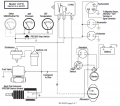
Here is a typical wiring example, note the pressure gauge in the upper right:
Modifying the ladder logic is the simplest answer but he may not have access to the PLC.
What you're missing is that no logical inversion is needed. The sensor closes to ground when the oil is low. This is a legacy from the days when they worked by shorting the primary of a magneto.
Because we don't really know if it is PLC input or a hardwired logic, if PLC the simplest is to change the occurance of the SW input logic.
If so no need for a relay.
Max,
Because we don't really know if it is PLC input or a hardwired logic, if PLC the simplest is to change the occurance of the SW input logic.
If so no need for a relay.
Max,
His initial post indicated an Allen Bradley PLC and later he mentioned an input card that requires +24 volts. A pull up resistor and invert the logic in the PLC would be sufficient.
His initial post indicated an Allen Bradley PLC and later he mentioned an input card that requires +24 volts. A pull up resistor and invert the logic in the PLC would be sufficient.
What you're missing is that no logical inversion is needed. The sensor closes to ground when the oil is low. This is a legacy from the days when they worked by shorting the primary of a magneto.
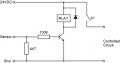
The inversion was to guard against the failure of the relay. If you rely on the grounding of the sensor to switch on the relay whose NC contacts are running the device, then failure of the relay means the device keeps working. This solution fails safe if the relay fails or if the sensor wiring fails.
I'm not suggesting there is any one right answer - this was just a solution that would work!
I was assuming it was a typical 2 wire sensor, not one with a conductor and the frame, otherwise it would be quite simple to change the logic, were it a two wire device.
Max.

 Facebook
 Google
 GitHub
 Linkedin