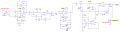
Differential Op amp for audio

The circuit shown in post#1 does not have a differential imput. the balanced MIC input of the Fishman Mini may have one, but we don't get to see it. That had me confused for a bit.
I have seen differential mic inputs used in a effort to reduce HUM pickup, and that can be effective if it is done right, AND if the input connections are actually differential.
 

Thread Starter

rpschultz

Joined Nov 23, 2022
825
Why two gain pots in parallel?
I wondered about this. AI suggests:
  • Lower thermal noise, 2 in parallel gives 3 dB less noise.
  • Redundant wipers, makes them less scratchy, more stable
  • Lower wiper resistance, reduces error
  • Averaging taper behavior, smoother gain sweep
  • Higher power handling

Not my design, but Fishman evidently thought it was warranted.
 

AnalogKid

Joined Aug 1, 2013
12,147
I wondered about this. AI suggests:

Lower thermal noise, 2 in parallel gives 3 dB less noise.
I think the only thing on that list that could matter is the lower thermal noise, but the application of the theory to this circuit is incorrect.

If you have two correlated noise sources, then when you combine them into a common load, the noise voltage at the noise adds linearly. Two *correlated* sources, twice the noise.

If you combine two uncorrelated noise sources (such as two randomly-selected resistors), the noise voltages add logarithmically. With two 1 Vrms sources, the resulting summed voltage is 1.414 Vrms. That is 3 dB less than the sum of *two correlated voltages*, not 3dB less than a *single* voltage source.

Tek used to do this in their scopes. The combined outputs of multiple low-gain stages had the same gain as one higher gain stage, but with less noise.


Multiple resistors in parallel *always* will be noisier than a single equivalent resistor (all other resistor parameters being equal).

ak
 

Thread Starter

rpschultz

Joined Nov 23, 2022
825
So you're saying I should stick with a single 50kA pot?
That's what I had originally, but recently I decided to try the dual 100kA in parallel.
 

Ian0

Joined Aug 7, 2020
13,155
I think the only thing on that list that could matter is the lower thermal noise, but the application of the theory to this circuit is incorrect.

If you have two correlated noise sources, then when you combine them into a common load, the noise voltage at the noise adds linearly. Two *correlated* sources, twice the noise.

If you combine two uncorrelated noise sources (such as two randomly-selected resistors), the noise voltages add logarithmically. With two 1 Vrms sources, the resulting summed voltage is 1.414 Vrms. That is 3 dB less than the sum of *two correlated voltages*, not 3dB less than a *single* voltage source.

Tek used to do this in their scopes. The combined outputs of multiple low-gain stages had the same gain as one higher gain stage, but with less noise.


Multiple resistors in parallel *always* will be noisier than a single equivalent resistor (all other resistor parameters being equal).

ak
Just being picky here, but the noise powers add linearly, not the noise voltages add logarithmically, that's what gives gives the √2 factor.
Two cascaded gain stages each with a gain of 10: the second will amplifiy the noise of the first by 10 and add its own noise, that will be more noise than the first one amplifying by 100.

Although it is rarely the main source if noise, then making the gain-setting resistor 10 times as large increases its noise by √10, not by 10.
 

Ian0

Joined Aug 7, 2020
13,155
So you're saying I should stick with a single 50kA pot?
That's what I had originally, but recently I decided to try the dual 100kA in parallel.
I use two pots in parallel for a completely different reason. A mono pot has only three terminals soldered to the board, its pins can therefore bend. Using a 6-terminal stereo pot makes it stable on the pcb.
 

Thread Starter

rpschultz

Joined Nov 23, 2022
825
I use two pots in parallel for a completely different reason. A mono pot has only three terminals soldered to the board, its pins can therefore bend. Using a 6-terminal stereo pot makes it stable on the pcb.
I’m using 9mm pots so they are mechanically stable either way
 

AnalogKid

Joined Aug 1, 2013
12,147
Just being picky here, but the noise powers add linearly, not the noise voltages add logarithmically,
I know that.

I limited my post to noise voltages because that is easier for many people to visualize / grasp / understand. I left out the part about the difference between RMS and RSS.

ak
 
Top