Differential Op amp for audio

Thread Starter

rpschultz

Joined Nov 23, 2022
821
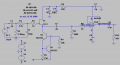
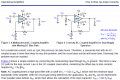
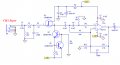
I have this circuit from a Fishman Mini guitar amplifier that I have used for Audio.
1781049794600.png

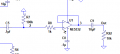
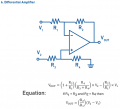
I'm having a hard time understanding what resistors match up with the textbook differential op amp, because there's only 1 resistor connected to the + input and 3 connected to the - input. Unlike the schematic below.
1781049843546.png

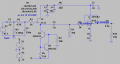
I also have built this circuit without C6 and R7 (picture 1), thinking this was a HPF that I wanted to get rid of. But I'm not so sure because I still get a HPF at about 35 Hz.
1781049962684.png

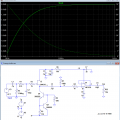
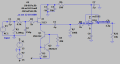
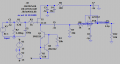
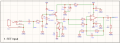
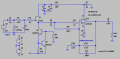
Finally, when I spice this, the output is only 1 dB above the input. But when I measure, I get +6 dB.
1781050425386.png
1781050465383.png

I'd like this to be simply a buffer with little or no gain. But it seems there are things about differential amps that I don't understand.
 

AnalogKid

Joined Aug 1, 2013
12,143
Your circuit is not a differential amplifier. Note that in your second schematic there are two distinct inputs, V1 and V2. In your schematic, there is only one signal at the input connector, and only one signal at the Q1 source that drives the opamp circuit.

What is it that you are trying to achieve?

ak
 

ci139

Joined Jul 11, 2016
1,993
a random guess -- the j-Fet or it's stage may not perform as well as the real thing or the 5532 is not that sensitive (has input loss ?) as the real life one
 

Thread Starter

rpschultz

Joined Nov 23, 2022
821
Of note.
  • I chose to use a LM4562 instead of NE5532 show in hardware picture. Both bipolar, shouldn't affect the gain. I can't seem to get the LM4562 model to work in spice.
IMG_8193.jpeg
 

crutschow

Joined Mar 14, 2008
38,529
Below is the circuit with a gain of 1:
You removed R7 which upset the bias and caused the op amp to saturate.
I added it back and increased it's value, since the R7C5 time-constant was causing the observed rolloff.
I increase the value of C9 to the original value of 10µF, as that was also causing some low frequency rolloff.
I changed the op amp to a gain-of-one follower.

When you do a simulation, look at all the node voltages with the DC op pt command and you will see whether the circuit is operating correctly.

1781102579698.png
 

Thread Starter

rpschultz

Joined Nov 23, 2022
821
Below is the circuit with a gain of 1:
You removed R7 which upset the bias and caused the op amp to saturate.
I added it back and increased it's value, since the R7C5 time-constant was causing the observed rolloff.
I increase the value of C9 to the original value of 10µF, as that was also causing some low frequency rolloff.
I changed the op amp to a gain-of-one follower.

When you do a simulation, look at all the node voltages with the DC op pt command and you will see whether the circuit is operating correctly.
Hey that's awesome. Few responses/questions.
  • I need to keep C9 = 2.2u because that's the highest film I can get. Electrolytics allow DC voltage bleed that causes switch pop. Even at 2.2u the cutoff is like 20 Hz, plenty low enough for audio.
  • Standard inverting op amp does seem simpler. I wonder why the original circuit used a differential config?
  • Trying to learn how to bias an inverting op amp. I think it needs a reference to ground which is what R7 is doing, but I'm not sure what to look at in the DC op to tell me if it's properly biased or not.

I appreciate the help!
 
I think it needs a reference to ground which is what R7 is doing, but I'm not sure what to look at in the DC op to tell me if it's properly biased or not.
You are right R7 connects the amp to a reference which in this case is ground.
When you are looking for how the amp works at dc, open up all the capacitors. Example; remove C5, and the amp is looking at ground through 101k. It output will also be at ground.
1781113166995.png
 

crutschow

Joined Mar 14, 2008
38,529
Standard inverting op amp does seem simpler. I wonder why the original circuit used a differential config?
It's configured as a 150KHz HP filter with gain, although I don't see what R9 and C6 do (?).
I'm not sure what to look at in the DC op to tell me if it's properly biased or not.
You look at the input and output node voltages to see if they are correct.
Of course you have to know what those voltages are supposed to be, based upon the circuit configuration.
For example, if the output voltage is saturated at near one of the supply rails, then there is something wrong if the op amp is being used as a linear amplifier.
 

Thread Starter

rpschultz

Joined Nov 23, 2022
821
I'm missing something. Using 100k I get about 1/2 mV on input and output of the op amp. But using 39k I get less. I agree 100k seems to work better on the bode plot, but I wouldn't know that from the voltages shown below.

Note: I got the LM4562 working in spice, shown. Much less input/output voltage than NE5532, but still the 100k has higher voltages than original 39k. Hardware in post #6 uses LM4562.

1781116911087.png

1781116938211.png

1781117089816.png

1781117124414.png
 

crutschow

Joined Mar 14, 2008
38,529
Using 100k I get about 1/2 mV on input and output of the op amp. But using 39k I get less. I agree 100k seems to work better on the bode plot, but I wouldn't know that from the voltages shown below.
And you shouldn't.
The node voltages are DC bias voltages generated by the DC currents in the circuit.
The Bode plot shows AC signal voltages generated by the circuit gain, which can ride on some of the bias voltages.
Those are two distinct aspects of a circuit design, and one has only an indirect or no relation to the other, so don't confuse the two.

Sounds like you need to brush-up on your circuit design knowledge, as yours seems a little hazy. :)
 

Thread Starter

rpschultz

Joined Nov 23, 2022
821
Sounds like you need to brush-up on your circuit design knowledge, as yours seems a little hazy. :)
Absolutely. I've been learning a lot past few years (on AAC, thanks everyone). I understand a lot more than I did when I took circuit analysis in college, but "hazy" is a good word to describe my circuit design ability. Honestly I have considered taking Circuits II online, or maybe there's better online courses these days.

Yes bode plots are AC, but DC op are (obviously) DC. I'm just saying looking at the op amp input/output voltages doesn't tell me (or I don't understand) why the R7=100k works better than R7=39k.

This application note talks about it, but doesn't explain for a buffer gain = 1. But the goal as it suggests is to minimize the voltage difference between input/output. Difference doesn't change hardly between R7 = 39k and 100k, but the LM4562 has a lower absolute value (~1/2 mV) compared to NE5532 (19-20 mV).
  • 100 uV differential between 100k and 39k using LM4562
  • 7-8 uV differential between 100k and 39k using ne5532
  • The AC output (HPF) does change significantly between those 2 resistors. 100k being better.

1781120242309.png
 

Attachments

crutschow

Joined Mar 14, 2008
38,529
I'm just saying looking at the op amp input/output voltages doesn't tell me (or I don't understand) why the R7=100k works better than R7=39k.
And the DC voltages won't.
The AC response changes since the low-frequency rolloff is determined by the R7C5 time-constant, while the bias voltage is only changed slightly by the op amp input bias current (from the op amp data sheet) that flows through R7.
The voltage difference between the two op amp inputs is quite small, being determined by the open-loop gain vs. the closed-loop gain, and the intrinsic input offset voltage of the op amp (again in the data sheet).

The -3dB HP rolloff is 1/(2pi*R7C4), which is 15.9Hz for 100kΩ, and 40.8Hz for 39kΩ.
(Do you understand the frequency response of a simple RC network?)
 

Thread Starter

rpschultz

Joined Nov 23, 2022
821
The -3dB HP rolloff is 1/(2pi*R7C4), which is 15.9Hz for 100kΩ, and 40.8Hz for 39kΩ.
(Do you understand the frequency response of a simple RC network?)
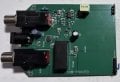
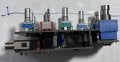
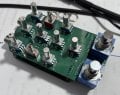
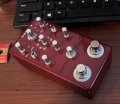
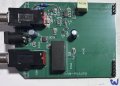
Yes. I started learning about RC networks in late 2022 here on AAC! The circuit in this thread is the JFET input and buffer (bottom board) before the larger EQ circuit (top board with all the knobs). I have spent over 2 years designing/prototyping this, doing extensive bode plots in spice and on my scope. I probably understand the AC frequency response better than the DC voltages.

IMG_8183.jpeg

IMG_8184.jpeg

IMG_8176.jpeg

The AC response changes since the low-frequency rolloff is determined by the R7C5 time-constant, while the bias voltage is only changed slightly by the op amp input bias current (from the op amp data sheet) that flows through R7.
The voltage difference between the two op amp inputs is quite small, being determined by the open-loop gain vs. the closed-loop gain, and the intrinsic input offset voltage of the op amp (again in the data sheet).
I need to think about this...

Thanks for the help, I appreciate your patience.
 

Thread Starter

rpschultz

Joined Nov 23, 2022
821
It works! I modified one of the prototypes boards per post #7:
  • Removed R9, 100k to ground.
  • Removed R10, R11 and C9, bridging R10

IMG_8196.jpeg

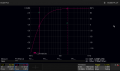
Here's the bode plot, fc=19 Hz. Not exactly as calculated in post #14, but close enough.

SDS804X_HD_PNG_3.png
 
I don't think that stage is intended to be a textbook differential amplifier. It looks more like an AC-coupled audio gain stage where the resistor network around the op-amp is setting the gain and bias conditions rather than implementing a pure differential function.

Regarding the gain discrepancy, I'd double-check the exact op-amp model, source impedance, and how the measurement is being taken in SPICE versus on the actual circuit. A 1 dB simulated gain versus a measured 6 dB gain suggests there may be something missing from the model or test setup.

As for removing C6 and R7, I'd be careful. Even if they contribute to the low-frequency roll-off, they may also be part of the biasing and stability network. The fact that you're still seeing a cutoff around 35 Hz suggests another RC network in the signal path is setting the dominant high-pass corner frequency.

Check these resources on high-pass filters:
https://electronics.stackexchange.c...nfiguration-with-diodes-and-electrolytic-caps
https://www.unikeyic.com/blog/designing-iir-filters-in-matlab-for-bh1790glc-heart-rate-sensor.html
https://www.digikey.com/en/maker/tu...er-understanding-an-electronic-filter-circuit
 

crutschow

Joined Mar 14, 2008
38,529
Here's the bode plot, fc=19 Hz. Not exactly as calculated in post #14, but close enough.
But that's for the rolloff at two different places.
My calculation was just for the C4/R7 rolloff.
The added rolloff from C9/R22 is the difference, as the -3dB sim rolloff at the op amp output is 16Hz, close to the 15.9Hz calculated.

The sim shows -3dB at 18.6Hz at the C9/R22 output, close to your circuit measurement of 19Hz.
 
Last edited:

Thread Starter

rpschultz

Joined Nov 23, 2022
821
I don't think that stage is intended to be a textbook differential amplifier. It looks more like an AC-coupled audio gain stage where the resistor network around the op-amp is setting the gain and bias conditions rather than implementing a pure differential function.
Assuming this is true, what advantage/disadvantage would this have compared to the simple buffer config @crutschow suggests in post #7?
 
I'm having a hard time understanding what resistors match up with the textbook differential op amp, because there's only 1 resistor connected to the + input and 3 connected to the - input.
The circuit around U1A (NE5532) is a 2nd order Sallen & Key HP filter with a gain of 2. R9 is normally connected to the output of the op amp and not to the inverting input. With this modification the roll-off at very low frequencies is less than 40dB per decade.

If you're looking for a differential amplifier, the balanced MIC input of the Fishman Mini has one, followed by a S&K HP filter similar to the one used in the line input preamp.
 
Top