Diac Oscillator CCT. A little help.

Thread Starter

electrician84

Joined Feb 13, 2018
3
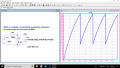
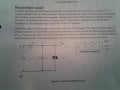
1st of all, check the attachment. It's from my electrician books.

Q-What is it that causes the capacitor to discharge at all?
A-It must be the diac falling below breakover voltage but what make it fall in the first place?

Can someone draw the waveform of the capacitor layered on top of the sawtooth wave? I just can't make it match up without contradictions.

20180213_145842.jpg
 

kubeek

Joined Sep 20, 2005
5,796
A t=0 Vdc is applied and C starts charging through R. As the voltage rises, it gets to the point where the diac breaks down and starts to conduct, discharging C. After C is discharged enough for the current throuh the diac to fall below its treshold, it stops conducting and the cycle starts again.
 

Dodgydave

Joined Jun 22, 2012
11,395
A diac is like two zeners back to back, that conducts when the voltage reaches 30V across it, then it has a Negative resistance and will let current flow until it reaches a minimum value, then it turns off, the minimum voltage is around 5 to 10V. Diacs are mainly found in AC dimmers or speed controls with a Triac.
 

AnalogKid

Joined Aug 1, 2013
12,077
Vout is connected directly to one end of the capacitor. GND is connected directly to the other end. Therefore, the sawtooth wave *is* the voltage across the capacitor.

A DIAC is a non-linear, asymmetrical device that exhibits hysteresis. If you remove the capacitor so the entire circuit is an input voltage, a current-limiting resistor, and the diac, and apply 50 V to the circuit, the DIAC will either conduct or not conduct. Sounds obvious, but it is more complicated than that. Whether or not there is conduction depends on how the 50 V got there. If you turned the power source up from 0 V to 50 V, the DIAC will not conduct because its breakdown voltage is 60 V. If you applied the power source at 100 V and then turned it down to 50 V, the DIAC will be conducting because the voltage across it exceeded its breakdown rating. Once the DIAC is conducting, it will stay that way until the voltage across it drops below its cutoff voltage (10 V in the example). Then the DIAC turns off, and will not conduct again until the voltage across it exceeds 60 V.

ak
 

ian field

Joined Oct 27, 2012
6,536
1st of all, check the attachment. It's from my electrician books.

Q-What is it that causes the capacitor to discharge at all?
A-It must be the diac falling below breakover voltage but what make it fall in the first place?

Can someone draw the waveform of the capacitor layered on top of the sawtooth wave? I just can't make it match up without contradictions.


View attachment 145892
The diac is a breakover device - pretty much a triac with no gate (its triggered by reaching its breakdown voltage). As long as the feed resistor supplies less than the holding current, the gateless triac triggers and shunts the capacitor down to a very low voltage. with no holding current, it releases and the resistor starts charging the capacitor for the next cycle.

The diac is bidirectional and pretty handy for AC circuits. The programmable unijunction is popular for DC work - its basically a thyristor with 2 gates - one at each end. The circuit arrangement is different, but the 2 devices have a fair bit in common.
 

Threeneurons

Joined Jul 12, 2016
30
The DIAC not just two zeners back to back. It does not conduct until the voltage drop reaches the "strike" voltage (nominally between 30 to 35V, depending on device). Then it stays ON until the voltage drops below its "drop-out" voltage (usually between 10 and 15V). This property is important when properly driving a TRIAC. If you look at a typical TRIAC, it may need several 10's of milliamps to trigger. Look at a motor speed control, or lamp dimmer circuit. The energy that triggers the TRIAC comes from a small capacitor, in the ballpark of 0.1uf. When the voltage across it hits the DIAC "strike" level, current from it flows thru the DIAC into the TRIAC gate. Enough energy must be passed to turn ON the TRIAC. This means the voltage across the cap will drop. If the DIAC stops conducting immediately, then the TRIAC may not trigger. Having that lower dropout voltage, lets the cap deliver a significant amount of its energy, at a very high, but brief current pulse (W = 1/2CV^2, where W is work[energy]).

Look up neon relaxation oscillators: https://en.wikipedia.org/wiki/Pearson–Anson_effect

You can use DIACs in place of neon bulbs, in neon logic circuits, including counters, using this effect. But with voltages a 3rd, that of neon bulbs.

A spark gap, will also work as a relaxation oscillator. I made one using a 2KV supply, that oscillated ~1MHz.
 

PAFMC01

Joined Mar 20, 2013
12
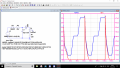
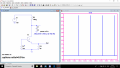
This is not a thyristor.It contains two pn-junctions.Has a symmetrical structure.This is how the simulation with my model looks
View attachment 146312
I think you will find a diac IS a class of thyristor. Thyristor family comprises Triacs, SCRs, SCS, SBS, PUT* and Diacs. (probably a couple more I have forgotten)

As an aside: a PUT (Programmable Unijunction Transistor) has no kinship at all with a UJT (UniJunction Transistor) The former is also a 4 layer device and the latter is a single PN junction.

Like thyristors and triacs the Diac is a 4 layer device but instead designed to be used in breakover mode. It can be modelled as a triac without a gate, and with a deliberately low (typically 30 to 40 volt) breakover. Each model diac has its breakover voltage tightly specified.

You call it a double pn junction device, but that characterisation does not show off the way it works. The positive feedback giving rise to negative resistance modelling makes it more a PNP-NPN combo just like a triac, where the NP junction of the PNP transistor equivalent is the same as the NP junction of the NPN equivalent transistor.

It is not an NPN (or even a PNP). To get the negative resistance characteristic you need the extra layer hence PNPN (or equally NPNP)

one reference: http://hyperphysics.phy-astr.gsu.edu/hbase/Electronic/diac.html

another https://www.quora.com/What-is-the-difference-between-Triac-and-Diac-What-are-some-examples

Love your model and waveform graph - totally right, just disagree with your characterisation of the diac.
 

takao21203

Joined Apr 28, 2012
3,702
so maybe even a simple LED has some hysteresis and could be pressed to workk as oscillator.
It has capacitance certainly so why use additional capacitor, though if it blinks it will be too fast to see it.
 

Bordodynov

Joined May 20, 2015
3,430
I think you will find a diac IS a class of thyristor. Thyristor family comprises Triacs, SCRs, SCS, SBS, PUT* and Diacs. (probably a couple more I have forgotten)

As an aside: a PUT (Programmable Unijunction Transistor) has no kinship at all with a UJT (UniJunction Transistor) The former is also a 4 layer device and the latter is a single PN junction.

Like thyristors and triacs the Diac is a 4 layer device but instead designed to be used in breakover mode. It can be modelled as a triac without a gate, and with a deliberately low (typically 30 to 40 volt) breakover. Each model diac has its breakover voltage tightly specified.

You call it a double pn junction device, but that characterisation does not show off the way it works. The positive feedback giving rise to negative resistance modelling makes it more a PNP-NPN combo just like a triac, where the NP junction of the PNP transistor equivalent is the same as the NP junction of the NPN equivalent transistor.

It is not an NPN (or even a PNP). To get the negative resistance characteristic you need the extra layer hence PNPN (or equally NPNP)

one reference: http://hyperphysics.phy-astr.gsu.edu/hbase/Electronic/diac.html

another https://www.quora.com/What-is-the-difference-between-Triac-and-Diac-What-are-some-examples

Love your model and waveform graph - totally right, just disagree with your characterisation of the diac.
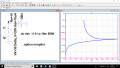
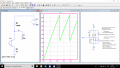
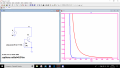
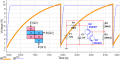
Answer the question: to what voltage will the capacitor discharge when using a thyristor and a triac. Tip ~ 1V. The thyristor and the triac consist of not identical pn-junctions. There is such a structure that you described, called SIDAC. It performs functions similar to the DIAC, but discharges the capacitor to 1V.Another. The transistor in avalanche mode has a negative impedance. Both in direct and reverse mode. Therefore, it is sufficient to make a symmetrical transistor and it will perform the role of Diac. By the way, one of the signs of Diac is a symmetric transistor.
See
1.png 2.png 3.png
 

Danko

Joined Nov 22, 2017
2,152
One more PNPN structure utilization:
PNPN_structure.png
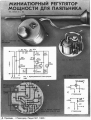
In attachment - DIY regulator for soldering iron, using circuit above.
Soldering_iron.png
 
Last edited:
Top