Designing circuits for military applications

nsaspook

Joined Aug 27, 2009
16,336
Considering the quality of the majority of current consumer electronics and it becomes obvious why mil-specs are so demanding. The relative stress levels are quite different. I clarified that in one job interview when they asked about how I handled stress, specifically.
I replied that I tried to avoid it. Then they asked what I considered "high stress". I responded: "Coming under heavy automatic weapons fire." They assured me that was not part of the job, and hired me. And they were correct.
The point being that in many tactical situations there is no room for equipment failure to perform perfectly. Lives and more depend on it.
Mil-Spec can be a double-edged sword. When you have a product designed for Shock Tests and Navy requirements it's also not that easy to destroy it with simple hammers and hand tools. We had procedures for emergency destruction (smash and dump overboard in lead-lined sacks) of classified materials and equipment. NK, Iran and Russia managed to get sufficient information from 'destroyed' equipment to reverse engineer some cryptographic equipment because it was so tough to completely sanitize without using something like thermite explosives inside the ship.

Iran
1718327309163.png
Various exhibits show communications devices and encryption equipment used by US embassy staff

1718327594046.png
1718327415653.png

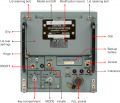
As the raid came rather unexpectedly, communications personnel had to rush in order to get all crypto gear destroyed in time. The image above shows part of the communications room in the embassy, with a KW-7 unit clearly visible at the front. It has been pulled out of the 19" rack, the top has been removed and the critical cipher boards have been taken out and destroyed.

NK
https://pbase.com/bmcmorrow/usspueblo

1718328355178.png
1718327901957.png
The North managed to get a almost complete set of machines from the ship because they had too much equipment, too few sledge hammers and the destruct order from 'God' came too late.
 

MisterBill2

Joined Jan 23, 2018
27,642
I am aware that some un-named aircraft had acid bottles rigged for damaging cryptograpic systems. But even that was not totally effective. Automatic weapon fire can be effective but in close quarters it is always hazardous.. Grenades, properly placed, are able to d a fair amount of damage, but that is very hazardous.
 

atferrari

Joined Jan 6, 2004
5,015
I want to start building electronics projects intended for use in military and naval applications. Naturally, the PCBs and their respective components must be absurdly durable and reliable, being able to withstand extreme temperature, pressure, shock, and corrosive environments.

A good place to start is using low profile ICs and components, in addition to abiding by the IPC class 3 standards. What are some other measures I can take to make sure these circuits are fool proof? What about the board mounted cable connectors? The Molex ones I have are quite tall and seem like they could break a solder joint if stressed too hard.

All input is greatly appreciated!
Justin
The first thing I would do is convincing myself of not using the expression "absurdly".
 

Tonyr1084

Joined Sep 24, 2015
9,744
KAPL wanted to buy four of the units I designed but could not find "Bear Products". Now my department head had to explain things.
Funny story. I had a similar experience at one company. One of our inspectors were named Roslyn. She and I were always at odds. Roz was a pain in the arse. I was working on a high voltage circuit board (ignition control board) and it was being a big pain in the arse as well. So I started referring to it as the Roz board. Engineers within the company were unaware of the relationship and had to call me into a meeting to explain what the Roz project was.
I am curious what others have done specifically to make PCBs and electronic systems more reliable and rugged.
My experiences with engineers, one who shared with me their mantra, said that when designing commercial products they'd build it with the normal usage in mind and then engineer a product that would meet those "normal" conditions by designing a product to 133% of normal conditions. When engineering for the military they'd design to 150% of normal conditions.

My mother-in-law had a washing machine, new, and broke down just outside the warranty. It was a mode shift coil that was designed to work at 102% of normal. The coil simply shifted between agitate and spin. Easily replaced but unavailable. You'd have to buy the whole mechanical guts at $135.00. If you had a repairman do the job you were looking at $400 total cost. I fixed the coil for $1.99 plus tax. It was a failed "fusible link". My MIL didn't pay me for fixing her machine. And I went for 146% normal use. Why 146? That was just what I was able to find. What does that mean? IF (and I am making up numbers now) if the link was designed to burn out at 200˚F the one I put in wouldn't fail until 292˚F. I don't think those were the actual numbers, I don't recall the actuals as that was about 15 years ago.

"Robust plus" is what the product you build is going to have to face. Even if it's something as simple as a nylon foot for a stool.
 

MisterBill2

Joined Jan 23, 2018
27,642
Of course, now that I went back and looked at post #1 again, I see that the discussion has gone astray. "Designing Circuits" is a whole lot different from designing and producing hardware. Really, creating a circuit design might even be the easy part of any mil-spec project. Even optimizing it might be a lot more effort than just creating the design.
In that case, the ts should seek employment with one of the companies that produces products for the military groups.
 

Thread Starter

WakelessFoil

Joined Apr 16, 2020
28
Of course, now that I went back and looked at post #1 again, I see that the discussion has gone astray. "Designing Circuits" is a whole lot different from designing and producing hardware. Really, creating a circuit design might even be the easy part of any mil-spec project. Even optimizing it might be a lot more effort than just creating the design.
In that case, the ts should seek employment with one of the companies that produces products for the military groups.
I am doing this work for someone else, I am not trying to start my own contracting business. I am speaking hypothetically as not to disclose sensitive information. Unfortunately that backfired...

I suppose it was my fault. I should've been blunt and specific.

If I put a PCB in a box, throw it into salt water, and set off a bomb next to it, what are some not-obvious ways I can modify the PCB/components to protect it from the shock and elements? It needs to operate flawlessly under these conditions with no faults in 114 years.
 
Last edited:

nsaspook

Joined Aug 27, 2009
16,336
Of course, now that I went back and looked at post #1 again, I see that the discussion has gone astray. "Designing Circuits" is a whole lot different from designing and producing hardware. Really, creating a circuit design might even be the easy part of any mil-spec project. Even optimizing it might be a lot more effort than just creating the design.
In that case, the ts should seek employment with one of the companies that produces products for the military groups.
Did you really think the discussion was actually about the OP designing and producing hardware? If you need to ask here about that sort of thing, it's a sign IMO the question is not very serious.
 

dl324

Joined Mar 30, 2015
18,360
I want to start building electronics projects intended for use in military and naval applications
If you're referring to the US military, it doesn't work that way. It's highly unlikely that they'd contract with some unknown, unproven company.

When I got my ASEET degree, I hoped to work for a company named ESL who's primary focus was military projects. I was enthralled by the stories several guys who graduated before me told.

When I worked at HP Labs in the late 1970's, we had a military contract to design some GaAs logic chips for them. They wanted something that was faster than MECL which topped out at around 300MHz back then. The GaAs circuits were around 10X faster.
 

Thread Starter

WakelessFoil

Joined Apr 16, 2020
28
If you're referring to the US military, it doesn't work that way. It's highly unlikely that they'd contract with some unknown, unproven company.

When I got my ASEET degree, I hoped to work for a company named ESL who's primary focus was military projects. I was enthralled by the stories several guys who graduated before me told.

When I worked at HP Labs in the late 1970's, we had a military contract to design some GaAs logic chips for them. They wanted something that was faster than MECL which topped out at around 300MHz back then. The GaAs circuits were around 10X faster.
Read earlier messages. ^
 

ErnieM

Joined Apr 24, 2011
8,415
Back 10 years ago the company I worked for was making an aerospace box (build to print) controller.

It had a covered switch marked "Zeroize." That told the computer things to clear the memory.
 

MisterBill2

Joined Jan 23, 2018
27,642
OK, although my rugged stuff experience has been auto electronics and industrial machines. The causes of failures in a system created with adequate margins are motion caused by shock and vibration, and also thermal cycling. Aside from those external forces, some components just age-out.(aluminum electrolytic capacitors.)
So the very first step to reliable products is to use reliable components and operate them well within their ratings. Then make sure that they can not move relative to their mountings because that either breaks the component or it's solder connection.
Thermal cycling is usually not avoidable, but reducing the amount should be the goal. A thermally conductive encapsulation material can help, and also reduce or eliminate motion. Those methods work in both mobile equipment and in industrial stuff.
But they also make any servicing or repairs a lot more work.
 

nsaspook

Joined Aug 27, 2009
16,336
Back 10 years ago the company I worked for was making an aerospace box (build to print) controller.

It had a covered switch marked "Zeroize." That told the computer things to clear the memory.
That was on some things that had internal crypovarables.

1718407270447.png
1718407311383.png
In the old days we had a special code tape dispenser for the KG-84 cryptovariable tape reader, that was replaced by the FILL module, so the code couldn't be copied after use.

We had two other special switches for sensitive devices.
1. Battle-short. Disable power and thermal protections, run until melted.
1718407780307.png
2. A enable switch for electronic self-destruct. A relay circuit to put high voltage on the logic and power lines of the internal circuit boards.
 

MisterBill2

Joined Jan 23, 2018
27,642
I recall seeing a piece of old radio equipment with a switch just tagged "BATTLE", and asking about it. It bypasses all of the fuses, an interesting concept indeed.But I did wonder how it bypassed the fuse for the dynamotor that drew about 35 amps.
 

Reloadron

Joined Jan 15, 2015
7,892
If I put a PCB in a box, throw it into salt water, and set off a bomb next to it, what are some not-obvious ways I can modify the PCB/components to protect it from the shock and elements? It needs to operate flawlessly under these conditions with no faults in 114 years.
Then you start with the box making sure it meets mil spec for waterproof integrity to a specified depth and once the guts are in the box you do mil spec shock and vibration testing and any other testing the contract calls out. I have no idea what the product is and really matters not to me. Your board and any / all components must be mil spec. For example you would not use a SN7400 IC on your board, you would use a SN5400 (standard versus mil spec), the latter is a mil spec version of the same chip.

Many Military Standards have been replaced over the years where ISO and AMS specifications are called out. Really depends on the product which specs may or may not apply. Often if a contract is involved the contract will spell out what specifications need to be met. Again, it all depends on the product. Whoever is making the product should know what specifications the product must meet and any testing methods and procedures for final acceptance of the product. There is much more to it than opening a widget factory.

I generally start with a theme tablet and a pencil with a large eraser. Oh yes, you may want to start with IPC-A-610E class 3 standards as an intro to circuit boards.

Ron
 

Thread Starter

WakelessFoil

Joined Apr 16, 2020
28
The causes of failures in a system created with adequate margins are motion caused by shock and vibration, and also thermal cycling.
Very good point. I had not thought about thermal cycling. I remember working on old Macs as a teenager and the big components detaching from the vertical power supply board. Those things got pretty toasty considering the lack of active cooling.
 
Top