Design Wireless I/O for sprinkler controller. What I/O to use?

Thread Starter

ZBOLTMAN

Joined Jul 5, 2025
8
Designing a wirelss I/O to go from the garage RAINBIRD sprinkler, (Front yard), controller to the backyard system.
Need 4 channels. Needs to transmit RF for 100FT thru 4 walls, glass and stucco.
Was going to buy this:
AC 100 110V 220V 4CH RF Wireless Remote Control Switch Radio Receiver With 2000M Long Distance Remote Controller Suckers Antenna - AliExpress 44
I would then open the transmitter, solder into the PB pads, using 4 relays and small full wavebridge for each.
(The rainbird puts out 24vac, convert it to DC for the relays to close the contact for the PB input.)
For the receiving end, I was going to use SOLID state power relays after the simple provided relays. Will design a snubber circuit for them.

Any better Ideas on how to transmit 4 channels? Any other ideas for this concept?
 

sghioto

Joined Dec 31, 2017
8,634
Why not use 24vac relays or possible ac input optocouplers like the PC814 to activate the transmitter buttons.
Why do want to use SSRs, what's wrong with the relays in the receiver?
 

Thread Starter

ZBOLTMAN

Joined Jul 5, 2025
8
Why not use 24vac relays or possible ac input optocouplers like the PC814 to activate the transmitter buttons.
Why do want to use SSRs, what's wrong with the relays in the receiver?
I am on a curious budget.... My Wife says if I can't design a wireless system for less than the cost of a new sprinkler controller, then forget it. I'm using what stock I have on hand. Have alot of In4001 diodes and 24vdc relays. Although that PC814 chip looks very tempting...
As for the receiver end of things. This unit will be outside and will get very HOT. I've read that SSRs endure the high temps better.
Going to use a tiny filtered temp controlled cooling fan with the opening on the bottom of the enclosure.
Also, because the loads are inductive coils; Even with a diode, I've seen what they do to mechanical relays.
This is a design challenge for me. I want to try the impossible with as little as possible.
 

MisterBill2

Joined Jan 23, 2018
27,359
OK, I see a bunch of concepts here. Using SSRs INSTEAD of mechanical relays makes sense. The question then is indeed the control link. First, it will need to be powered from somewhere, and that will need to provide power to operate the 24 volt AC valves. A single analog receiver with four tone sensing resonant tuned circuits can trigger the different valves. Those would be simple LC tuned circuits , resonant in the audio frequency range. They also could be"Touch-Tone frequencies, allowing the use of available hardware. Yes, I have left out some details. My choice would be a wired link, since a power connection is still required.
 

sghioto

Joined Dec 31, 2017
8,634
This is a design challenge for me. I want to try the impossible with as little as possible.
If you decide to go with that wireless relay module it would be more efficient if the module is set for toggle ON, toggle OFF.
The 24 volt DC relays would need to be pulse for say 500ms when a zone is activated and deactivated. This will save a lot of battery in the transmitter.
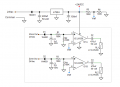
I have put together a circuit to do this below using only a few dollars worth of components if interested.
Will need two of the circuits seen in the gray box for 4 zones.
1752189804514.png
 
Last edited:

Thread Starter

ZBOLTMAN

Joined Jul 5, 2025
8
If you decide to go with that wireless relay module it would be more efficient if the module is set for toggle ON, toggle OFF.
The 24 volt DC relays would need to be pulse for say 500ms when a zone is activated and deactivated. This will save a lot of battery in the transmitter.
I have put together a circuit to do this below using only a few dollars worth of components if interested.
Will need two of the circuits seen in the gray box for 4 zones.
View attachment 352445
Thank you so very much for that. It is spot on for what I need.
 

MisterBill2

Joined Jan 23, 2018
27,359
Another question about any relays, because suddenly the whole project seems to be getting rather complex. While there may be adequate isolated alternate action modules available, it is not likely that an adequately rated alternate action SSR is available.
For starters, the concept of linking the wireless transmitter to the Rainbird controller will result in destruction . Use opto-isolators for the interface, with the diode bridge and a series resistor to limit the opto-coupler input current to a safe value.
On the receiver end, you need to interface whatever the output is to control the relays to operate the water valves.

Presently it seems unlikely that the wireless link will cost less than the second Rainbird controller. BUT the option of a wired remote extension seems reasonable. I am guessing that the existing controller has more outputs that are not presently connected.
 

sghioto

Joined Dec 31, 2017
8,634
No destruction as the relay contacts will isolate the Rainbird from the Transmitter.
I suggested using PC814 optocouplers earlier as they don't require rectification.
 
Last edited:

MisterBill2

Joined Jan 23, 2018
27,359
No destruction as the relay contacts will isolate the Rainbird from the Transmitter.
I suggested using PC814 optocouplers earlier as they don't require rectification.
The sprinkler controller devices that I have had to work with all had 24 volt AC output connections for the solenoid valve. Only the outputs and one common were conveniently accessible. Getting to the relay contacts, or the power switching solid state device, would have been a big deal. It has been quite a few years since then, I do not recall the brand of that controller.
 

sghioto

Joined Dec 31, 2017
8,634
The sprinkler controller devices that I have had to work with all had 24 volt AC output connections for the solenoid valve. Only the outputs and one common were conveniently accessible.
That is Correct.
In this proposed setup the 24vac outputs from the Rainbird will momentarily activate an external 24 volt DC relay and circuit whose contacts will be wired across the buttons in the transmitter. The output from the receiver will activate SSRs with snubbers to drive the solenoid valves
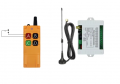
Possible TX and RX unit the TS suggested
1752184222693.png
 

MisterBill2

Joined Jan 23, 2018
27,359
THAT is getting a bit complicated. You could use opto-isolators, much smaller than most relays. AND,REALLY, how difficult would it be to rout a 5 conductor cable?? at 24 volts it can go with "Class C" wiring rules.
 

Thread Starter

ZBOLTMAN

Joined Jul 5, 2025
8
That is Correct.
In this proposed setup the 24vac outputs from the Rainbird will momentarily activate an external 24 volt DC relay and circuit whose contacts will be wired across the buttons in the transmitter. The output from the receiver will activate SSRs with snubbers to drive the solenoid valves
Possible TX and RX unit the TS suggested
View attachment 352464
That is exactly the scenario I was planning. The Old outside box has a 120 feed so I will have a nice 24ac power supply and convert that to DC for other components. I plan doing a tiny power unit to keep the transmitter going without battery.
 

sghioto

Joined Dec 31, 2017
8,634
In that case the relay circuit I posted is not needed assuming the transmitter can operate continuously over the time needed.
According to the specs it operates on 9 volts at 13ma so probably fine
 
Last edited:
Top