Design of a timed multiple leds lamp

Thread Starter

Karenzee

Joined Mar 6, 2015
47
Hi,


i'm trying to design a led lamp with four leds who will be turned on/off on a precise time.

The leds are rated 1w: 2.4-2.6 and 3.2-3.6 forward voltage and 350ma.

A single on/off switch then the cycle:

first led 3 minutes on then off, second led 30 seconds then off, third 3 minutes and fourth 30 seconds.

the casing is in aluminum and and the led are spread 1.96 inches apart and fixed to an aluminum radiator (no fan)

I don't know what would be the easiest and compact solution for a timed circuit like this.

I'll appreciate any suggestions.

Thanks!
 

dl324

Joined Mar 30, 2015
18,402
I'm thinking a 556 dual timer and a handful of resistors, capacitors, and transistors.

What accuracy do you require?
What is the operating voltage?
What are the space constraints?
 

wayneh

Joined Sep 9, 2010
18,127
I’m pretty sure it could be done also with a single clock and a counter, since everything happens in increments of 30 seconds.
 

Thread Starter

Karenzee

Joined Mar 6, 2015
47
The only constraints are size and weight (placing can be either vertical or horizontal)

The cycle is exactly as described 30 minutes (to the seconds) and 30 seconds.

It's switch off/on cycle (no pause between the leds)
 

danadak

Joined Mar 10, 2018
4,057
If I have time I will try this, but I think this will work. One chip.
Only external is switch and a bypass cap for power and mosfets
to drive leds.

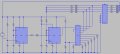
upload_2018-12-17_19-28-11.png

Basically its a chain of one shot counters to generate the interval, and a LUT
to cycle sequentially the leds based on when its timer starts. I can reduce HW
even more if code is used vs all this HW. To just one PWM and the debouncer.

As it stands it only uses roughly 25% of the parts capability/resources.

Regards, Dana.
 

dl324

Joined Mar 30, 2015
18,402
OP is looking for an "easy" and "compact" solution.

Two 555 timers is one IC and a handful of discrete components.

A clock, counter, and decode logic is at least 3 IC's.

It's unclear what the solution in post #5 is using. A PSOC4?
 

danadak

Joined Mar 10, 2018
4,057
As stated earlier one chip, the schematic shown is just part
of the resources inside chip, so one chip is all thats needed.

It is a PSOC4.

Only external needed is switch, and a cap for bypass of the PSOC. And power
msofets to take care of the high current drive needed by LEDs. 555 also
needs MOSFETs, its only good for 200 ma.

Timing accuracy is +/- 2% over temp and V. Or add 32 Khz xtal, 2 caps,
and then accuracy << 1% total.

if I use code more HW can be released internal, would take 1 debouncer,
one timer, and code. The it would be easy to do 100000+ LED sequence.

Regards, Dana.
 
Last edited:
You failed to mention what power supply you intend to use. Take a look at www.picaxe.com for a 5th grade solution.
One ULN200x IC's and resistors for each LED could drive 7 LED's. You need a digital I/O port per LED,

An I/O expander could be used if only I2C was available.
 

danadak

Joined Mar 10, 2018
4,057
I guess if the only tool you have in your tool box is a hammer, everything looks like a nail...
Could do this with a 186/286/386/486/I7/Microcip/ATTINY/Freescale..............I like those
tools as well. But not quite as much for the low end stuff as PSOC Whats to not like about
routability analog and digital, extensive analog, DSP, 20 bit A/D, SAR, DMA, custom
internal component creation........

555 timers are like 8051 CPU, you can still get the 8051, but why use a part thats a
fraction of todays capability and ease of design. That would be an advocate of pony
express mail delivery, still works, but its funky.

Regards, Dana.
 

danadak

Joined Mar 10, 2018
4,057
The picaxe stuff getting pretty interesting. I still like being close to the
HW, but then I am using lots of wizards in tools that remove me one
layer at a time from HW. Pulling me kicking and screaming into the 21'st
century :).

Regards, Dana.
 

eetech00

Joined Jun 8, 2013
4,709
Hello

Here's another way to do this, but not that compact (takes 3 chips). Although the AND gates might be replaced with diodes.
The mosfets are shown driving resistors as loads but are intended to drive LEDs.
I didn't check the mosfet specs...just grabbed them out of the LTspice junkbox. :D

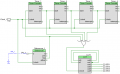
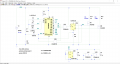
I checked the CD4060 timing circuit on a breadboard but the rest of the circuit was only simulated. When the circuit powers up, RL2 energizes then after 3 minutes shuts off, then RL1 energizes for 30 seconds then the circuit resets. The cycle then starts over.
It should work.

eT

LEDTimer.png
 
Last edited:

Picbuster

Joined Dec 2, 2013
1,059
Hi,


i'm trying to design a led lamp with four leds who will be turned on/off on a precise time.

The leds are rated 1w: 2.4-2.6 and 3.2-3.6 forward voltage and 350ma.

A single on/off switch then the cycle:

first led 3 minutes on then off, second led 30 seconds then off, third 3 minutes and fourth 30 seconds.

the casing is in aluminum and and the led are spread 1.96 inches apart and fixed to an aluminum radiator (no fan)

I don't know what would be the easiest and compact solution for a timed circuit like this.

I'll appreciate any suggestions.

Thanks!
Use a pic12f675 a mic29 for it's power 4 mosfets to drive leds and a couple of caps and resistors.
Use the internal clock 4Mhz and make a counter of 0.1 seconds or use a xtal when higher accuracy is needed.
count to 30 min * 60 sec / 0.1 sec counter tick = 18000 for 30 minutes.
A simple program will do the job should fit one A4.

Or use a pic16f690 / 18f14k22 or higher add usb or rsr232 allowing you to alter settings(timing) to store in pic's flash.

Picbuster
 

Thread Starter

Karenzee

Joined Mar 6, 2015
47
So far the 556 dual timers looks like the easiest and takes less space than other examples i saw being mentioned.

555 timers are like 8051 CPU, you can still get the 8051, but why use a part thats a
fraction of todays capability and ease of design. That would be an advocate of pony
express mail delivery, still works, but its funky.
But in this case it might not be the most suitable choice, still really appreciate the suggestion (still if by "funky" you meant less than accurate for this project it's more than relevant)

The picaxe stuff getting pretty interesting.
I agree thanks for the link.
 

danadak

Joined Mar 10, 2018
4,057
Because it can do the job less expensively and with less space??
If that's true go for it. But one ATTINY85 or one PSOC 4, can do all of this onchip, no
external timing components except chip bypass. And handle switch debounce and not
have loose timing due to electrolytic cap tolerance and T and V effects.

So one adds up the costs and board space and performance and makes the decision,
pretty straight forward.

ATTINT85 footprint - http://ww1.microchip.com/downloads/...ller-attiny25-attiny45-attiny85_datasheet.pdf

PSOC 4 footprint - http://www.cypress.com/file/138656/download

Regards, Dana.

PS : Timing accuracy of 555 in datasheet does not add in C and R tolerances. I am thinking
its 10% at best when ALL factors are evaluated. And notice their specs done with
.1 uF C, not a cap this design probably would need......
 
Last edited:

dl324

Joined Mar 30, 2015
18,402
So far the 556 dual timers looks like the easiest and takes less space than other examples i saw being mentioned.
Whether that will work depends on how exact you need the 3 minute interval to be. That will require a big capacitor (220uF) and leakage currents will be an issue. CMOS 555's would help some, but I don't think they come in a dual form. A CD4538 dual one shot would address the timer leakage, but the capacitor leakage is still a concern. You could address that by selecting a timing resistor that gives you the correct times based on the particular cap used (which will probably have a 20% tolerance).

Initially I was thinking a discrete T flip flop to alternate between the two sets of LEDs, but that's more wiring and discrete components and can be finicky. Adding a D flip flop would be easier.

What is your area budget?
 

Thread Starter

Karenzee

Joined Mar 6, 2015
47
What is your area budget?
1k (circuit, extra parts, designing the box, etc...) i don't include the power supply in this.

There shouldn't be any pause between the leds (the perceived shut off time between the leds should be around 1 microsecond)
 

AnalogKid

Joined Aug 1, 2013
12,174
There are four mutually-exclusive outputs, so I don't think a couple of 555's are going to be a complete solution.

***Not counting development time***, can anything can beat an 8-pin PIC and four logic-level MOSFETs?

ak
 
Top