Design for a very narrow beam 915Mhz antenna

Thread Starter

Daniel M

Joined Dec 17, 2015
2
Hi guys,

I need some advice designing an antenna. I am a computer programmer by trade, I know microcontrollers and some electronics, but RF and antennas is really out of my league. Here's the thing:

I would like to build a narrow beam antenna, as narrow (and as portable) as possible, capable of sending through a LORA device a message aiming to a particular spot where another LORA device can receive it.
The receiver could receive from anywhere, so I think a "normal" antenna should do on the receiver side, but the sender should be restricted to the direction it points to, and if the receiver is not directly in line, the message sent should be ignored/lost.
To give you an idea of size, I wish to aim the target within a radius of 1 meter or 2, at a distance of about 100 meters, so well inside the capabilities of a low power 915Mhz LORA antenna.

Is such a thing possible? Am I dreaming? :)
Thanks in advance for your advices.
 

sagor

Joined Mar 10, 2019
1,049
Not sure I understand, but to get a focus point of 1M to 2M at 100M, you would need a huge dish antenna to get that kind of "focus" at 915MHz. Just not practical.
There are many Yagi style antennas for that band, with perhaps 15 to 20 elements, that would give a "focus" of about 30 degrees beamwidth at 915Mhz. That may be the best you can hope for. Those Yagi antennas would be perhaps 6ft to 8ft in length.
You have to remember that radio waves do bounce and scatter in various ways, and it is very difficult to create a radio "beam" that is only in one direction, with nothing radiating in other directions. There is always some RF in all directions, even if weak. At 100M, the receiver would pick up just about anything close by, even if an antenna is pointed away from it.
 

LowQCab

Joined Nov 6, 2012
5,101
So far, there is not enough information that has been provided to
determine whether or not what You want is practical, or not.

1)
How directional, ( in degrees ), must the Receiving-Antenna be ?
All details are important.

2)
How large may the Receiving-Antenna be ?

3)
How. and where. will the Receiving-Antenna be mounted ?

4)
What is the maximum number of degrees of coverage ( at -3db ),
must the Transmitting-Antenna be restricted to ?

5)
What are the maximum physical dimensions of the Transmitting-Antenna ?
.
.
.
 

Papabravo

Joined Feb 24, 2006
22,065
At higher frequencies than 915 MHz, dish antennas are used on both ends of the link. Rifle scopes are used to direct the transmitting antenna directly at the receiver. This is usually done across a valley, e.g. mountain to mountain on dry cool mornings and evenings. Check DX records for 247 GHz and 405 GHz.
 

Papabravo

Joined Feb 24, 2006
22,065
Not sure I understand, but to get a focus point of 1M to 2M at 100M, you would need a huge dish antenna to get that kind of "focus" at 915MHz. Just not practical.
There are many Yagi style antennas for that band, with perhaps 15 to 20 elements, that would give a "focus" of about 30 degrees beamwidth at 915Mhz. That may be the best you can hope for. Those Yagi antennas would be perhaps 6ft to 8ft in length.
You have to remember that radio waves do bounce and scatter in various ways, and it is very difficult to create a radio "beam" that is only in one direction, with nothing radiating in other directions. There is always some RF in all directions, even if weak. At 100M, the receiver would pick up just about anything close by, even if an antenna is pointed away from it.
Radiation patterns for a Yagi display significant energy off the back of the beam. I've made a number of surprising contacts during contests off the back-of-the-beam. That said I'm not really sure about the construction of dish antennas.
 

Thread Starter

Daniel M

Joined Dec 17, 2015
2
Thanks guys for your comments and advices. Now I understand a bit better what can or can't be done with RF, and it sure seems impracticable for what I had in mind. I'm just discovering LORA and have fun implementing a network of message exchanges using it. I guess I'll search for another way. My best bet would be an IR or laser beam but the detection from any direction on the received side on a larger area, and not just a small point seems a bit complex.
 

ronsimpson

Joined Oct 7, 2019
4,660
I don't see the need for a laser type beam. I have used Zigbee networks for a decade over long distance. Outdoors I do not like 2.4ghz! It is stopped by tree leaves, rain or high humidity. The 900mhz is good or the 5G is good. All of these are line of sight. The antennas need to see each other.
Use a mesh network if you can. With mesh data is passed in a hop, hop, hop fashion to get from one end to the other of the network.
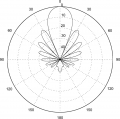
There are not many high gain antennas for 900mhz. I can find many at 2.4 and 5G that have patterns like this. Most of the energy is focused in one direction. You will not get much better than this.
1729427828988.png
 

LowQCab

Joined Nov 6, 2012
5,101
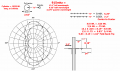
This design may be what You are looking for in a Receiving-Pattern ............
.
Super Simple Reflector 1 .png
.
.
For the Transmitter ..........
For better performance vs a Yagi,
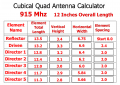
use a "Cubical-Quad" Antenna, with as many "Directors" as You deem necessary.

With these 2 Antenna designs working together,
You can reliably cover 2-miles of distance with 1-Watt of Transmitter-Power.
.
Standard Quad Dimensions .PNG
.
.
.
 

MisterBill2

Joined Jan 23, 2018
27,310
Actually an IR system can give the broadest coverage with just a few IR LEDs. Consider the new fad of replacing wifi with Light Fi. The concept of using IR to communicate using LED light fixture additions. Or maybe the fad has died out, I don't hear about it any more.
The benefits of using modulated light are that it is easily generated and not regulated, except at damaging amplitudes. And it can be focused or radiated in all directions.
 
Top