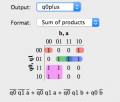
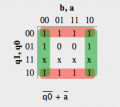
I guess I have already done the don't care conditions when assigning the next state, for example input a could be ba or !ba. But I thought if it is a rule of thumb to simply put don't care on the state 11 since that one is not obtainable with a D Flip Flop since the input is inverted and can only become 10 or 01 with one input D. But I am not sure about this...I guess my question is what do you mean by "forbidden state"? Perhaps you can change your state diagram to show what is meant? My suggestion would be to always go back to the state diagram when making changes. Then, go forward again. I think making changes at the K-map stage is not clear and error prone.
There are ways to perform state minimization which can save logic but that is a relatively complicated step. The other thing is to look for common minterms between the k-maps. I don't see any.
I would be interested in your "forbidden state" step. Maybe I can learn something!
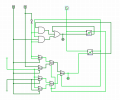
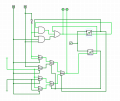
I used muxes because the gates in our lab-kit were not enough, but sure, I'll make a new one with AND and OR gatesI cannot understand this schematic. Can you do it just with standard sum-of-products form. AND and OR gates and put on some net labels? Why muxes?
Not chaotic. It's beautiful. Your layout is very clear. Does it work?View attachment 224424
kind of chaotic
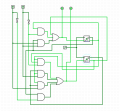
There is at least one error in your "all gates" schematic. It goes not match the minterms in the k-maps and is different than the "gate and mux" schematic. I strongly suggest adding net names. It looks like some confusion between the q0 and q1 outputs.Nope, I have been trying all day. Trying to go through it slowly step by step...
It works great with logisim...
View attachment 224459