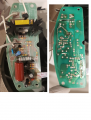
Dehydrator heater question

Thread Starter

kenzo42

Joined Feb 26, 2014
45
Disclaimer: Forgive me for my noobness. I know playing with mains is dangerous.

I'm on 120v here in the US. I wanted to make a (Arduino heater and fan controlled octocoupled relay) "smart dehydrator" based on the attached circuit that someone designed on Thingiverse. However, I noticed in the design, he doesn't step down the 120v for the heating coil (a lot of small things were left out since the creator didn't intend it to be a walk-through).

I've heard heating coils are basically resistors so they are not needed. So my question is can the heater coil connect directly to 120v like it is pictured in the drawing? I would bypass the circuit boards since I believe they are solely for temperature control and timer.
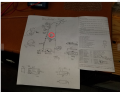
Untitled1.png
board.png
Thermal fuse, relay, line length, and having it wired will all be done according to his diagram.

wiring.png

Thank you
 

LowQCab

Joined Nov 6, 2012
5,101
Everything depends on the actual Hardware that You have to work with,
and exactly how the Temperature will be regulated.

What is the ideal Temperature ?,
how accurate, and/or, "tight" does the Temperature control need to be ?,
how much Current does the Heating-Element draw ?

You probably only need a good High-Voltage, Mechanical, Heater-Thermostat.
.
.
.
 

Thread Starter

kenzo42

Joined Feb 26, 2014
45
Everything depends on the actual Hardware that You have to work with,
and exactly how the Temperature will be regulated.

What is the ideal Temperature ?,
how accurate, and/or, "tight" does the Temperature control need to be ?,
how much Current does the Heating-Element draw ?

You probably only need a good High-Voltage, Mechanical, Heater-Thermostat.
.
.
.
I'm using a Dallas temp sensor and DHT22 sensor for humidity. It'll range from 45-80 Celsius depending on which mode is set. Temp hysteresis - 0.4. Humidity hysteresis is 1%.

I do not know about the current draw. If I had that info, that would answer a lot of my questions. =) Is there a way to figure that out?
 

LowQCab

Joined Nov 6, 2012
5,101
I'm using a Dallas temp sensor and DHT22 sensor for humidity. It'll range from 45-80 Celsius depending on which mode is set. Temp hysteresis - 0.4. Humidity hysteresis is 1%.

I do not know about the current draw. If I had that info, that would answer a lot of my questions. =) Is there a way to figure that out?
What is a Dallas temp sensor ?

To find out how much Current the Element draws,
go to Harbor-Freight and get a ~$20.oo Amp-Clamp-Meter,
then connect the Element to Line-Voltage, and Amp-Clamp one leg of the Line-Cord.
The Current right at start-up is what is important.
The Current will drop-off after about ~30-sec to 1 minute.

You may not need to be concerned with the Current if
your 2 Controllers will directly handle the Load-Current.
Do You have links or PDFs for the 2 Controllers ?
.
.
.
 

Thread Starter

kenzo42

Joined Feb 26, 2014
45
What is a Dallas temp sensor ?

To find out how much Current the Element draws,
go to Harbor-Freight and get a ~$20.oo Amp-Clamp-Meter,
then connect the Element to Line-Voltage, and Amp-Clamp one leg of the Line-Cord.
The Current right at start-up is what is important.
The Current will drop-off after about ~30-sec to 1 minute.

You may not need to be concerned with the Current if
your 2 Controllers will directly handle the Load-Current.
Do You have links or PDFs for the 2 Controllers ?
.
.
.
Yes. Here's a link to the relays. The Arduino will monitor the temperature and humidity by the sensors which will in turn control the opening and closing of both relays.

DAOKI 5PCS 5V One 1 Channel Relay Module Board Shield with optocoupler Support High and Low Level Trigger https://www.amazon.com/dp/B00XAGT05...abc_K2H2XB976Z85F8V7ZK0S?_encoding=UTF8&psc=1

This is a Dallas sensor pdf.
https://www.farnell.com/datasheets/2345098.pdf

Thanks for the help.
 

LowQCab

Joined Nov 6, 2012
5,101
This is totally over-the-top crazy complexity for simply keeping Filament-Spools dry.

A small room, ( like a Closet ), with a Dehumidifier inside is all You need.
If You want to make it as dry as possible,
simply put a small "Space-Heater" inside the Closet, along with the Dehumidifier.

And, You certainly don't need "precision" Temperature and Humidity control.

Dehumidification of a Full-Spool of Filament that has been
left exposed to a damp environment takes lots of TIME,
think in terms of weeks, You can not "speed it up" into a few hours.

The Dehumidification Process should be thought of as a "preventative-storage-procedure",
because once the moisture permeates the Plastic,
it's almost impossible to get it out, ( evenly, down to the core ).
---------------------------------------------------------------------------------------------------------

The Relays that You Linked to are probably just barely adequate in Amperage-Rating,
and will probably have a short life-span.
I would recommend a Solid-State-Relay, ( SSR ),
for any high-power continuously-cycling application.

Controlling this with a Computer, and Precision-Sensors, is ridiculous.

If You really want to go way-over-the-top ...........
Put the Spool, and the Heater, into a sealed box, and then pull a vacuum on it.
.
.
.
 

Thread Starter

kenzo42

Joined Feb 26, 2014
45
This is totally over-the-top crazy complexity for simply keeping Filament-Spools dry.

A small room, ( like a Closet ), with a Dehumidifier inside is all You need.
If You want to make it as dry as possible,
simply put a small "Space-Heater" inside the Closet, along with the Dehumidifier.

And, You certainly don't need "precision" Temperature and Humidity control.

Dehumidification of a Full-Spool of Filament that has been
left exposed to a damp environment takes lots of TIME,
think in terms of weeks, You can not "speed it up" into a few hours.

The Dehumidification Process should be thought of as a "preventative-storage-procedure",
because once the moisture permeates the Plastic,
it's almost impossible to get it out, ( evenly, down to the core ).
---------------------------------------------------------------------------------------------------------

The Relays that You Linked to are probably just barely adequate in Amperage-Rating,
and will probably have a short life-span.
I would recommend a Solid-State-Relay, ( SSR ),
for any high-power continuously-cycling application.

Controlling this with a Computer, and Precision-Sensors, is ridiculous.

If You really want to go way-over-the-top ...........
Put the Spool, and the Heater, into a sealed box, and then pull a vacuum on it.
.
.
.
What's it to you if I want to go over the top? For me, it's a fun project.
 

LowQCab

Joined Nov 6, 2012
5,101
Well, I gave You the "secret-sauce",
put it in a small sealed box, with a heater, get it hot, then turn off the heater, and pull a vacuum on it.
You can probably completely dry a full Spool in about ~4-hours.
.
.
.
 
Top