Decide frequency for Wien bridge oscillator

Thread Starter

Teknolog

Joined Sep 1, 2013
31
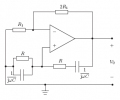
How does one decide at what frequency \(\omega\) this Wien bridge oscillator can give an output signal? (I.e. an output signal with a greater magnitude than zero).

I know that the voltage at the input terminals of the op amp is 3 times higher than the voltage at the output V0. But how does this give the frequency \(\omega\)?
 

Attachments

MikeML

Joined Oct 2, 2009
5,444
Think of the Wein network as a three-terminal frequency-dependent voltage-divider. The input the network is connected to the output of the opamp; the ouput (tap) is connected to the non-inverting input of the opamp; the bottom connected to ground.

There is only one frequency ω where the phase shift from input to output of the Wein network is zero degrees. The loss is one-third (0.3333) at this ω. According to the Barkhausen Criterion, the amplifier will oscillate if the closed-loop gain is higher than one, at the same time the phase shift is zero or multiples of 2∏.

Note that the voltage gain of the opamp is (1+2R1/R1), or three, which just compensates for the one-third loss in the Wein network. Note that in a practical oscillator, the loop gain must be just slightly higher than one...
 

LvW

Joined Jun 13, 2013
2,037
According to the Barkhausen Criterion, the amplifier will oscillate if the closed-loop gain is higher than one, at the same time the phase shift is zero or multiples of 2∏.
Of course, everything OK - except one single typing error:
It is the LOOP GAIN that must be slightly larger than one (not the "closed-loop gain")

One hint for teknolog: For an automatic stabilization of the output amplitude (no hard clipping) there a various methods. The most simple one is to place two diodes (anti-parallel) across the feedback resistor.
 

Thread Starter

Teknolog

Joined Sep 1, 2013
31
There is only one frequency ω where the phase shift from input to output of the Wein network is zero degrees.
But the input signal (which is only +/-VCC) is a DC voltage, while the output is alternating. What does phase shift between them mean?
 
Last edited:

LvW

Joined Jun 13, 2013
2,037
But the input signal (which is only +/-VCC) is a DC voltage, while the output is alternating. What does phase shift between them mean?
By saying "input signal" you mean the dc supply?
You should NOT call this "input" in order to avoid confusion.
On the other hand, I understand your question because - in fact - you ask where are any other signals coming from?
This is a good question - and you can find a variety of answers in corresponding text books.
In short: Because the loop gain is real and positive - for one single frequency fo - this frequency, which certainly is contained in the power-switch-on transient, will continuously rise in amplitude (a feedback loop with a loop gain larger than unity cannot be stable). This effect is the source of the oscillation phenomenon.
The amplitude will rise until it is limited either by the limited supply voltage (bad solution because this results in a clipped sinusoidal wave).
Better solution: Soft limiting using diodes or signal-dependent non-linear resistances like FET, thermistor, AGC-loop,...
 

Thread Starter

Teknolog

Joined Sep 1, 2013
31
If I understood correctly, what the Wien bridge oscillator does is that it takes the supply voltage (Vcc+/-) and turnes this into an oscillating (i.e. alternating) signal. There doesn't need to be any other input signal (although there could be).

In short: Because the loop gain is real and positive - for one single frequency fo
How can you see that it's just for one single frequency? Can you show it mathematically?

And MikeML, I clarify my previous question, I would appreciate an answer: How can there be a "phase shift" between a constant voltage (Vcc) - which can be considered as having 0 frequency or an infinite period - and a periodical voltage? How can you even measure a phase shift between two signals when one of them - the Vcc - literally has no phase?
 

LvW

Joined Jun 13, 2013
2,037
If I understood correctly, what the Wien bridge oscillator does is that it takes the supply voltage (Vcc+/-) and turnes this into an oscillating (i.e. alternating) signal. There doesn't need to be any other input signal (although there could be).


How can you see that it's just for one single frequency? Can you show it mathematically?

And MikeML, I clarify my previous question, I would appreciate an answer: How can there be a "phase shift" between a constant voltage (Vcc) - which can be considered as having 0 frequency or an infinite period - and a periodical voltage? How can you even measure a phase shift between two signals when one of them - the Vcc - literally has no phase?
1.) The WIEN network (WIEN, not WEIN) which is responsible for the frequency determination is in principle a bandpass. This passive bandpass has the following properties:
* there is one single frequency fo where the phase shift between input and output is zero
* at this frequency fo, the output-to-input ratio is 1/3.

This means, there is only one single frequency fo with a REAL transfer value (which is 1/3). As the oscillation criterion (Barkhausen) requires a REAL loop gain of unity, the circuit can only oscillate at this frequency fo if the loop is closed with an amplifier having a gain of 3 (3*1/3=1)., OK?

2.) From the above it is clear that the phase shift concerns of course only the input node of the WIEN network (opamp output) and the output of that network (opamp input).
The dc supply has "only" the task to allow opamp operation. From the viewpoint of energy bilance you can say that losses in the oscillating system are compensated by energy "pulses" provided by the dc supply.
(remember the principle of a pendulum clock).

As another visualization you can imagine that the whole closed-loop circuit behaves similar to as lossless (idealized) LC parallel resonance circuit (both have a theoretical bandwidth of 0 Hz).
 
Last edited:
Top